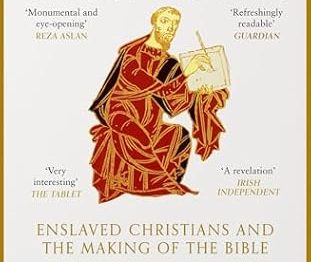
Candida Moss, God’s Ghostwriters, (William Collins, 2024)
https://www.goodreads.com/review/show/8703796999
Democratising the history of the New Testament
As we all know, there were many slaves and ex-slaves in the Roman empire. Some of them – tabellarii or tahydrómoi (letter carriers), angelos (messengers), nomenclatores (memorisers of names and texts), lectores (readers out loud, often children), notarii (shorthand writers), grammatici (grammarians), librarioli (library specialists) – were engaged in the business of writing. The people whose hands wrote down the gospels probably included these enslaved workers. Even booksellers tended to be freedmen, probably having begun their careers as enslaved copyists. The apostles themselves were called messengers (apostoloi).
When I selected this book to read (recommended by a friend) I was expecting it to be of the Jesus-never-existed conspiracy theory corpus. Instead, I found a sober and thoroughly scholarly work.
The book’s main argument is that many more than has generally been recognised of the people in the Roman Empire whose existence we can infer from evidence in the New Testament were slaves. Furthermore, these enslaved people were often highly literate, and this group probably included some of the authors or copyists of the Gospels. This is a credible and well referenced premise.
Moss draws our attention away from our former focus, inviting us to notice the servants enabling an activity. ‘People have translated and interpreted the New Testament without enslavement in mind.’ For example, in the story of Jesus healing the paralytic in Capernaum, she discusses not the patient but the four ‘friends’ who lowered him down through the roof. Jesus commends the four for their ‘loyalty’, and his healing is framed in terms of enabling the man now to do his own work (carry his own bed).
Pauline conceptions of the Christian’s relationship to Christ and to God can be seen to be modelled upon conceptions of the slave’s relationship to their master (eg 1 Cor. 6:12, 7:23).
We owe the preservation, and sometimes creation, of these wonders of literature to these workers. Moreover, the story of Christianity was spread not just by the written gospels but orally, by word of mouth, ‘the unauthored gossip of the masses, of women and of enslaved people’, the slaves attending at the high priest’s house who heard Peter denying Jesus three times, kitchen workers who heard Jesus calling for more wine at the Wedding of Cana, etc. Early believers were used to reciting from scriptures in synagogues and carried on this tradition.
There is so much to say about the history of the New Testament and how it was written. I appreciated that this book stayed ‘on topic’ and didn’t try to go into discussion that was not related to the subject.
Refocussing on these sometimes anonymous agents is an important contribution towards democratising the history of the New Testament.


Leave a Reply