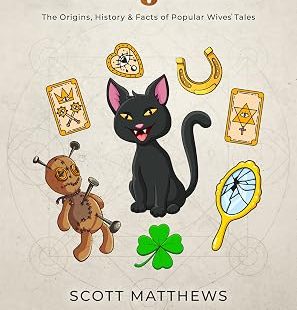
Scott Matthews, Superstitions, Folklore, Myths & Legends, (2022)
https://www.goodreads.com/review/show/8684750657
Charming origin explanations for popular superstitions
What is the difference between a superstition and a fact? What is the difference between a myth and a memory? Matthews examines the origins of superstitions and old wives’ tales.
Do you knock on wood, look for four-leaf clovers, cross your fingers when making a wish, cover your mouth when you yawn, spit when you see something bad, say ‘bless you’ when someone sneezes, jump when the wind starts a rocking chair rocking, avoid black cats or killing spiders or walking under ladders or letting milk boil over? You are under the spell of a well-worn lie, but you won’t be alone. Despite our modern education, don’t we all still enjoy consulting horoscopes?
Matthews also includes modern variations on ancient themes. For example, superstitious beliefs around clocks chiming have morphed in modern horror films into alarms ringing in the dead of night. Fear of the number three is so persistent it has a name – triaphilia. Fear of Friday the 13th is called triskaidekaphobia.
Some of these will surprise you. The belief that horseshoes bring good luck comes from a story about St Dunstan nailing the Devil to a wall, while shoeing his hooved feet. The prohibition against turning a loaf of bread upside down may have evolved in mediaeval France when upside down bread was left out for executioners.
Pirates (and other sailors) really did wear eye-patches so one eye could always be adjusted to the darkness below deck. It has been proven to be false that spicy food causes ulcers. ‘Feed a cold, starve a fever’ is bad advice; starving is bad for your illness whether it’s bacterial or viral. Bats do not want to nest in women’s hair. Lightning does, sometimes, strike in the same place.
Some widely held lore:
- When a stopped clock chimes, there will be a death in the house.
- Never kill a swallow, open an umbrella indoors, bring an old broom into a new house, spill the salt or break a mirror.
- If a portrait falls off the wall, that person will die.
- Elder and hawthorn trees and branches mean death.
- A full moon beckons werewolves and can induce insanity.
- The gift of a purse should always include money.
- Yule logs and acorns prevent lightning.
- Babies should not see themselves in a mirror before the christening.
- Spitting, a rabbit’s foot, salt on a doorstep ward off evil.
- A knife under the bed of a woman giving birth will ease her pain.
I’m a passionate student of mythology, and in my historical novels always try to work in the ‘lore’ of a culture as well as the history. I enjoyed reading the charming origin explanations of these popular superstitions.
The explanations are not heavily historical. They are more charming factoids than serious sociology. Each myth is illustrated by a cute cartoon.


Leave a Reply