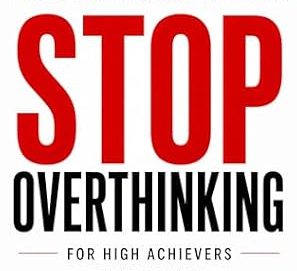
Manjul Tewari, Stop Overthinking for High Achievers, (2026)
https://www.goodreads.com/review/show/8703832527
How to stop ‘looping’ and start acting
How do you stop your mind from the ‘noise’ that keeps you stuck in inactivity, especially if you are used to asking a lot of yourself? This book is not a recipe about ‘thinking less’ but rather ‘thinking more effectively’. Each chapter finishes with a ‘workshop’ section to aid you in training the new skills.
Some bullet points to stick on my bulletin board:
- Don’t wait for clarity before acting. You become ready by acting.
- Sometimes one decision is all it takes to change everything.
- Making a decision is not about choosing the right option. It’s about trusting yourself enough to choose.
- Momentum doesn’t come from confidence, it creates it.
- Perfection is not excellence; it’s avoiding the discomfort of imperfection, and it comes at a cost.
- You don’t need to do more; you need to do it daily.
- Focus on the next step, not the entire outcome.
To make the list of worthy aphorisms a more enjoyable experience, we follow the journey of ‘Ethan’, a senior strategy manager. His presentation is just ‘missing something’, and he can’t figure out what. He is stuck in indecision, an endless loop of ‘what if’s running through his head. It’s not his business ability that is eroding, it’s his confidence. ‘He has lost the ability to trust the moment he needed to choose.’ 23 minutes before the big meeting, he is still looping.
Then, Mark is chosen over him as project leader. The team still listen to Ethan’s input, but they no longer wait for his decision. At home, he spends hours replaying conversations, reviewing emails.
A wise old man on a park bench points out, ‘Endlessly repeating the same old what ifs is not thinking, it’s repetition.’ Tewari calls this ‘the Action-Clarity Loop’. He recommends the ‘Two-Minute Action Rule’. Pick the smallest possible action. Start within two minutes. Don’t think beyond that.
There’s an element of Cognitive Behaviour Therapy here. When you find yourself in a loop of repetitive thoughts, give it a name (eg ‘this is just a self-doubt thought’) and by doing so, step out of it and move on to action.
Books like this are inevitably a list of worthy aphorisms, and as is usual, I am quite familiar in theory with a lot of them, without being able to claim that I have implemented them in practice.
The whole book is pretty much devoted to one central concept, yet it’s worth reading a whole book about it in order to drum it in, as the wisdom is counter-intuitive. We think we need clarity in order to act. In fact, we become clear in the process of acting.
There are not a lot of unnecessary words here. In fact, it’s 17800 words in 251 pages, a lot of 4-5 word sentences, one-sentence paragraphs. No matter how busy you are, it won’t take you long to read.
At the back there are 15 exercises designed to help you implement this ‘reset’.
 Susie Helme
Leave a comment