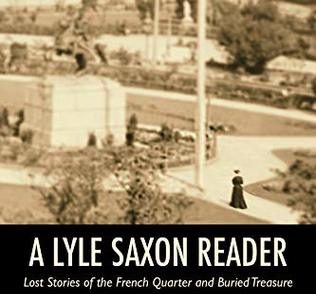
Edited by James Michael Warner, A Lyle Saxon Reader, (Cultured Oak Press, 2018)
https://www.goodreads.com/review/show/8684705335
39 stories about New Orleans 1919-1923
Born into a broken home in New Whatcom, Washington, ‘Genteel Southern author’ Lyle Saxon later fell in love with Baton Rouge where he lived with his mother and maternal aunts, and New Orleans, especially the French Quarter. He campaigned for the preservation of architectural landmarks, and some of these more directly historical writings are in this collection. Other articles are like a guided tour of the Vieux Carré. He loved the Mardi Gras.
These stories, published in the Times-Picayune Sunday Magazine during the 1920s, paint character sketches and pictures of this bygone world, often wrote about real current news stories – for example the story of Angelo Guirlando who murdered his brother-in-law, and the one about morphine addict Grace Gardiner – and was criticised at the time for commingling fact with fiction.
His more fictional stories include:
- A dying man imparting to the narrator a treasure map, an incomprehensible coded diary and a promise of buried Spanish dubloons.
- The few surviving Confederate veterans holding a reunion in New Orleans.
- The self-proclaimed ‘prophet’ Otto Marti selling prayers for ten cents.
- Delphine wondering whether the paved streets brought the automobiles or the automobiles paved the streets, as she saves to buy one.
I dipped into these stories hoping to learn something about American literary history, maybe to discover an F Scott Fitzgerald (though I hated This Side of Paradise). I found the stories quite varied, yet a bit old-fashioned in style. I wondered if they had been ‘dumbed down’ to suit a Sunday magazine audience.
The most interesting are the character sketches of real people. Many are from a series he published on ‘Unusual Ways to Make a Living’ – the Neapolitan woodcarver who refuses to make smaller furniture to fit modern houses; the hotel manager who ‘uses all [his] ideas, all [his] imagination, all the time’; the Biagis who make plaster saints and paint them gold; the park photographer who enjoys life as it comes; the man with the parakeets who tells fortunes; the woman who rents out hurdy-gurdies.
These are people the like of which you won’t see today. These discoveries are like finding buried treasure.
In a very short space (usually a page and a half) Saxon creates pictures of a bygone era and people we don’t want to forget.


Leave a Reply