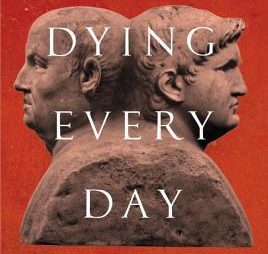
James Romm, Dying Every Day, Seneca at the Court of Nero, (2014)
https://www.goodreads.com/review/show/8712932284
Courage in the face of lunacy
Ancient Rome’s great philosopher Seneca returns from political exile to tutor the boy Nero, hopefully as a rector (steersman) shaping Nero’s rule. Nero becomes increasingly vain, paranoid and tyrannical, and Seneca finds it more difficult to wield his moral influence. Finally, his erstwhile pupil forces him to commit suicide.
Looking at evidence from his day, namely the first century drama Octavia, Seneca’s own writings, and those of historians Cassius Dio and Tacitus, we can’t work out whether Seneca was a Stoic philosopher or a Machiavellian conspirator. Tacitus found him a riddle, living a righteous, upright life, yet amassing great personal wealth.
49 CE, and the emperor Claudius is failing. It seems the empire will either fall to 12-year-old Domitius, renamed Nero, or 9-year old Britannicus. Nero’s power-hungry mother Agrippina, now married to Claudius, is determined to use her wiles to shove him into the position. Herself recalled from exile under Caligula, she recalls Seneca from exile in Corsica to tutor the boy.
One can’t help but sympathise with the man. He has to walk the tightrope between his ideals and his utter subservience to an absolute lunatic. He is forced into a direct role in the matricide of Agrippina and even dares (cautiously) to allude to it in his plays.
It’s easy for us, in hindsight, to point out his inconsistencies and his hypocrisies. I’d much rather see someone who, having already lived through the insanity of Caligula and the despotism of Claudius, now has to live through it all over again and, despite his intelligence and erudition, finds himself powerless to stop it. Considering that the swords of the Proletarian Guard could have fallen upon him at any moment, such courageous writings as The Pumpkinification of the Divine Claudius are positively heroic.
No, he was not a proto-Christian. His brother Gallio washed his hands at St Paul’s trial in Greece like Pontius Pilate.
Did he collude with the Pisonian Conspiracy against Nero? We could hardly blame him if he did.
As we watch another powerful leader wreak havoc on the world while surrounding himself with sycophants, we ever more admire the courage of Seneca. Nero left the Roman Empire in a state of chaos. Is the current state of the Middle East sowing the seeds of the end for America?


Leave a Reply