Category: Book reviews – fiction

  • Review: The Platinum Receiver

    Review: The Platinum Receiver

    Kyle Robertson, The Platinum Receiver (‎PIMI eBooks, 2017)

    https://www.goodreads.com/book/show/36290808-the-platinum-retriever

    Orphaned before his parents even had a chance to give him a name, Daedalus Platinum is a Retriever, chasing the deadbeat parents of the world. Parents should be obligated, he believes, and when he finds them he makes them pay, with their lives. But he has people chasing him, too—the Obliterators. They just cancel you from the planet, remove your existence.

    The Obliterators are aliens, but ‘not from a different planet, they just have a mixture of otherworldly DNA in their system’—in other words, ‘mutts’. Daedalus’ mother’s undead body has been used for xenomorphic procreation. The monsters are his half-siblings. He has some strange power; he’s the only one on Earth who can obliterate them.

    Loved: ‘Nature was my mother’s executioner; I was just nature’s axe’, ‘they came at us like cheetahs on the Serengeti’. I loved the fighting in the finale using moves from the various different martial arts schools.

    This novel’s Concept is highly innovative. The voice is colloquial, almost gangster, short, sharp sentences, cop-talk-like clichés. The narrator addresses the audience as ‘you’, in daily journal entries, full of sassy 4th wall asides like ‘That was cathartic. All right, back to the story’.

    Verb tenses are all over the place, which is distracting, though it lends a feel of breathlessness. It either needs the grammar sorted out or crafted into a deliberate style choice.

  • Review: Voices from the Dead

    Review: Voices from the Dead

    Tony Bassett, Voices from the Dead (‎The Book Folks crime thrillers, 2025)

    https://www.goodreads.com/book/show/244102463-voices-from-the-dead-an-unputdownable-british-crime-thriller-packed-with

    DS Sunita Roy and her boyfriend and colleague DI Tom Vickers happen to be attending a wedding at a Queensbridge hotel, when a guest reports witnessing a murder from her balcony, through one of the windows in the opposite building. The victim is successful beauty expert Candy Goodhope.

    Who could have murdered her in her hotel room? The boyfriend? The husband? The business rival?

    In another case, Miranda Higley is waiting for her ex-husband to lay a new floor for her when she is brutally attacked.

    It helps that there is an eyewitness, and the police also have CCTV evidence and numerous people to interview who were with Candy on the day. These characters, as we meet them, are interesting and colourful. Even the perps are sympathetic. Sunita is often accompanied by Tom or DC Brett Dawson, so we hear her thought processes though dialogue.

    The Plot is exciting, with enough surprises to keep us hooked, and the Pace is just right. We learn the clues at just the same time that the police do, so there’s plenty of time to assimilate it all.

    Bassett’s crime novels feature very realistic (it seems to me) police procedures, meaning we get right down into the story. He takes us through the investigation process, as day by day new clues are discovered. It never turns out to be who you suspect, and the boss always gets it wrong at first. Sunita’s uncanny ability for lateral thinking saves the day. And though we get all the clues, it always takes a bit of a stretch of Sunita’s ingenuity to solve the crime.

    I loved how we didn’t understand the rationale behind the title until the very end, making it a kind of punchline.

    I received an advance review copy for free, and I leave this review voluntarily.

  • Review: Timeline Dissonance

    Review: Timeline Dissonance

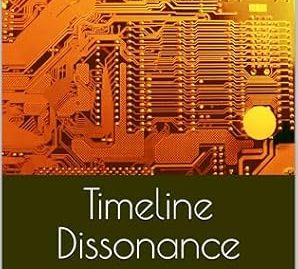
    Vicki Regan, Timeline Dissonance (2025)

    https://www.goodreads.com/book/show/234118263-timeline-dissonance

    We left Sarah and Eleanor from Book 2 in a world of truly nightmarish ‘temporal dysphoria’, people and objects popping in and out of different timelines. Now, they are captive under fascistic martial law, labelled as ‘Primary Dissonants’ by baddie time bandits still bent on destroying all free will. ‘Temporal alignment’ has become outright thought control and even ‘total reality manipulation’. The confused population accepts the new regime as better than the chaos that went before.

    Sarah, her voice across the airwaves, is a constant throughout all timelines, but she still sees the nightmares of disastrous futures she lived. She reads a forbidden book, which teaches strategy to the resistance. Eleanor secretly develops new technology to disrupt the system. She and Sarah know that ‘consciousness itself resists determinism’. It’s ‘quantum resonance feedback’, and Eleanor knows how to exploit it.

    The end is no utopia; democracy is messy, but human, full of the possibilities of all the timelines.

    The ‘optimised society’ of New Philadelphia is described chillingly. The techy stuff is great, highly detailed and sounds plausible. The techy workarounds the resistance fighters come up with to thwart the techy oppression are ingenious.

    The excellent writing of Books 1 and 2 continues. Fantastic suspense and pace, but interspersed with enough human relationship stuff to give us a breather from all the sci-fi jargon. We would have benefited from some layman’s explanation of the real science—quantum, entanglement, dissonance.

  • Review: Quantum Entanglement

    Review: Quantum Entanglement

    Vicki Regan, Quantum Entanglement (2025)

    https://www.goodreads.com/book/show/232441758-quantum-entanglement

    We left Sarah Collins in Book 1 sitting on a park bench, having time-travelled to a new timeline, one where her ally Dr Eleanor Hastings, doesn’t recognise her. She doesn’t even know whether this timeline’s Eleanor is one she can trust. Nevertheless, she takes a job with her at her Quantum Temporal Institute. Sarah studies ‘atmospheric anomalies’.

    Eleanor doesn’t know whether to trust Sarah, either, but she’s been seeing her in her dreams.

    As in Book 1, the action begins right away; by Chapter 2 we’re already swept up, as Sarah is arrested for ‘temporal espionage’, and the two women are on the run again, trying to save the world from shadowy bad guys intent on seizing control of time. They find allies.

    Sharp and pacey writing. The style is colourful, yet fresh, avoiding too many clichés. I was impressed by the way Regan weaves the backstory of Book 1 into the new plot. The ticking timebomb is great. Eleanor says, ‘we have three weeks to ensure they never find me—or better yet, to dismantle their entire operation.’ It’s bigger than that, Sarah realises. They just might ‘lose more than our lives’; they might ‘lose all possible futures’.

    It’s not a victory—we need to read Book 3—but we know that the quantum entanglement of love is eternal, across all realities.

    I thought the explanation of the ‘science bits’ was great. It didn’t even matter if such technology is not really possible, Regan makes it all sound so plausible. Phrases occur and recur—‘chronological inconsistencies’, ‘temporal dissonance’, ‘quantum dampening’—which we don’t quite understand the meaning of, but that’s OK. It sounds cool.

    I loved the concept of ‘Aberration Type-3s’, retained memories from erased timelines, ‘timeline bleed’, and ‘chronological stress points’. I loved ‘triangulating your chronological signature’. Loved the mathematical equation of Sarah’s and Eleanor’s relationship.

  • Review: Seven Rivers: The Darkness

    Review: Seven Rivers: The Darkness

    B. Luiciano Barsuglia, Seven Rivers: The Darkness (Koa Aloha Media 2025)

    https://www.goodreads.com/book/show/235105617-seven-rivers

    A supernatural journey of redemption

    Cora and Gabe are fighting. She has a baseball bat; he has a gun.

    It ends badly in a devastating car accident, and she ends up at the Seven Rivers Recovery Clinic in bandages. But this is no pristine hospital, no wholesome rehab facility. It starts with the tea–they’re giving her some kind of hallucinogen–then the pain and the terror, the savage bandage changes. The place operates according to an unfamiliar set of rules, which Cora now has to work out. The other residents aren’t welcoming, either. But at least they seem to know why they are there.

    ‘Some are here for recovery; others for redemption. Why are you here?’ Lady asks.

    ‘I’m hiding out, I guess,’ says Cora.

    I liked the parallels between pain and terror, but the horror begins too soon. We need to build up to it. And there’s too little action. We start hearing about ‘the ragged pulse of her fear’ before we even see anything to be afraid of. There’s no explanation as to why she’s ended up in this place and no explanation as to why Gabe is threatening her life.

    The chapter headings read like a ‘Pilgrim’s Progress’–Integrity, Acceptance, Humility. Cora is on a journey of self-discovery and redemption about which we get no clues until page 109. She witnesses horrors. Ex-robbers in a heist gone wrong. Each room, each interaction with the other guests confronts her with the consequences of her guilty past.

    A few too many clichés for me, coupled with some phrases we don’t really know the meaning of–‘an unease that lingered like a shadow’. I liked ‘tremors that shook her very atoms’.

    I liked the Concept–a surreal environment (Purgatory?) forcing someone to accept the consequences of their past behaviour, but Cora’s psychology doesn’t really come through. The unexplainedness contributes a surreal, spooky Kafka-esque atmosphere, yet I didn’t get the sense that Cora was trying to figure it out, which was frustrating. We can’t empathise with Cora’s suffering if we don’t understand why.

    In the end, she confronts the fear of death, something I don’t see treated in many novels, surprising considering that it’s probably the biggest fear humans face.

  • Review: Half a Cup of Sand and Sky

    Review: Half a Cup of Sand and Sky

    Nadine Bjursten, Half a Cup of Sand and Sky, (Alder House Books 2023)

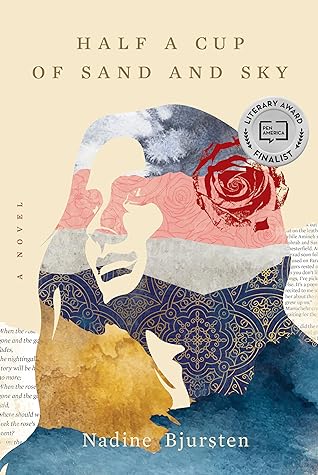
    Amineh meets up with her friend Ava for a picnic in a Tehran park. Nearby, some students are protesting against the shah, and they can hear the police sirens approaching. One of their friends Tahmures has been murdered by the state. Soon, they, too, would have to risk everything for the freedom they desired. Some look to Ayatollah Khomeini for leadership; others, like Tahmures, to the politics of Karl Marx.

    She meets Farzad, older than her but respected, at a memorial for Tahmures, and Ava likes his friend Dariush.
    Five years earlier, her grandmother had died, and her cousin Qasem had taken over the family rose farm in Qamsar, but there was no life for her there, now. Amineh is writing a novel about her parents, yet she hardly remembers them—they died when she was eight—and everyone around her wants her to make it political.

    See the full review on Goodreads.

  • Review: The Venetian Heretic

    Review: The Venetian Heretic

    Christian Cameron, The Venetian Heretic, (Orion 2025)

    Intrigue and Inquisators in 17th C Venice.


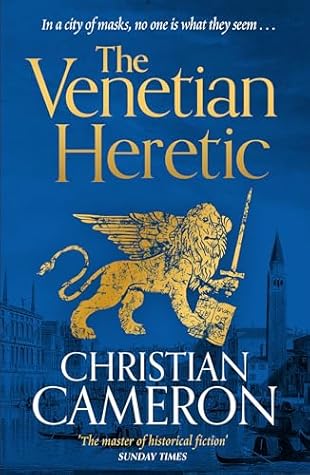
    Richard Hughes, an English fencing master in Venice, a former soldier and galley slave, takes in students and accommodates a studious roommate Filippo. He teaches a woman, an opera singer of some fame.


    A professor of philosophy has been murdered in Padua—a libertine. An innkeeper’s wife has gone missing, but why would the Holy Inquisition be looking for her? There are plots and intrigues and people chasing bad guys in gondolas led by a villain in a red mask. The ticking time bomb at the end is marvellous.

    See the full review on Goodreads.

  • Review: Endurance

    Review: Endurance

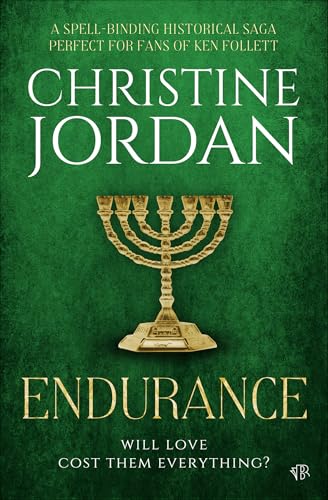
    Christine Jordan, Endurance, (Bloodhound Books 2024)

    The story of the Jewish community in mediaeval Gloucester, based on real historic people
    1216. Tzuri witnesses the coronation of young King Henry. The Jewish community of Gloucester hope the new regime will be kinder. His love, the draper’s daughter Vernisse, a Christian, finds him in the crowd and surreptitiously holds his hand.

    See the full review on Goodreads.

  • Review: Boundary Waters

    Review: Boundary Waters

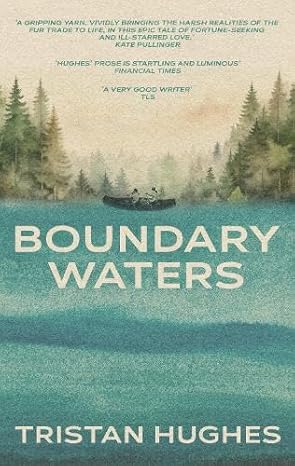
    Tristan Hughes, Boundary Waters, (Parthian Books 2025)

    Canada 1804, the wild frontier. Arthur journeys into the wild wilderness in a birchbark canoe, with a ‘parcel of scoundrels’ led by the erratic drunkard McLeod. There is a treasure—a lost cache of valuable furs—its riches to be won.
    The tale is told to Esther, a Saulteaux woman he meets along the journey.

    See the full review on Goodreads.

  • Review: Murder on the Ordinary Express

    Review: Murder on the Ordinary Express

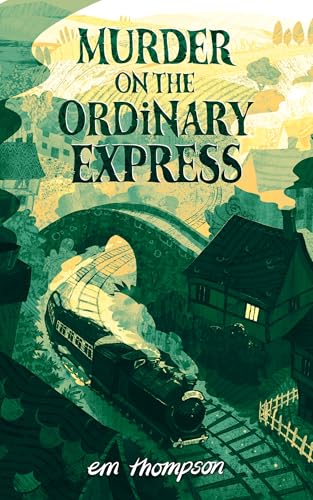
    Em Thompson, Murder on the Ordinary Express, (Eccentric Directions 2025)

    This extremely funny novel features Thompson’s unique writing style and innovative vocabulary tricks. He turns other parts of speech into other parts of speech: ‘uncountitude’, ‘pedantic plodology’, ‘bloodredded moments’, ‘freshenupped’, ‘fastidious pernickityness’, ‘alimonious divorce’. She is ‘highly umbraged to have her probity impugned’. Any clichéd metaphor or pun you might find in here will be cleverly turned on its head and done something even cleverer with.

    See the full review on Goodreads.