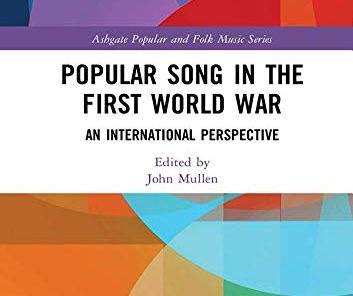
Popular Song in the First World War – an international perspective, edited by John Mullen, (Routledge 2018)
https://www.goodreads.com/book/show/40245763-popular-song-in-the-first-world-war
Analysis of music hall during WWI, from both sides, from sixteen scholars
Before the generalisation of the gramophone, enjoyment of popular music took place in music halls. Editor Dr John Mullen opens the discussion with treatises on WWI music hall in Britain and France. The music hall crowd, contrary to what we have been told, did not necessarily express gung-ho support for the war.
‘The songs about the war are about Tommy, not about the empire.’ Songs about the front spoke about soldiers’ daily lives.[1] Editors of trench newspapers ran song competitions.[2]
Interestingly, there are no British music hall songs about hating Germans.[3] Even the American ‘Hunting the Hun’ is more humorous than bellicose.[4] Whereas in Germany, after losing two world wars, ‘music connected to these traumatic events was not popular’, instead focussing on ‘nostalgia of the past’, songs about love and homesickness.[5]
Also surprisingly absent, says Mullen, is anti-war sentiment per se, despite the large, especially in the latter years, anti-war movement. This relative absence can be explained by the mass participation necessary to the music hall experience – encouragement of sing-along choruses and audience participation – meaning an emphasis on ‘consensus’. More common is the humoristic poking fun at the effect the war effort was having on people’s lives. Such as ‘Lloyd George’s Beer’, complaining about the government’s reducing the alcohol content in beer.
Another trend was an emphasis on ‘respectability’; music halls stipulated ‘no vulgarity’. Marie Lloyd, when required to change the lyrics of her ‘She Sits Among the Cabbages and Peas’ to avoid the scatological pun, famously changed it to ‘She Sits Among the Cabbages and Leeks’.[6]
Popular song, says Mullen, is not ‘a reflection of real history which takes place elsewhere’. Instead, it is ‘a way that artistes and audiences represent the world to themselves and to each other’.
Mullen’s understanding of music and culture in general is highly nuanced.
Eric Sauda looks at French popular song. André Rottgeri looks at Germany. Clive Barrett looks at war resistance songs in Britain, with a look at songbooks and personal diaries from the period. Guy Marival specifically studies the French ‘Chanson de Craonne’, which became an anthem of the radical left. Anne Simon writes about gender and romance, separation and homecoming in France. Christina Gier writes about the theme of masculinity in America, also looking at musicological questions such as how the tone was influenced by what key the melody was in. Amy Wells addresses women in song. Melanie Schiller writes about Claire Waldoff and Berlin cabaret. Chris Bourke looks at the war from New Zealand, Pakeha (Europeans) and Maori music. Erick Falc’her-Poyroux looks at the war from Ireland, Gaelic culture and the drive for Home Rule and socialism. Lidia López writes about eroticism in Spanish cuplés. Pedro Félix talks about ‘turbulence’ in Portugese music and fado. Dragan Aleksić looks at Serbian music and national identity.
Several of the authors mention industrialisation and the impact of technological development. All these chapters are interesting, but I found especially valuable the international perspective, seeing popular music from both sides of the war, and the reflection in popular music of the changing roles of women.
It is well and cogently written, scholarly yet not high-fallutin’.
This is a book for WWI buffs, musical history buffs, music hall fans and anyone wanting to learn.
John Mullen is Professor at Rouen University. He is author of The Show Must Go On: Popular Song in Britain during the First World War (Ashgate 2015).
I was given a copy by the author.
[1] Mullen
[2] Eric Sauda
[3] Mullen
[4] Christina Gier
[5] André Rottgeri
[6] John Mullen, The Show Must Go On: Popular Song in Britain during the First World War (Ashgate 2015).
 Susie Helme
Leave a comment