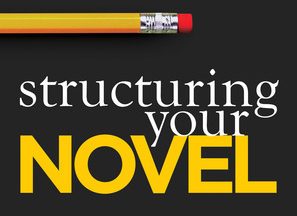
K. M. Weiland, Structuring your Novel (PenForASwordPublishing 2013)
https://www.goodreads.com/book/show/18371991-structuring-your-novel?ref=nav_sb_ss_1_22
This how-to manual goes over not just how to Outline your novel, but how to structure it.
The dramatic elements necessary for a good hook. An opening line must have character + action + setting.
The first 20-25% is the setup, in which you develop personality + motivation + beliefs. Make clear what they stand to lose. Every scene must matter, like dominoes up to the 1st plot Point.
The inciting event = sets the story in motion. (when the crime happens)
The key event = is what the story is about. (when our man takes the case)
Use your characters’ personal surroundings, tells us about how they live, how they are reacting to things, etc. and the earlier the better-before the 1st plot point. Use all the senses.
The 1st Plot Point-25% mark-moment when character crosses her personal Rubicon, often including change in physical setting or cast of characters, something to which Prot reacts very strongly. Make it cataclysmic.
1st Pinch Point – around 3/8th mark. She runs afoul from reacting to 1st Plot Point.
Midpoint- at the 50% mark. Prot’s reaction to the 1st Plot Point, point at which she can never go back. Prot stops reacting and starts acting, arc of personal growth
3rd Act-Slugfest
2nd Pinch Point-At 5/8th mark-showcases the Antagonist, how Ant is capable of defeating Prot.
3rd Plot Point -at the 75% mark. She responds in a completely different way with action and fights back.
Climax- last 10%. Shows a glimpse of how Prot has changed- a relaxed moment when we see her in the middle of her new norm.
The anatomy of a scene = scene (external action) + sequel (internal reaction). Goal + Conflict + Outcome. The sequel = Reaction (period of introspection) + Dilemma (Review + Analyse + Plan) + Decision.
The anatomy of a sentence = Motivation + Reaction; Cause + Effect; 1. Feeling/thought 2. Action or response 3. Speech.
It also features Dos and Don’ts on Dialogue, Conflict, Disasters, Telling and Showing and general Writing Style.
A lot of stuff you may already know, but it never hurts to have it all laid out for you.






 Susie Helme