Tag: religion

  • Review: Witchborne

    Review: Witchborne

    Rachel Grosvenor, Witchborne (Fly on the Wall Press 2025)

    https://www.goodreads.com/book/show/230752566-witchborne

    Woman’s inhumanity to woman—with special powers

    Because she is a child of spring, blacksmith’s daughter Agnes has a special power bestowed upon her at birth—fire does not burn her. But those around her don’t see it as special—they think she’s a witch. Even her mother thinks it’s ‘an affliction’. She pretends that her gift is instead the less magical ability to bind water in a bucket.

    Something calls to her. ‘Agnes’.

    The local beauty Saskia, against whom she is always compared, teases her.

    Against her will, Agnes is betrothed to the tanner’s son. She rebels by pulling a stunt at the wedding, which no one finds amusing. She enters into a loveless marriage with Silo and now always smells of urine, upon which everyone remarks numerous times.

    To win everyone’s approval, she must have a son. So, she goes to a local cunning woman the Widow Sewall and makes a pact. The Widow warns that ‘to play the Gods’ one has ‘to bargain for the ever after’.

    Everything Agnes does seems to make things worse for her, and the blessing of a son doesn’t change that. The rivalry between Agnes and Saskia affects their babies, and Agnes increasingly hides herself away to avoid retribution. Toward the denouement, there are some twists in the tale, and we find out that previous generations have also made bargains and been shunned. Agnes’ desire to be accepted by her family clashes with the pact she made with the Widow.

    Surprisingly, Agnes’ magic power doesn’t much come into the story; it’s mostly about her unhappiness and her rivalry with Saskia.

    This is a fictional mediaeval world, verging on fantasy, yet it abides by societal rules familiar to our history. Conformity is expected, women are subservient, witchcraft is feared, and rumours kill. The cycle of ‘woman’s inhumanity to woman’ continues.

    The review first appeared in Historical Novels Review.
  • Review: The Splendour Before the Dark

    Review: The Splendour Before the Dark

    Margaret George,The Splendour Before The Dark (MacMillan 2018)

    https://www.goodreads.com/book/show/42610157-emperor-nero?ac=1&from_search=true&qid=a10aegZt6C&rank=1

    The story of the musical charioteer emperor Nero, rehabilitated


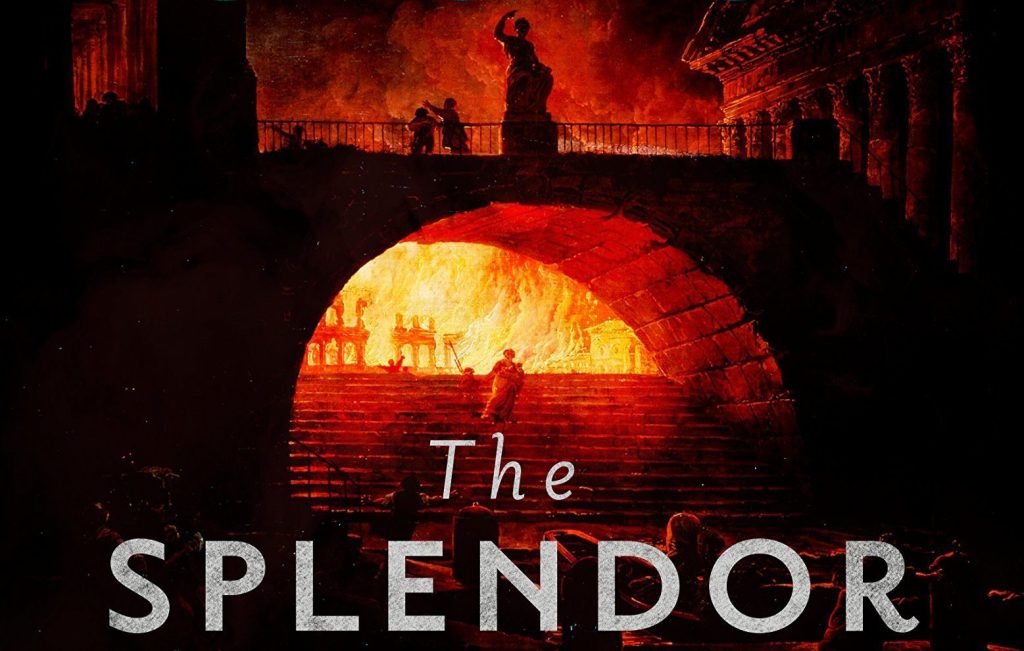
    Nero awakes at his seaside villa in Antium. The previous night he had performed his epic on the Fall of Troy. He longs to be a professional musician or competitive charioteer. Alas, as his mother had finagled, he is emperor of Rome. The sybil at Cumae told him ‘fire will be your undoing’, but there’s no fire at the racetrack or the theatre. A messenger brings the news, Rome is on fire.
    A legend is going around that Nero had played his cithara ‘while watching Rome burn’.
    After the fire, Nero’s vision of a new city is realised. The construction of the Domus Aurea takes up a large part of the book. It would cost 22,000 million sesterces. He conceives the idea of selling citizenships to wealthy freedmen. Despite the emperor’s good efforts, he is blamed. So, they look for a scapegoat, and Caesar finds it in the writings and apparent confessions of the Christians. They go willingly to their martyrdom.
    Two events shake Nero’s happiness. He uncovers a broad conspiracy to kill him and replace him with Gaius Calpurnius Piso—the Pisonian Conspiracy. Some of his best friends are implicated. And his beloved Poppaea Sabina and unborn child die—George paints it as an accident.
    Contains a breath-taking account of a chariot race, including how it feels from the charioteer’s point of view.
    This presents a more hagiographic picture of Nero than I’m used to—even the relationship with the poor catamite Sporus is portrayed as consensual—apparently he castrated himself. Taking other liberties with the story, too, it veers considerably from the primary sources.

  • Review: Creating Christianity

    Review: Creating Christianity

    Henry Davis, Creating Christianity – A Weapon Of Ancient Rome (Independent Publishing Network 2021)

    https://www.goodreads.com/book/show/59829661-creating-christianity—a-weapon-of-ancient-rome?ref=nav_sb_ss_2_36

    The delicious Jesus-never-existed conspiracy theory

    This work develops the Jesus-never-existed conspiracy theory. It’s based on a conundrum all who have compared the works of Flavius Josephus and the New Testament can’t help but notice. The Gospels write about stuff that supposedly happened during Jesus’s lifetime, in the 30s, and Josephus writes about the same stuff happening during the Great Revolt, in the 60s. I mean, exactly the same. Davis lists over 44 parallels, and I myself have come up with more.
    The words and phrases used are almost word for word identical; the geography matches; even the body counts tally.
    To cite just two examples:
    In the story of the Good Samaritan, robbers stole the man’s clothes and goods and left him half dead. At Beth Horon, in Samaria, the rebels stole the legion’s mules, clothes and goods, and left them half dead.
    In the story of the Gadarene swine, Jesus casts out the demon named ‘Legion’, who hides in a tomb, into 2000 pigs who run off a cliff. At Gadara, a legion of Jews have a demonic (rebellious) spirit. The leader hides in a tomb. Jews are ‘swine possessed by demons’, they run off a cliff, 2000 are dead.
    Many chapters are devoted to arguing that the royalty of Rome and the royalty of Judaea were interconnected genealogically, but I do not find that scandalous at all. Royalty intermarried all over the place. I do not think this means, however, that writers of histories were using secret nicknames in order to obscure their familial connections. I certainly don’t think it implies, as Davis believes, that Flavius Josephus never existed because he was secretly Arrius Calpurnius Piso in disguise.
    I skipped over the chapters on onomatology (the etymology of names) because like gematria (numerology), you can manipulate letters or numbers to say anything you want. Using these wacky techniques ‘I am the Alpha and the Omega’ of Revelation 1:8 translates as ‘I am Arrius Calpurnius Piso’. I mean, really?
    If you’ve read Revelation you know the gospel writers were using some kind of code, but I don’t think this was it.
    Everyone in post-70 CE imperial Rome and Herodian descendants take on new pseudonyms, and it’s all great fun, but after a while, my eyes glaze over. If person x was secretly the same person as y—e.g. if Publius Clodius Thrasea Paetus and Gaius Calpurnius Piso and Caesinni Paeti were all names for the same person, then people would have to have had more wives and children and much longer CVs than Suetonius, Tacitus et al say they did. One can always invent fictional wives and children, or conceive that when Tacitus wrote x he really meant y, but it’s applying common sense to the CVs—would person x really have done what person y did?—that we start debunking.
    I’m crazy about ancient history conspiracy theories, especially ones that involve ‘Jesus’, like the ‘Bloodline of the Holy Grail’. This is similar. The Bloodline theory posited an imaginary Dagobert III, whose descendants supposedly carried the bloodline of Jesus and Mary Magdalene through the Merovingian kings.
    It’s rather specious to suggest that Josephus invented Christianity. This is the same man who devoted most of his writing to proving to his Roman and Jewish readers that Titus the destroyer of Jerusalem was the Messiah.