Tag: religion

  • Review: Mozote

    Review: Mozote

    Tom Phillips, Mozote (2022)

    https://www.goodreads.com/book/show/60709550-mozote?ac=1&from_search=true&qid=YFVltjOHI3&rank=1

    This ambitious political thriller with supernatural elements features the human dramas involved when liberation theology preached and practiced by the priests draws down repression from the government.
    Father Gabriel Martin, Vatican exorcist, believes it was a galla, a Sumerian demon, that took his wife, the knowledge revealed to him during an exorcism. Also during an exorcism, a demon tells him he will meet Lucifer ‘in Mozote’.
    Nicolas Carranza and Jose Garcia, senior officers in the Salvadoran Army, drive up the Cacahuatique volcano to a doorway to the interior. As a young man, Garcia had been down there and sold his soul to a creature called Neti. Once inside, they meet three Argentinians, who issue them a nefarious mission—kill Archbishop Oscar Romero. His work preaching against the government’s repression has drawn attention from the Army.
    Alejandra Rivera de Hernandez is prosecutor in the case of Romero’s assassination. She is determined to prosecute all the decision-makers within the death squads, but she gets no help from the Police, as they are complicit. She uncovers a conspiracy that goes all the way to the top of the Army, even including collusion from the US Embassy.
    A couple of US nuns face danger delivering food, medicine and supplies to the beleaguered poor. Ale’s son Jose speaks at night to the ghost of his dead sister. Her other son Max’s girlfriend Ana leads a guerrilla mission into the jungle.
    In the real world, people are not motivated by demons and exorcisms and do not do evil deeds because they have sold their souls to the devil. Nevertheless, I thought the supernatural element an enticing addition to the story.
    Despite the supernatural elements, and despite some misunderstandings about the history of Communism, the portrayal of El Salvador’s death squads is intelligent and believable. This is because a lot of the story is taken from historical events and real people, blending into that fictional characters. For this reason, the cast of characters is enormous, and the events are as complex as real-world events are. Historical backstory is accomplished by citing CIA memoranda, a clever device. In places the exposition is delivered in dialogue, which tends to make dialogue sound unnatural.
    This is an excellent novel, and you will also learn a lot about the death squads in El Salvador. I loved the concept of mixing the real and the fictional and the juicy supernatural bits.

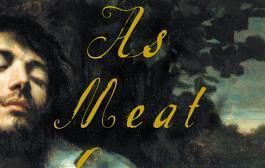
  • Review: As Meat Loves Salt

    Review: As Meat Loves Salt

    Maria McCann, As Meat Loves Salt (Harvest Books 2003)

    https://www.goodreads.com/book/show/271487.As_Meat_Loves_Salt

    Jacob Cullen and his brothers dredge the pond on a Royalist estate to discover the body of a man, Christopher Walshe, who had not even been missed. Jacob is to be married, but his behaviour on the wedding day is something he can’t live down and his bride Caro can’t forgive.
    In disgrace, he joins with Christopher Ferris, recruited into the New Model Army as a pikeman. He learns pikemanship and competes with another soldier for Ferris’ attentions. He yearns to find out what happened to his brothers and his wife and hides from Ferris his secret shame.
    After the devastating battle of Basing House, Ferris deserts, and, takes Jacob with him. They go to London and happily live with his aunt in Cheapside. Jacob suffers from ‘pangs’ of love for Ferris. They finally become lovers, and, though less enthusiastic than Ferris, Jacob follows him to found a colony of Diggers. He dreads the hard labour and privation, and worries that he’ll not find privacy with Ferris away from judgemental religious eyes.
    Jacob is a big man, and his fierce love leads to behaviour perceived as ‘brutish’ by Ferris and the idealistic Diggers. Don’t expect a happy ending.
    The portrayal of the hardships, the endless waiting around, the periodic terrifying battles, the cold, wet and filth of army life is extremely evocative. The battle scenes are exceptionally gory.
    The tale is told in the first person, with exceptional attention to period-accurate language, resulting in a strong voice from the past. Yet, sometimes the language is so antique that the meaning is too oblique to modern eyes. It’s long and slow, as life probably was back then, but it’s worth the effort.

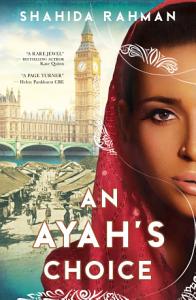
  • Review: An Ayah’s Choice

    Review: An Ayah’s Choice

    Shahida Rahman, An Ayah’s Choice (Onwe 2022)

    https://www.goodreads.com/book/show/60736093-an-ayah-s-choice

    Turn-of-the-century aspiring artist Jaya Devani years for a life beyond the confines of her small Indian village of Khesar. Unloved by her beleaguered and widowed mother, Jaya’s only joy is her brother Krishnan and the beautiful forest to which she can escape to create her drawings.
    A position as an ayah (nanny) in an English household offers the escape she craves. Colonel William Edmundson is often absent; Memsahib Sara is emotionally erratic and takes laudanum tea to sleep. Jaya falls into a clandestine relationship with William, in his study at night. When the family move to London, she has to choose whether to stay with them or remain in India and marry a friend of her brother’s.
    Like many women, Jaya’s subservient position clashes with her independent spirit. If love were the only question, her situation would not be impossible. William’s choices are less than ethical, to say the least, but Jaya continues to buy his justifications. She sees that it is not just the master/servant relationship that causes injustice; she sees William treat his wife as ‘furniture’.
    The realities of life outside the study catch up to them, and Jaya finds the realities of life outside the Edmundson house even harsher. In the end it is the support of women that rescues her, and Jaya uses her artistic skill to further the cause of women’s suffrage.
    When Jaya falls into William’s arms, I found myself thinking, ‘you idiot’, yet don’t we all often take this path?
    After exclusively following Jaya, suddenly Chapter 27 takes up her erstwhile fiancé Rafik’s point of view, and Chapter 28 turns to William’s. It kind of ruins things to see inside William’s head for a bit.
    This tale of female empowerment is a well written peek into colonial oppression and women’s oppression across the two countries.
    This review was written for Historical Novels Review.

  • Review: Anatomy of a Heretic

    Review: Anatomy of a Heretic

    David Mark, Anatomy of a Heretic (Head of Zeus 2022)

    https://www.goodreads.com/book/show/58367813-anatomy-of-a-heretic?ac=1&from_search=true&qid=b3p4bMAr6c&rank=1

    London 1628. Gentleman assassin Nicolaes de Pelgrom aka Wiebbe Hayes is the devoted nephew of George Villiers, duke of Buckingham, darling of King James. He is engaged by the widow Mariam Towerson to travel to the Indies to exact revenge for the murder of her husband.
    On the same journey is apothecary Jeronimus Cornelisz, hired in Amsterdam to escort precious cargo. Cornelisz has just murdered someone with a poisoned letter and is rumoured to be under the influence of the Rosicrucian Torrentius.
    Also aboard the Batavia is the beautiful Lucretia Jansz and her maid Zwaantie, who is under Cornelisz’s influence.
    The commander of the ship is Francisco Pelsaert, constantly at odds with the skipper Ariaen Jacobsz. The mutinous mood of the crew and the enmity between the men in charge provide the perfect fodder for the nefarious schemes of Cornelisz.
    As the two assassins clash, so do their respective missions. The ship is wrecked on the reefs of the Abrolhos Islands (now called Batavia’s Graveyard or Beacon Island), and the fateful voyage becomes the stuff of history, the dark, carnal, bloodthirsty details with which I won’t spoil you.
    The author gives little for free, jumping straight into gorgeous and grotesque scenes with no backstory, which makes the first few chapters hard reading, but it’s worth it once you get going. The writing is sumptuous and decadent, including some truly inspired curse words—e.g., ‘shit-spangled daughters of flux-cunnied curs’.
    I felt certain that an evil character like Cornelisz would not prove to be well rounded, but even he becomes briefly human in the face of cataclysm.
    This lush masterpiece lives in the underbelly of a vibrant period when unscrupulous adventurers clawed for profit from the New World.
    This review was written for Historical Novels Review.

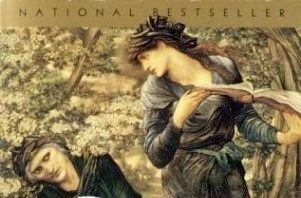
  • Review: Possession

    Review: Possession

    A. S. Byatt, Possession (Vintage 1991)

    https://www.goodreads.com/book/show/41219.Possession?ac=1&from_search=true&qid=I6SN8nY1ey&rank=1

    Roland Michell is a researcher investigating the work of (fictional) Victorian poet Randolph Ash. In a library he happens upon some correspondence from Ash to a lady, whom he believes to be the (fictional) poet Christabel LaMotte. The fictional poets are loosely based on Robert Browning and Christina Rossetti.
    Roland pursues the subject from library to stately home, hoping to achieve an academic scoop before rival researcher Mortimer Cropper—who also pursues a literary-research relationship with Beatrice Nest—beats him to it. Roland collaborates with Maud Bailey, some relative of Christabel’s. The blossoming relationship between Roland and Maud parallels that of Ash and Christabel.
    Christabel is described as ‘generic Victorian lady, specific shy poetess’. She wore ‘emerald green boots’ and had ‘a hint of greenness’ in her hair, drawing a poetic comparison to the fishy-serpent-fairy Melusina, about whom she wrote an epic poem. Her poetry had apparently been received differently by subsequent generations of feminists—‘swing skirted and lipsticked in the 50s, miniskirted and trailing Indian cotton in the 60s, black-lipped under pre-Raphaelite hairbrushes in the 70s’. There is much imagery of Nimue bewitching Merlin under the hawthorn, entrapped females, ladies sleeping enchanted in glass coffins, ladies enveloped by waves.
    Roland and Maud discover that Ash’s and Christabel’s affair drove Christabel’s companion-maybe-lover Blanche Glover to suicide and resulted in a lovechild Ash never knew about.
    This Booker winner is considered a work of ‘postmodern literature’, categorised as ‘historiographic metafiction’, combining historical fiction with metafiction (which continually reminds the audience to be aware they are reading a fictional work). As such it uses frequent allusions to other artistic, historical and literary texts. There are entire chapters consisting only of Ash’s and Christabel’s wordy, erudite correspondence and other entire chapters of poems or journal entries.
    ‘There’s a reference to almost everything in Randolph Ash, sooner or later’ is said about the fictional poet’s work, which I feel goes for Byatt’s work, too. This is–and I have been looking for one, after a slew of easy-read who-dunnits—a thoroughly grown-up book. It was very hard to get into; I’ve tried off and on to start reading it over a space of three years (and I confess, I skipped over the poems). In this quick-swipe, dumbed-down day and age, it’s hard to devote such a block of time as is required to read such a meaty work. We’ve got to keep trying, lest we forget how.

  • Review: Belle Nash and the Bath Soufflé

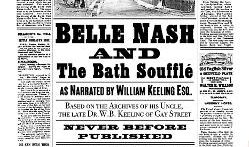
    Review: Belle Nash and the Bath Soufflé

    William Keeling, Belle Nash and the Bath Souffle (Envelope Books 2022)

    https://www.goodreads.com/book/show/60416029-belle-nash-and-the-bath-souffle?ac=1&from_search=true&qid=gL73lqsKnQ&rank=1

    It’s 1831 in Bath, and Mrs Gaia Champion cook’s soufflé has collapsed. Belle is tying his cravat in preparation for the party, while his ‘cousin’ Gerhardt can’t take his eyes away from his own beautiful image in the mirror.
    Councillor Belle Nash of Gay Street is openly a ‘bachelor’. He joins forces with the astute widowed Gaia to upset the status quo.
    The soufflé failure reveals a conspiracy of political corruption, and the crew set off on a madcap and often nonsensical investigation. The substandard grocer Hezekiah Porter and the dastardly Magistrate Wood are up to something. Mrs Crust’s Pie Shop and the decidedly inferior Shirley Haytit’s tearoom become the spots for a stake-out. Add to the mix Molly Jenkins’ house of ill repute, some deadly crumpets and a royal pronouncement by Princess Victoria, and the day is saved. The soufflés of Bath will rise again.
    Satirical fun is poked at the social mores of 1830s Bath, and the characters are witty—the snooty Lady Passmore, who wouldn’t deign to arrive before lesser mortals; Gerhardt, who insists on wearing a wig, speaks English using German syntax and has an interest in regression therapy; Miss Prim, who takes her knitting everywhere she goes; Mr Quigley, who wears a tea cosy for a hat; the beautiful young clerk Lucius Lush—joined by a gaggle of amusing cooks, maids and butlers.
    The very idea of setting the failure of a soufflé as the inciting incident is genius. The writing is lush. The humour is educated, witty rather than ha-ha, peppered with clever puns and literary and historical references. It has an old-fashioned feel to it, serving to bring the reader right into the period.
    This hilarious Regency satire is Book 1 of the Gay Street Chronicles. I can’t wait for the next.
    This review first appeared in Historical Novels Review.

  • Review: My Husband Bar Kokhba

    Review: My Husband Bar Kokhba

    Andrew Sanders, My Husband Bar Kokhba (Gefen Publishing House 2003)

    https://www.goodreads.com/book/show/7520364-my-husband-bar-kokhba?ac=1&from_search=true&qid=dNaS5T6ONW&rank=1

    Michal, the (fictional) wife of Shimeon bar Kokhba, the man destined to lead the last great Jewish revolt against Rome (132-135CE), recounts her life story to her nephew Yose ben Halafta, who is writing the Seder Olam (the rabbinic view of biblical chronology). The story begins aboard ship en route to Cyrene, where Shimeon is convinced the revolt will begin.
    We follow the couple during the days of the earlier revolt, the Kitos War (115-117). We encounter other famous Jewish revolutionaries, Lucuas, Pappus and Julianus, but unfortunately, they never quite become characters, nor do the main characters.
    The rebels march from Cyrene for a prophetic forty days into Egypt. The aim is to effect ‘the ingathering of the Nations’, when according to the prophecies of Deuteronomy all the Jews of the Diaspora would return to Jerusalem to worship the One God. However, they never quite make it into Alexandria, held back by the class of rich Jews there who are happy with Roman rule.
    Atypically, Michal is invited in to listen in meetings of the menfolk, so we hear the arguments and the military strategy. The ideological battle within the Pharisees is still live, between Hillelites and Shammaiites like Shimeon, the Hillelites leaning toward appeasement, the Shammaiites leaning toward zealotry.
    There is a confusion of goals. Some want only to rebuild the Temple; some even believe Hadrian will be their ally in this. Some want to kill Roman soldiers; some want to kill Gentiles. Michal is unhappy that, without a clear order against it, innocents are being killed in the mayhem of war.
    The backstory exposition in the first chapter is awkward, with Bar Kokhba telling his wife about recent events that she would certainly have known all about. At a few points, we even head-hop into Hadrian’s point of view, which I don’t think works.
    There was very little in historical record for this work to draw upon. Despite the discovery of several letters from the Nasi to his commanders, almost nothing is known about the man. The book portrays the enormity of the ambition to defeat mighty Rome, all the while showing us as well what the womenfolk at home had to do to keep the home hearths burning. A final chapter, a sort of epilogue, recounts what happened to everybody after the defeat, which I found a bit extraneous.

  • Review: A Very Modern Marriage

    Review: A Very Modern Marriage

    Rachel Brimble, A Very Modern Marriage (Aria 2022)

    https://www.goodreads.com/book/show/59834542-a-very-modern-marriage

    On the occasion of Nancy’s wedding, Octavia and Louisa are discussing the future of their brothel on Carson Street.
    At his gentlemen’s club in Bath, William Rose discusses with other men the prospects for his textiles business. He is losing business due to his not being a family man. To truly succeed in the business world, he must have that token of respectability, he must have a wife.
    William visits Octavia at Carson Street, but what is the nature of this relationship?
    Octavia desires that aura of respectability, too; she yearns to be a ‘woman of business’. She wants to invest her hard-earned (though questionably-sourced) earnings in his Manchester mills. She also wants him to teach her the rudiments of business.
    The two enter into a mutually beneficial arrangement, but was falling in love part of the bargain?
    William is disappointed when Octavia doesn’t see his Manchester cotton mills as the havens of happiness he wants them to be. Octavia’s desire to forge a new life and leave the past behind is going to require more than just a ring on her finger and moving to a new city. For a true meeting of the hearts, William needs her to love herself as much as he loves her. All’s well that ends well, and the three ladies of Carson Street look forward to a new future with husbands on their arms.
    The characters in this story are credible and likeable, and the love story is interesting. However, the congenial society outlined here is a jolly fantasy. I believe it doesn’t reflect the depth of the social opprobrium meted out to whores in Victorian times, the hardships and the dangers they faced, nor the degree to which the whole idea of ‘women in business’ was frowned upon.
    This Victorian romance is Book 3 of the Ladies of Carson Street.
    This review was originally written for Historical Novels Review.On the occasion of Nancy’s wedding, Octavia and Louisa are discussing the future of their brothel on Carson Street.
    At his gentlemen’s club in Bath, William Rose discusses with other men the prospects for his textiles business. He is losing business due to his not being a family man. To truly succeed in the business world, he must have that token of respectability, he must have a wife.
    William visits Octavia at Carson Street, but what is the nature of this relationship?
    Octavia desires that aura of respectability, too; she yearns to be a ‘woman of business’. She wants to invests her hard-earned (though questionably-sourced) earnings in his Manchester mills. She also wants him to teach her the rudiments of business.
    The two enter into a mutually beneficial arrangement, but was falling in love part of the bargain?
    William is disappointed when Octavia doesn’t see his Manchester cotton mills as the havens of happiness he wants them to be. Octavia’s desire to forge a new life and leave the past behind is going to require more than just a ring on her finger and moving to a new city. For a true meeting of the hearts, William needs her to love herself as much as he loves her. All’s well that ends well, and the three ladies of Carson Street look forward to a new future with husbands on their arms.
    The characters in this story are credible and likeable, and the love story is interesting. However, the congenial society outlined here is a jolly fantasy. I believe it doesn’t reflect the depth of the social opprobrium meted out to whores in Victorian times, the hardships and the dangers they faced, nor the degree to which the whole idea of ‘women in business’ was frowned upon.
    This Victorian romance is Book 3 of the Ladies of Carson Street.
    This review was originally written for Historical Novels Review.

  • Review: In Shadows of Kings

    Review: In Shadows of Kings

    K. M. Ashman, In Shadows of Kings (Silverback Books 2014)

    https://www.goodreads.com/book/show/20810891-in-shadows-of-kings?ac=1&from_search=true&qid=LqrO1d5DVD&rank=2

    Rhodri ap Gruffydd, nicknamed Tarian (Shield of the Poor), has summoned his knights to a secret banquet. King Henry of England is dead, Edward Longshanks yet in the Holy Land, but more battles with the Welsh are in store on his return. Tarian and his knights are doubting the leadership of Prince Llewelyn.
    At Brycheniog Abbey, Abbot Williams, the man who murdered Garyn’s parents, discusses the transport of the True Cross to Rome. Garyn ap Thomas, the blacksmith’s son, joins his wife Elspeth for dinner, exhausted from rethatching the roof. His brother Geraint, missing the camaraderie of the Crusades, is about to leave on a journey aboard a ship commissioned by Tarian.
    Owen Cadwallader comes to the manor of the deceased Sir Robert Cadwallader to forge a marriage between Sir Gerald of Essex and the elder daughter, Suzette.
    Father Williams and the newly betrothed Sir Gerald seem to have it in for Garyn’s family and livelihood, and he has to flee. He joins the Blaidd (Wolves) mercenaries to fight brigands. The rescue of a kidnapped girl brings new information about the True Cross, leading Garyn to realise that he had been double crossed.
    Tarian’s flotilla disembark on a new world and battle with the natives, aided by the Mandan, a people who speak their language. They’ve come seeking the descendant of Madoc, who travelled three times to the New World.
    The characters are lively, the dialogue credible and the plot exciting, alternating interestingly between Wales and the new World. The writing is just archaic enough to pass, but without any embellishments. This is Book 2 in the Medieval Series, and Book 1’s backstory of the retrieval of the True Cross and the persecution of Garyn’s parents is handled skilfully. It keeps the promise of the ‘direction you will not expect’ promised in the Foreword.
    This review was originally written for Historical Novels Review.

  • Review: A Taste for Killing

    Review: A Taste for Killing

    Sarah Hawkswood, A Taste for Killing (Allison & Busby 2022)

    https://www.goodreads.com/book/show/60186466-a-taste-for-killing?ac=1&from_search=true&qid=vxUUUOGgTY&rank=1

    Master Godfrey Bowyer and his wife Blanche are arguing again, and throwing crockery, within earshot of the servants, Gode, Runild and Alwin, who will have to clean up the mess. But before anyone can retire, the Master and Mistress collapse vomiting, the Master to his death. The healer pronounces it a case of poison, and Serjeant Catchpoll is summoned, bringing along his journeyman Walkelin. The bow-maker was little liked, but who would go as far as murder?
    They report to the lord sheriff William de Beauchamp, and Catchpoll rides to inform lord Bradecote.
    At some point in the past, the Master’s roving eye had caught Runild, and the effect is beginning to show. Mistress Blanche had motive aplenty, but why would she have knowingly taken the poison, too? Godfrey had taken her bowl after she had thrown his against the wall, so it could be that she herself was the intended target.
    Godfrey’s brother Herluin the Strengere arrives, expecting to inherit the business. He had been seen a week earlier in private conversation with Gode, she gesticulating wildly and saying the word ‘loyal’. He had also had heated words with his brother at the door just before the fateful dinner. Both Herluin and Blanche have secrets in their past.
    We have suspicions from the start as to the identity of the murderer, but the unravelling of the evidence is interesting.
    A good mediaeval whodunnit. Clues are drip-fed as the lawmen interview person after person. There are numerous characters in the town, so we’re on our toes as to who might have had a hand in the murder. I’m not familiar with Worcester dialect, but the language has local flavour. It captures well the mediaeval times, where people rarely venture beyond their own manor or village, rank is all-important, and information spreads slowly.
    This review was originally written for Historical Novels Review.