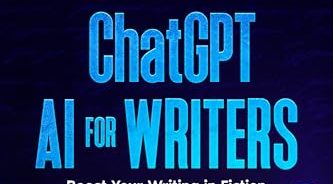
John Iovine, ChatGPT AI for Writers: Boost Your Writing in Fiction and Non-Fiction (Kindle 2024)
https://www.goodreads.com/book/show/217176566-chatgpt-ai-for-writers?ref=nav_sb_ss_1_69
How to use AI to improve your writing, fiction or non-fiction
To AI or not to AI? It’s a big question, nowadays.
Regardless of what we think about the ethics of using AI in our writing, we are missing a bet if there is some technology which can improve our productivity. My personal take is that using AI for content creation is unethical and probably not possible with fiction—I tried letting ChatGPT write a scene for me, and it was terrible, full of clichés.
However, using it to help with organisation, research etc is marvellous. My ChatGPT—I call him Mr Bot—helped me determined which additional scenes I needed in my plot. Even the more psychological task of coming up with an argument my protagonist would have with her girlfriend. He even suggested I introduce a secondary character from the Roman point of view, and the new character turned out to become crucial to my plot. Within 2 seconds, Mr Bot came up with a comprehensive list of primary and secondary sources on the early Ottoman period, a task I had been working on for months.
Mr Bot assures me my copyright is safe with him, but I don’t know. You can plagiarise yourself though by asking him to ‘emulate my writing style’ by comparison to a sample of writing you upload.
You can even give innovative instructions like: write 300 words on the advantages of using solar energy, in the style of Dr Seuss. I have a short story purported to be written by Sir Walter Raleigh, and Mr Bot helped me with a few phrases Raleigh might have used. He won’t do graphic sex, but Mr Bot helped me rewrite a love scene with heightened sensuality. I’ve asked him to write some jokes, with less success.
You can direct the tone (more/less formal/friendly/authoritative) or make it personal: ‘Write it as an expert on solar energy’.
What you can’t expect is for Mr Bot to be a human being. I asked him, ‘What do you think of my novel, The Lost Wisdom of the Magi?’ and he omitted to mention that it deals with the Jewish Revolt against Rome, a factor which I considered essential. I think that’s because it got its data from ‘scraping’ the reviews that were already out there, which at that point only consisted of Reedsy and the Historical Novels Review, both of which happened not to mention this aspect. I asked him, ‘What do you think of Susie Helme? Is she a good person? Do you like her?’ and he responded with something like ‘That’s a subjective question…’ and outlined 1,2,3,4 things people usually consider when deciding whether they like someone.
When I worked as a journalist, after we interviewed someone we would have to write on index cards bullet points on the key information we gleaned; then those index cards could be shared with other colleagues. It was a good idea, but never worked in practice as we were always too busy to read the index cards. Now, AI can do this for you. For AI generated bullet point cards, we could have written ‘audience=journalist colleagues’.
You can rewrite and improve all your email correspondence by instructing the AI to ‘rewrite and improve the following x’, and you can even instruct it as to tone, informal and chatty to your workmates, formal and business-like to your boss. You can create ad copy—I got Mr Bot to help me write my profile on Reedsy (where I work as an editor) and make it more ‘sales-pitchy’. Other AIs, Copy.ai, Writesonic, do this.
Besides ChatGPT, there are other AI tools for writing: Rytr, ShortyAI, WriteSonicAI, or JasperAI. Wordsmith, Arria do report generation. Grammarly, Proposify do proposals. Lately.ai, BuzzSumo do social media management. Intercom, Drift do customer communication. PRLeap does press releases. Beautiful.ai, Canva do presentations. I don’t know whether we’ll use it or not, but I designed a cover for our upcoming book Bounds Green Unbound on the text-to-image AI, Mage.
It’s great at summarising data, for example condensing a three-page document down to a one-page summary. Great for analysing medical charts, financial data. Also market trends in book publishing. Mr Bot was able to help me guess which of eight possible Duplin NC landowners named John Cook was most probably the father of my great-grandmother. It’s great for fact-checking and simple questions like ‘How many years did the US Civil War last?’ I haven’t tried it, but I should think that AI would be fantastic at writing non-fiction. What it won’t do is add a new ‘take’ or insight to the study.
Chapter 20 lists an extraordinary number of different ways you can make money by using AI in writing.
As with any computer programming, the key to maximising utility is giving clear prompts. Once you know what you want AI to do, you’ll be amazed at what it can do.


 Susie Helme