Tag: nutrition

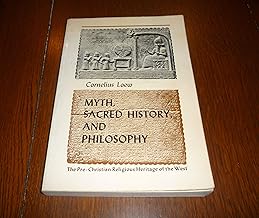
  • Review: Myth, Sacred History and Philosophy

    Review: Myth, Sacred History and Philosophy

    Cornelius Loew, Myth, Sacred History and Philosophy (Harcourt, Brace & World 1967)

    https://www.goodreads.com/book/show/26308179-myth-sacred-history-and-philosophy

    This comprehensive study looks at the evolution of religious thought from the early Sumerian creation myths to Plato’s Academy.

    To early Man, the church and state were the same institution, and city-states evolved out of precincts surrounding temples and shrines. Human leaders (kings) were thought of as descended from or adopted by the gods, and it was their responsibility to align human order with the divine. Creation was considered to be a (sexual) union between Mother Earth and Father Sky. The Egyptian pantheon reflected a political conflict between the desert (Seth) and agriculture (Osiris).

    The earliest art of 7500 BC, naked female figurines, showed a reverence for fertility. The ancient Greeks’ reverence was for the concept of fate, to which even the gods were subject. Then developed the concept seen in the Book of the Dead that the deceased was to be judged by the gods for his ethical behaviour in life.

    With Pharoah Akhenaten came the first concept of monotheism (although I believe the historical Moses was earlier).

    Hebrew sacred history drew from this history, reflecting ‘the conviction that there is an ultimate other than man, society or the cosmos’, and the idea that God was bigger than the cosmos. Their sacred books portrayed kings as real humans. Religious thought stressed appeals for social justice. The Deuteronomic ‘reforms’ reflected the different political situations of Israel (Samaria) and Judah and cultic rivalry with the worshippers of Baal.
    The Greeks invented drama in 535 BCE (Thespis and the tragodoi), influencing later civilisations’ thinking that stories of the gods were ‘just stories’. Xenophanes went so far as to say that man created God in his own image. Cultic practices emphasised both ‘the Apolline remoteness with God and the Dionysiac identity with it’ (ER Dodds). Amid the growing confidence of post-Persian Athens, later dramatists stressed the concept of moira (fate).

    Socrates’ hero as archetype strove for personal awakening, moral wholeness and an ultimate that was superior to the state, an idea that was considered ‘impiety’ and for which he was executed in 399 BCE.

    Auguste Comte mapped the philosophic evolution from anthropomorphic theology to metaphysical philosophy (using concepts rather than gods) to positive science to genuine knowledge.

    Much can be said about this subject, and this book goes some way toward saying it.

  • Review: The Rule of Four

    Review: The Rule of Four

    Ian Caldwell, Dustin Thomason, The Rule of Four (Dell Publishing Company 2005)

    https://www.goodreads.com/book/show/18431.The_Rule_of_Four?ac=1&from_search=true&qid=4mGd67XEr3&rank=1

    Princeton thriller complete with secret codes, Florentine friars, hidden crypts, sealing wax, ancient diaries and assorted Renaissance occult lore.

    Princeton 1999. Two students are on the verge of solving the mysteries of a (historically existing) 15th-century Venetian text Hypnerotomachia Poliphili. Tom Sullivan and Paul Harris are launched into an adventure that ends with a murder. The story is set in a world of spectacular practical jokes and interclub rivalry that is Princeton culture – eating club ‘bickering’, arch singing, the Good Friday sermon and banquet, togas, limericks, steam tunnels, the annual stealing of the Bell Clapper from Nassau Hall, and even the now defunct Nude Olympics.

    The Hypnerotomachia tells of the dreams of Poliphilo, and the text, studied before him by Tom’s father—dead from an accident that let Tom with scars—is known for its hypnotic effect on its readers.
    Nov 1497. Two messengers bring a letter sealed 4 times in dark wax to San Lorenzo church near the Vatican. After dire warnings not to read the letter, they open it anyway. The wax contains belladonna. When he discovered their treachery, a Mason at the church slew them. Tom’s father discovered this fact from a letter from Francesco Colonna and publishes a book containing his ‘Belladonna Document’. He claims that the author of the Hypnerotomachia was not the monk Colonna but rather a Roman aristocrat. The monk Colonna was a confessed rapist, where the aristocrat was a model of virtue.

    With one month left before graduation Tom is in his dorm room with Paul, Charlie and Gil. Charlie suggests a game of laser tag in the steam tunnels. Chased by proctors and campus police, they pop up in the middle of the Nude Olympics.

    Someone is murdered, but the incident is dropped while other storylines are progressed, which seems unrealistic to me. In real life, the students would have demanded at the scene to know who it was. In a final riddle, Colonna includes geographical information leading to his secret crypt, encoded in a ‘rule of four’.
    I wonder if the ‘cornuta code’ Tom and Paul discover, revealing the secret message from Colonna, is really there in the actual book.
    In places the story jumps unconvincingly back and forth in time. Sometimes it reads like fine literature, unlike the Da Vinci Code to which it is compared. For example, Tom’s love story with Katie is told beautifully. It has a bit of a ‘fizzle out’ ending. After the grand finale, a few more chapters say what happened to everybody, who got jobs where. Also, maybe I missed it, but was the mystery actually solved?

  • Review: Cold Sassy Tree

    Review: Cold Sassy Tree

    Olive Ann Burns, Cold Sassy Tree (Mariner Books 2007)

    https://www.goodreads.com/book/show/40389231-cold-sassy-tree?ac=1&from_search=true&qid=ksVGD3FBKk&rank=1

    6-stars. Charming family drama set in the old South

    5 Jul 1906, the day after the first Fourth of July celebration in Cold Sassy, Georgia. Will is 14. Grampa comes by for his morning snort of whiskey and announces his intention to marry Miss Love Simpson, young enough to be his daughter and – a Yankee!

    Miss Love works as a milliner at grandpa’s store, and the ladies in the family consider the new liaison a scandal, especially as Granny had just died 3 weeks ago. On her death bed, he’d heard Grampa praying, ‘Lord, you know my sin.’

    There are those who said that the expensive coffin was a sure sign the stingy old man had something he felt guilty for. Will knows differently. Granny had once said she wouldn’t mind being buried on a bed of roses, and Grampa creates one for her grave, weaving roses one by one into a burlap cloth.

    Will’s memories of Granny all have a down-home Southern feel. Granny saved the kids some sausage and ham because their father had decided Southern Presbyterians were God’s chosen people and should eat accordingly. Grampa had sold off her ancestral land but refused to use any of the proceeds to make her house ‘modrun’. A good part of the school year is devoted to teaching kids how happy the slaves were ‘before the war’ (which my own grandmother pronounced ‘befo-wa the wawa’).

    Up on the railroad tracks, the trestle calls to Will like ‘one of them si-renes’ of Greek mythology. A mill girl Lightfoot saves his life from a passing train, and big black Loomis saves his dog. The well-wishers all want to talk about grandpa eloping with the milliner.
    Aunt Loma decides she wants the piano, and the family goes to war. Miss Love treats Will with respect, and he empathises with her in the battle that ensues.

    When Pa and Grampa get the town’s first two automobiles, there’s a parade from the train station all the way to the store.

    Miss Love gives Grampa a new lease on life, and with the help of Will, works her way into the fabric of the family.

    As the town name is modernised ‘over grandpa’s dead body’, to Progressive City, the old sassy (sarsaparilla) tree is cut down for a road widening.
    This charming, wonderful and heart-warming tale is told in a believably 14-year-old voice, written in the Southern idiom of my childhood.

  • Review: The Lost World

    Review: The Lost World

    Michael Crichton, The Lost World (Alfred A. Knopf 1995)

    https://www.goodreads.com/book/show/8650.The_Lost_World?ac=1&from_search=true&qid=ZTz8SLnWSd&rank=1

    6 stars. Technothriller with dinosaurs. What’s not to like?

    First of all, the notion that anyone in this fictional world hasn’t heard of Jurassic Park and its demise is ludicrous – nondisclosure agreements or not.

    That aside, the now dino-phobic Dr. Malcolm is recruited by rich investor Richard Levine to go dinosaur hunting in Costa Rica.

    Levine is called to Rojas near Panama to examine a carcass – of some large lizard. He says to Marty Gutierrez, field biologist, ‘It’s not a damned lizard.’ He cuts a sample from the femur before the Public Health men destroy it. There are rumours of other ‘aberrant forms’. The animals are said to crave the lysine in genetically modified soybeans.

    Ed James meets Dodgson and Basildon at 2 AM. They want to know about ‘Site B’. ‘Find Levine,’ says Dodgson.

    Levine lands with Diego the pilot on Isla Sorna. Elizabeth Gelman, head of research at the San Francisco Zoo, has examined Levine’s sample. It looks like a lizard, but with the smooth muscle fibers of a warm blood, nucleated red blood cells of a bird, and a radio tag. ‘Somebody’s raising these things,’ she says.

    Engineer Jack Thorne has built all the equipment to be ‘lightweight and strong’. Hyena expert Sarah Harding flies from Tanzania. Mechanic Eddie Carr discovers the dino-factory, disused for years, has power.

    This isn’t just dinosaurs and screaming humans. There are the dastardly capitalists trying to steal intellectual property. There is Levine trying to study the animals and Malcolm trying to test his theories about evolution and extinction. But it’s once the humans start to interfere with the natural processes that the dino-shit starts really hitting the fan.

    Once the action starts, there’s no let up. Sarah and Kelly are battling raptors, while Levine and Malcolm deal with angry tyrannosaur parents.

    A dense jungle is the perfect setting for suspense. You hear breathing, but all you can see is a chain-link fence. Suddenly, you realise the raptors have chameleoned into the patterns of the fence and the shadows cast by the windows.

    The tension increases as some of the humans (Dodgson) are trying to kill other humans (Sarah). The rescue helicopter comes and goes.

    As the scientists examine each element, we learn more about the science. For example, Sarah explains predator/prey ratios to Eddie while pondering the surprising large numbers of velociraptors.

    6 stars. The perfect technothriller.

  • Review: Death Match

    Review: Death Match

    Lincoln Child, Death Match (Anchor 2006)

    https://www.goodreads.com/book/show/39027.Death_Match?ac=1&from_search=true&qid=8OLbjb50nY&rank=1

    6 stars. A technothriller with a twisty solution to the crime

    Maureen Bowman hears the Thorpe baby crying. Both Lewis’s and Lindsay’s cars are in the drive. Finally, she goes over. Following the child’s line of sight, she sees the trauma.

    Christopher Lash steps out of a cab on Madison Avenue. Eden Incorporated offers its clients an AI-selected ‘perfect soulmate’ selected by ‘Liza’, a supercomputer built by Dr. Richard Silver. Eden is hiring Lash, a psychologist specialising in human relationships, to investigate the Thorpe double suicide. Lewis and Lindsay had been one of their ‘supercouples’, couples whose particulars had matched 100%.

    Posing as an investigator for the couple’s insurance policies, he interviews Lindsay’s father. ‘The happiest couple I’ve ever seen,’ he says.

    Then, another supercouple commits double suicide. The wife survives long enough to say, ‘Make it stop. The sound in my head.’ These comprise what the FBI calls ‘equivocal deaths’, deaths that are related but with the nature of the relation unknown.

    Lash can only suggest the possibility of homicide, probably a rejected Eden candidate. James Groesch is flagged. Lash has been getting phone hang-ups, and his credit card is declined. Only once in his career has he seen a serial killer like this.

    Eden head of research Tara has been matched with a colleague – Gary Handerling, who, when investigated, proves to have utilised Eaton information to target vulnerable women.

    Reluctantly, Eden brings him ‘inside the wall’, allowing him access to client files. He tries the interview process as an applicant and is rejected. Lash, for some reason not removed from the Eden applicants database, is matched with a soulmate – Diana Mirrin, and they have a date. But the next supercouple on the list, the Connellys, are under threat.

    The brilliant twisty solution to the crime relies both on Lash’s expertise as a psychologist and Eden’s computer wizardry. Despite computer processing and AI having dramatically moved on in 29 years since its 1994 publication, the techno-bits don’t seem antiquated and still surprise.

  • Review: Exactly

    Review: Exactly

    Simon Winchester, Exactly (William Collins 2018)

    https://www.goodreads.com/book/show/40037112-exactly?ac=1&from_search=true&qid=gFAM49o7Yk&rank=1

    This is the exciting true-life history of precision engineering, beginning with establishing the difference between the concept of ‘accuracy’ and the concept of ‘precision’.

    The book features a fascinating structure, being enchaptered according to ascending measures of precision. A 1/2 inch ‘tolerance’ in shoes, e.g., is acceptable, but for the Hubble telescope, a measurement error on the mirror (later repaired) 1/50 the thickness of a hair rendered its images from outer space useless.
    The remarkable Antikythera Mechanism was supposed to predict eclipses, but when tested in modern times proved to be very inaccurate at it. Interestingly, it never occurred to ancient Greeks to use it as a clock.
    The centuries long struggle to measure longitude, the time difference between a ship and homeport, was finally solved by the British success of Harrison, driving the success of the British Empire. But the story shows that a mechanism has to be both duplicable and manufacturable at a reasonable cost.

    John ‘Iron-mad’ Wilkinson’s patent for boring cannon barrels and James Watts steam engine fuelled the industrial revolution.

    Henry Maudsley’s micrometre measured the actual dimensions of an object. ‘The ideal of precision’ we owe to Maudsley.

    In early America muskets were not made with interchangeable parts but had to be repaired individually by a blacksmith. This led to defeat at the Battle of Bladensburg in 1814. Humans will inevitably err; precise machines will not.

    Galileo had first noted the relationship between length and time, as a pendulum swing rate depended on the length of the pendulum.

    Eventually, mankind developed the concept of ‘traceability’ – the ability to connect time to an official US atomic clock. James Clerk Maxwell discovered that constants in nature were to be found at the atomic level i.e., the wavelength of light.

    There is an interesting appendix on the history of measurement. A six-year survey on the length of the meridian from Dunkirk to Barcelona divided by 10 became the standard post-revolutionary French meter, then cast in a platinum étalon.
    However, this was before continental shift was understood, and the measure of the meridian was eventually found to be off by 2/10 of a millimetre. It took 7 decades for the international community to agree on new standards.
    I borrowed this book at my scientist sister’s house and only read up to page 124, but I can’t wait to read the rest of it someday.

  • Review: The Martian

    Review: The Martian

    Andy Weir, The Martian (2014, this edition Ballantine Books 2014)

    https://www.goodreads.com/book/show/18007564-the-martian?ac=1&from_search=true&qid=CJG9KsLXxn&rank=1

    A nail-biting techno-thriller and story of Man’s triumph over Nature


    Over Christmas I watched the 2015 Matt Damon-starring film The Martian with my sister’s family. My nephews said, ‘You know that bit in Apollo 13 (after ‘Houston we have a problem’) where they dump everything out on the table? They made a whole movie out of that.’ A whole movie about finding ingenious techy solutions to life-threatening situations in outer space. My niece gave me the book for Christmas, which my sister says is one of her favourites. According to her, the science in the story is all accurate, and she should know, as she has been nicknamed ‘the Science Lady’.
    Botanist and engineer Mark Watney is accidently left behind on the planet when a NASA mission to Mars has to abort due to a severe sandstorm. Though his shipmates think he’s dead, he is very much alive and manages to survive in a hugely hostile environment thanks to high-tech equipment left behind by NASA missions to the planet and a series of MacGyver-type ‘tinfoil and gum’ solutions. The science behind each new strategy is explained.
    He has to reinvent the wheel in order to eat (he manufactures his own H2O and soil culture in order to grow potatoes), communicate with Earth (he spells out messages in rocks for the satellite cameras to see) and get around (NASA has left extra spacesuits and transport vehicles, and he gets his energy from previously erected solar panels).
    But it’s not just the science. Watney’s survival has as much to do with his strength of character, his sense of humour and his sheer chutzpah as it has to do with his engineering knowledge. This makes it not just a techno-thriller, but also a story about human fortitude and the triumph of Man over Nature.
    Unlike Cast Away, it is not boring at all. It’s full of nail-biting suspense. Many of the chapters begin ‘I’m f***ed’, before proceeding to outline some new ingenious fix. It is peppered with scraps of Watney’s humour, to which his shipmates also attribute his survival.
    Would be loved by Science Ladies (and gentlemen and nieces and nephews) and everyone else, too.

  • Review: Super Shorts

    Review: Super Shorts

    Writers’ Retreat UK, Super Shorts (Boxtree Media 2017)

    https://www.goodreads.com/book/show/126098367-super-shorts?ac=1&from_search=true&qid=8pVsTADTSR&rank=1

    It’s handy to have a short story collection handy, for bedtime reading when cracking a book seems like too much work.
    Flash fiction and very short stories are challenging to the writer, in that the reader’s attention needs to be grabbed quite quickly, yet the work must contain every element of a complete story—plot, climax, denoument. The thriftiness of the wordcount means that every word, every sentence has to count, hopefully resulting in a real jewel.
    Some think of a flash fiction piece as a little snapshot. Others believe a snapshot is not enough. It has to be a complete story.
    Think of Hemingway’s famous six-worder:
    For sale. Baby shoes. Never worn.
    The whole story is in there, read between the lines.
    This collection contains 31 short stories, the winners of Writers’ Retreat UK’s 2017 Short, Short Story Competition, in a variety of styles, few over 1000 words.
    The stories include a riveting rhinoceros-horn-smuggling chase scene, a story about depression remarkable in its depth of insight and one about a man craving to eat his wife’s leg.

  • Review: Seat 97

    Review: Seat 97

    Tony Bassett, Seat 97 (The Book Folks 2023)

    https://www.goodreads.com/book/show/134172257-seat-97?ac=1&from_search=true&qid=1EujyJSDj8&rank=1

    Journalist Nick Colton and his wife Greta sit next to a man at a Loretta Kay concert at the Royal Albert Hall. He tells them he has switched seats with someone to sit here, Row L Seat 97. Just then, shots ring out. David Barron, the man in Seat 97, a wealthy financial consultant, is dead.
    I really like how, about three-fourths into the story, just when it’s getting almost too complicated to follow, we are given a summary of the suspects, clues and alibis through the mouths of the police in a team operational briefing.
    It’s not all Colton’s point of view. There are numerous characters—as in real life, there are whole teams of journos, cops and suspects—but the only confusing ‘head-hopping’ (switching points of view mid-scene) is in chase scenes, which I think is appropriate and effective. The focus is on plot, and not so much characterisation. The main Protagonist is Colton, and his character is well developed.
    I love books where the working lives of the characters are portrayed realistically. So often detective stories feature completely unrealistic policemen. Bassett’s novels are exemplary on this point. His policemen have realistically cop-like dialogue and avoid clichés (donuts, etc). I am not a cop, but the accounts of police procedure seem true-to-life.
    As an ex-journalist, I can credit Bassett’s portrayal of the news desk of a daily newspaper with verisimilitude. One verisimilitude quibble: I have never heard of a hack asking for someone’s birth certificate. I can spot some nods to news events in London. The naughty minister’s story reminds me of the David Mellor scandal in 1992.
    His plots develop very much in the way that (I imagine) police investigations do. First the cops learn this, leading them to that inquiry. Then they discover more. Thus, the pacing is comfortable, slowly developing, then a rush of drama. As in real life, some of the leads don’t pan out, which gives it a true-to-real-life feel.
    There is sufficient scene-setting. The writing style is fluid; the dialogue is lively and believable. It was a genuine pleasure to read.

  • Review: The Song of Troy

    Review: The Song of Troy

    Colleen McCullough, The Song of Troy (Orion Paperbacks 1999)

    https://www.goodreads.com/book/show/480173.The_Song_of_Troy?ac=1&from_search=true&qid=ipcTjpDWxN&rank=1

    The story of the Trojan War just had to be told by Coleen McCullough. She is so steeped in ancient Greece that every cultural detail is perfect.
    She demystifies the age of gods and heroes, bringing to vivid life even the mysteries of antiquity, when snakes lived under altars. Olympians play no role here, except as the justification humans give for their actions. Peleus’ seduction of Thetis, for example, is painted as a ‘contest between the New Religion (e.g. Poseidon-worship) and the Old (e.g. Nereus-worship)’.
    Each chapter is told from one character’s point of view, so, we hear the story through the eyes of Paris, Odysseus, Achilles, Agamemnon, Helen. This allows for intimate snippets of characterisation which we don’t get in Homer. For example, Hektor sees in Helen’s eyes the hope that her prince might become the Heir, which he dismisses: ‘Time would teach her that Paris wanted no part of any responsibility.’ Helen bemoans, ‘Was there ever a fate worse for a woman than to know that not one person in her life is worthy of her?’
    The story of Agamemnon and Achilles’ fight over captives is very different from the Homeric version, as is Patrokles wearing Achilles’ armour. I rather think I prefer the Homeric versions. The fight scenes are breath-taking.
    We are treated to a version of the Trojan War, not as myth, but as a web of competition between the rulers of maritime powers and the personal vendettas involved. Paris’ abduction of Helen is payback for Telamon’s abduction of Priam’s sister Hesione, for example.