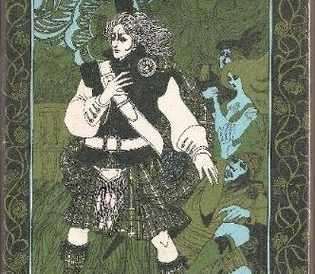
Sorche Nic Leodhas, Claymore and Kilt (Holt, Rinehart, and Winston 1967)
This is a compendium of folklore and folk history, stories about kings and castles.
It begins with the druids, who called themselves Gaedil (stones people). Higher knowledge was their exclusive domain, and they considered it unlawful to write anything down of their history. Folk history consisted in oral form in verse and took a druid 20 years to learn. As the druids were later exterminated by the Romans, this cultural wealth was largely lost.
The book treats early lords—beginning with Fingal (if indeed historical) who ruled Argyll as Ard-righ (high chief) of the clans between Wales and the West Coast—and early saints, including Ninian and Kentigern as well as Columba.
The concept of the book is to tell us about the folktales without actually narrating the folktales. It assumes readers already know the story. We are informed about the various versions of the tales and informed of where they differ from historical fact, but some of the stories are referred to rather than told. For example, a chapter heading announces ‘the riddle sent to Bruce’, yet the chapter does not tell us what the riddle was. This is unsatisfactory.
Though well-written, it is not narrative enough to be a book of folklore and not sociological enough to be a book about folklore. I checked out the tales on Google, so I did learn something, but I would’ve preferred a more narrative approach, which wouldn’t have added too many pages to the not-too-long 157-page book.
It is illustrated with beautiful curly Celtic art-nouveau line drawings.
Other books by this author treat ghosts, legends and tales from the Highlands.






 Susie Helme