Tag: literature

  • Review: The Coming of the Yirraalii

    Review: The Coming of the Yirraalii

    Steve A. Trotter, The Coming of the Yirraalii (Magpie Publishers 2024)

    https://www.goodreads.com/book/show/221570842-the-coming-of-the-yirraalii?ref=nav_sb_ss_1_27

    The prologue is spooky, like the misty forests of the Dreamtime.
    A battle is pending between the aboriginal Nyangbal mob and the Rain Forest mob. The issue is that a man has taken a bride who had been betrothed to another. Men of a certain mob are expected to marry women from another certain mob and no other.
    Balagaan likes Gawngan, but she is betrothed to Dangan. Balagaan won’t see her again until the festival in two years’ time. But he is caught kissing her good-bye and as punishment is sent to live with the Red Soil mob for five years.
    The tribes move from place to place, following the seasonal food supply, and they carefully husband their environment.
    At the Games, Balagaan comes head to head with Dangan, competing to claim Gawngan as wife. A Clever Man’s prophecy and a magpie, his totem, give him strength.
    Returning from a kangaroo hunt, the Nyangbal mob discovers white-skinned newcomers—Yirraalii—have invaded their land. The Yirraalii don’t understand the lore, and their violence disrupts the balanced society and the ecosystem. And Dangan is out for revenge.
    The setting and subject matter are exotic, but I wish they had been portrayed more clearly at the beginning. I could have used footnotes or a glossary. After I got into it, I was fascinated. It is set in Bundjalung, on the eastern coast of Australia. The invasion of the white men and their ‘thunder sticks’ and their ‘canoes with wings’ give us a clue as to the date.
    The culture is unfamiliar to a non-Australian, and right from the first there are multiple unfamiliar names and foreign words—bagaas, nulla-nullas, woomera, coolamons, janagan, dubay. The extensive use of foreign words brings the camera angle right down to the characters’ level, but it’s hard to get into, as we don’t know whether the names referred to are people, titles, or groups of people. And we lose track of who is a member of which mob. This all happens before we understand who are the main protagonists. This may not be an issue for readers who are more familiar with aboriginal culture, but I found it confusing.
    The novel seems to have been retitled Savages.

    This review first appeared in Historical Novels Review.

  • Review: The Paris Peacemakers

    Review: The Paris Peacemakers

    Flora Johnston, The Paris Peacemakers (Allison & Busby 2024)

    https://www.goodreads.com/book/show/203045222-the-paris-peacemakers?ac=1&from_search=true&qid=dSn1xdVGQq&rank=1

    Two sisters, in different worlds, try to heal the wounds from WWII
    1919 Europe is trying to heal, and so are two sisters, Corran and Stella. What does Corran’s specialty, the Greek and Latin classics she learned at Cambridge, even mean, now? Corran is going to Dieppe, to teach at a YMCA education centre for the troops.
    Stella and her Irish friend Lily experience the spontaneous celebration outside Buckingham Palace, the crowd baying for King George to share in their joy. In the crowd they meet American soldiers.
    Stella is in Paris, among ‘the chic and the shattered’, here to work as a typist for international peace. She wants to ‘get the years back’ that war has stolen from them all. Their dead brother Jack is a subject neither sister wants to acknowledge.
    Corran’s fiancé Rob is a surgeon, clearing casualties in France. As well as catastrophic injuries, they face an outbreak of influenza.
    The focus of this novel is both sad and uplifting. The damage and the desolation of war is well portrayed; we sense the characters striving to heave themselves and their world out of ruin. Even the Germans are helping.
    The descriptions of grief for Jack are emotional, the descriptions of wounds and amputations harrowing. Rob’s work is not only physically demanding, it requires huge strength of character—the mission to regain ‘dignity and self-belief after all they’ve been through’. At clubs playing American music, people are dancing ‘with a frenzy that was surely only this side of fun’.
    The parallels with the Odyssey are gorgeous and remind us of the relentless march of history.
    I found courage in this story, the courage to create a new world out of a destroyed one. This may be a work of fiction, but we must never forget that all this really happened, as our world slides into relentless repeat.
    This review first appeared in Historical Novels Review.

  • Review: Vu

    Review: Vu

    Kenneth Sinclair and Gillian Paschkes-Bell, Vu (Pantolwen Press 2024)

    https://www.amazon.co.uk/Vu-Kenneth-Sinclair/dp/1739362349/ref=sr_1_1?crid=21OSWPNK0M6WU&dib=eyJ2IjoiMSJ9.4hsIaNALbnWIRub4ElBoQBB3TZBOowzqDbHeChF0CWvEmgCPn-NzgQP4ICAHiR8GQcAb8z1ReHatZgdhvLSY4La2xBZBDxChK0Tlslu3rR3s6NLWeoyuPQiPX1liVyS01L5YsmWfEmKaX8Ku9GtFJ5JTgvUJXHFrobUhOBbMYsE7e5QO3UWQt70oFQmLeE4RuvFqsbJFO7ymT7Y4-cybEPeNLdF0xnkBZCWNabiq-a4.BDV1KirwDJhYymmC5_yYyRWVaAzl9xD9CNFzDUqRBg4&dib_tag=se&keywords=Vu+sinclair&qid=1755202331&s=books&sprefix=vu+sinclai%2Cstripbooks%2C628&sr=1-1

    To go back in time and tell 1001 stories to Scheherazade. What storyteller wouldn’t want that on their resumé?

    Gabriel is time-, or is it dream-travelled, ‘summoned’ to the princess, who inhabits a palace out of time and place.

    He tells her of the ‘black hulls of the Greeks’ bound for Troy, a star shining over Bethlehem, Chuang Tzu painting a crab, Taliesin speaking bardic riddles, Abelard and Héloïse continuing their chaste love, the corpse of Ghengis Khan carried across the desolate steppes, Marco Polo following the silk route, Boccaccio writing Decameron.

    The princess sometimes joins in the raccontage: the philosopher Averroes discussing eternity with the Almohad prince, perfume ‘drifting over the rose gardens of Shiraz’, Mansa Musa carrying gold to Mecca on a hundred camels.

    They take each other on a magic carpet ride, plucking up all the beauties history has to offer.

    I’ve never seen a book like this. The words are so beautiful, so image-rich, a cornucopia for the senses, they are almost poetry, gorgeous metaphor-filled erudite references to literary and artistic wonders. No chapter is one complete story, nor the complete story of one night with the princess, but rather a tangle of images—like dreams. Every paragraph is a jewel, an ‘iridescent text that causes others… to quiver a little’. They flit like butterflies, never quite anchored, like Japanese tanka court poetry, little bubbles linked not so much by narrative but by theme or emotive effect.

    Reading 280 pages with no plot structure and ‘almost no subject… only form, only style’ can be exhausting, but there is some thematic succession to the stories, and there are fleeting moments between Gabriel and the princess.

    A peacock screams, the princess turns her ring, birds fly through, and history begins a new day.

    This review first appeared in Historical Novels Review.

  • Review: The Curious Case of the Prawnographic Nibbles

    Review: The Curious Case of the Prawnographic Nibbles

    em.thompson, The Curious Case of The Prawnographic Nibbles (Kindle 2024)

    https://www.goodreads.com/book/show/220810951-the-curious-case-of-the-prawnographic-nibbles?ac=1&from_search=true&qid=2bh5v5kCbN&rank=1

    ‘It was a day to forget that Heather Prendergast would remember till her dying day, if not longer.’
    After a swanabout to the Cannes Film Festival with her celebrity aunt, which mostly involved shopping—and absolutely no revising—Heather Prendergast is ill-prepared for her exams at Merton Police College. Failure is not an option if she is to achieve her lifeheld dream of becoming ‘Prendergast of the Yard’. But why study? She can just learn her detecting from her illustrated Sherlock Holmes almanac.
    In her absence, someone has given Principal Pratley a video of his wife bonking Professor Morrison, and there has been an incident, resulting in hospitalisation as well as disgrace.
    On the way in to assembly, snotty classmate Daisy Miller (‘bleachblonde hair, beachball breasts, a bowlingball bum… an incongruous rhinoplastic nose and teapot ears’) insults Heather’s Cannes designer-wear by spilling her cherrycola on her.
    Then the new principal insults her designer coat and sends her to help Debbie Smith in the campus kitchen. And thus begins a hilarious caper.
    This contribution to the Prendergast of the Yard canon features Thompson’s signature brilliant wordplay. He invents words at will (equilibriumise her blood sugar levels, disacidify her discombobulation, uncarrier-bagging, whistlestop cleanathon, unscrewtopped, chimpanzoo, phlebotomised) and turns metaphors on their heads in clever ways.
    His characters are clowns: Prendergast, who takes herself sooo seriously and is always crazily dressed for any occasion; filthy rich and famous Aunt Elizabeth, who is always ready with some zany folk wisdom. Their madcap capers are reminiscent of Wodehouse or Tom Sharpe.
    Yet there is always a serious plot, and a satisfying conclusion where the baddies get what’s coming to them.
    Another hilarious Prendergast of the Yard novella.

  • Review: The Remembering: Of Leather and Stone

    Review: The Remembering: Of Leather and Stone

    Charles Paul Collins, The Remembering: Of Leather and Stone (Griffon House Media 2024)

    https://www.goodreads.com/book/show/220270639-the-remembering?ac=1&from_search=true&qid=fSp510crf1&rank=1

    When his mother is buried, the author discovers a treasure in the attic—his ancestors’ private journals, detailing their origins in the old country, their journeys to America, their lives and families. If we only knew how much our grandchildren would treasure such a thing, we would all do this.
    This is a family saga or genealogy—a ‘fact-based fictional account’. The tale is told in first person, as if from the pen of Cornelius Collins. In Part II, son Michael James picks up the pen. Then the other side of the family’s tale is told, stonecutter Giuseppe Ambrosini.
    Cornelius’s odyssey begins with An Gorta Mór—the Irish Potato Famine, one of the worst tragedies in human history. Collins’ descriptions of his ancestors’ sufferings and the horrendous ‘coffin ships’ are harrowing.
    I was moved by Cornelius’ admission that the famine was so hard on him that his mind had forgotten everything that happened in his life before it.
    Though the journey on the ‘coffin ship’ is terrible, immigrants in those days were treated better than they are now. On arrival in Milford, Massachusetts, bootmaking capital of America, Cornelius is immediately given food, shelter and a job as a cordwainer (bootmaker), a sense of pride in himself. He marries, starts a family and becomes a US citizen.
    I share the author’s passion for genealogy research. The trouble with genealogies in the bookshop or Amazon, however, is they are of little interest outside your grandchildren and your cousins. Unless someone in your family is a celebrity or a serial killer, your target readership is limited. There needs to be something in your family’s history that makes readers think ‘hey, that relates to me’. ‘These people lived here, did that and had these children’ is not enough of a story.
    Collins tells the story within the bigger human history in which his ancestors were players, bringing it home to his protagonists by quoting articles from the Milford Journal and the Framington Star of the time. We also learn in detail the processes of bootmaking and stonecutting.
    The Collins and Ambrosini families go through the Civil War, the abolition of slavery, the establishment of the Irish Republic, a visit from PT Barnum’s circus, the Great Depression, the misappropriation of the West from the native Americans, the invention of the telephone, votes for women, the sinking of the Titanic and WWI. Every year at Samhain (now Halloween) they hold a Cuimhneamh—‘the Remembering’—ceremony of ‘how it was with us in our time’.
    At some point, it becomes more of a listing of American news events than a family saga. It is also much too long.
    The ‘poor, tired, huddled masses’ who braved all these hardships and risks to create a better life in the New World, theirs is a big story, one for all of us.

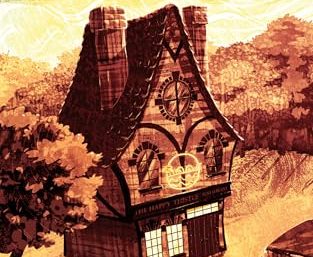
  • Review: The Happy Thistle

    Review: The Happy Thistle

    em.thompson, The Happy Thistle: The Curious Case of The Katenapped Girl (Eccentric Directions 2024)

    https://www.goodreads.com/book/show/219875720-the-happy-thistle?ac=1&from_search=true&qid=btkH39eHGB&rank=1

    Our gal at the Yard, Heather Prendergast, takes time off from her illustrious career working in the New Scotland Yard staff canteen. She is commissioned by her estranged father Sir Freddie to solve the case of the kidnapping of Katy, her stepmother’s daughter by a previous marriage.
    Prendergast leverages the copsmarts she learned in Hostagemurder class and Drugsbust class and undercover method acting at Hendon Police College as well as quirky lifesmarts she learned from her rich (and of course, eccentric) Aunt Elizabeth, with whom said father dumped her when he married said gold-digging stepmother.
    Evil genius ‘the Professor’ beavers away, assisted by his hyper-Scottish henchman Groaty McTavish, in a secret lab in the basement of a Highland-themed restaurant to crack the secret of dark matter—which, in case you wondered, is ρc+3H(1+wc,eff)ρc=0,ρΦ+3H(1+wΦ,eff)ρΦ=0—with which he plans to get rich, world domination, etc.
    The novel sports Thompson’s signature wit and creative wordplay. It’s full of genius puns, tongue-twisting alliterations and newly invented words, which are both hilarious and erudite (e.g. ‘the starstruck pipistrelle of night cloaked its wings across the milkywayed horizon to presage the passage of another customerless day’). No one in the history of the English language has created such inventive and side-splittingly funny metaphors. An educated scholar will pick up all sorts of clever references, yet at no point are we talked down to.
    The hilarious vocabulary does not detract from the interesting plot. Prendergast does her detective work, equipped with her bible, the Illustrated Sherlock Holmes Omnibus. The kidnappers’ best-laid plans begin to go humorously awry.
    We have character development, too, though the characters are comedic. The badguys hadn’t reckoned on HostageKaty having her own plans. Though the perps are too funny to be genuinely scary, there’s plenty of suspense.
    Funnier than Douglas Adams, and indeed, it contains some witty Hitch-hikers’ references.

  • Review: The Illusionaires

    Review: The Illusionaires

    Brian T. Marshall, The Illusionaires (Amazon Digital Services 2021)

    https://www.goodreads.com/book/show/58409445-the-illusionaires?ac=1&from_search=true&qid=CC8iWHxRzw&rank=1

    1938 A magician performs a trick on stage—he appears to have a third arm growing from his forehead—and takes a bow, ‘Ladies and Gentlemen, I am Richard Constairs.’
    Then, a voice from the audience, ‘No, I am Richard Constairs.’ This man has a third leg. He challenges three-arm Richard to a duel.
    Constairs wants to take his act into the movies. Karla doesn’t. So, he takes on a young apprentice, Charlie, and goes to Hollywood, hoping to bag a role on the making of the flying monkey scene in The Wizard of Oz. Is it illusion, or is it magic? Meanwhile, he’s training Charlie in the art of invisibility. And Charlie is teaching him things, too.
    Whenever Constairs needs something, he simply conjures it. Even if MGM and the Guild have everything all tied up, you’d think someone who is able to do actual magic would have the world as his oyster. He decides to take on the Guild. Trouble is, magicians are all dishonest, trick-artists. How to get them to work together? Constairs offers magicians collective bargaining power—they form the Illusionaires—at the same time offering Mr Louis B. Mayer, MGM’s Big Kahuna, a miraculous solution.
    1963 Charlie (Charles) is working for the CIA. Now, it’s time for some BIG tricks.
    The 1938 and the 1963 storylines tell completely different stories. What ties them together, besides the Charlie character, is the theme. What’s real? What’s illusion? What’s science? What’s magic? Who is pulling whose strings? The truth is as elusive as the Invisible Man. Even particle physics doesn’t have the answer. Says the CIA man, ‘all one can do is pick sides’. This is simply wonderful.
    The references paralleling with Oz are beautiful—the possible dual meaning of ‘there’s no place like home’; Constairs wants ‘to see the man behind the curtain’.
    The author seems to know all about The Making Of, and the story of how Hollywood worked back then is great fun. How magic works is even better.
    Marshall is a master of not Telling us too much, resulting in the surprising elements of the narration—the magic, if you will—hitting us with amazement. Every page has an artful phrase or sentence that will echo in your mind after you read them.

  • Review: Blood Sacrifice

    Review: Blood Sacrifice

    Douglas Jackson, Blood Sacrifice (Canelo Action 2024)

    https://www.goodreads.com/book/show/213846408-blood-sacrifice?ac=1&from_search=true&qid=swEb0jIUVB&rank=1

    Intrigue and excitement, fascinating character interactions, against a historical backrop


    January 1943. As 50,000 Jews in the Warsaw ghetto prepare to ‘create a story that will never be forgotten’, double agent Jan Kalisz is prepared to supply them with weapons. Smuggling them into the ghetto will be difficult. The Jews are starving, but they have treasure to trade—gold, gemstones, Picassos.
    Isaac Goldberg is ready to fight to the death. He tells Kalisz, ‘the Nazis will have us for breakfast; they’ll have you Poles for dinner’.
    New Gestapo member, Axel Weiss, is found hanging, and the man had secrets—and multiple aliases. Was he investigating corruption in the expropriation the Jews or looking for a piece of the action? The SS are a danger; the ghetto is a danger, traitors are not tolerated. The King of the Ghetto, The Piano Man—the saviour of the Jews or another Nazi bloodsucker?
    There is another threat, a cannibal targeting starving orphans, called The Golem.
    The Warsaw Ghetto, just before the final blaze of martyrdom, is a powerful setting. The stories of persecution, as the Nazis exterminate the Jews one street at a time, painful to read, give the story unstoppable tension. The people who orchestrate this terror use euphemisms—‘taken the train’, ‘resettled in the east’—to dehumanise what they are doing, which only serves to accentuate it for the reader.
    The timebomb in this story is horrific, and we feel it ticking on every page. Just when you think the stakes couldn’t be higher, it gets even more exciting.
    Jackson is masterful at giving away information a bit at a time, keeping us hooked. We’re kept guessing the whole way through—Who are the good guys? Who are the collaborators? Who is hiding what secret? The complex social identities—Germans/Poles, Jews/Aryans, Nazis/Resistance, Zionists/Communists—make for fascinating character interactions.
    Book 2 in the Warsaw Quartet.
    This review first appeared in Historical Novels Review.

  • Review: The Age of Heroes

    Review: The Age of Heroes

    Mikhail Gladkikh, The Age of Heroes (Quasaris Press 2023)

    https://www.goodreads.com/book/show/194025307-the-age-of-heroes?ac=1&from_search=true&qid=eGWsAB5zHa&rank=1

    What caused the Bronze Age collapse in the 12th Century BCE Mediterranean? This novel imagines that it was all the fault of the Olympian gods, meddling in the Trojan War with the use of advanced technology.
    Wanax (king) of Pylos Nestor has called a summit. The Trojans have broken their treaty with Pylos to form an alliance with the Hittites, and Hittite princess Ehli-nikkal (Helen), who had been promised to Nestor’s son Echelaos, is betrothed to prince Alaksandru of Wilusa (Troy). Wanax Agamemnon of Mycenae promises to rally all the Ahhiyawa (Achaeans) and Crete. Akhilleus is rallying the northmen of Iolkos. Machaon leads the chariotry from Miletus.
    Meanwhile, Assyria’s great king Ninurta-apal-ekkur is forming alliances to counter the threat from Egypt and uses the window provided by the Achaeans’ war to conquer Carchemish.
    Grave robbers break into the accursed tomb of Akhenaten at Pi-Ramesse, loosing a deadly force, until the goddess Wadjet steps in to help. There is an interesting take on the ‘curse’ of pharoahs’ tombs.
    Meanwhile, the Soarers (Olympian gods) are entering the human affray with ‘flying metal birds shooting deadly blue rays’. Some new technological ‘alien entities’ threaten even the gods, and they are fighting back using bio-engineering and science. And the Sea People are on the move, ready for conquest.
    Gladkikh does an admirable job of creating characters inhabiting this misty ancient time. Some of the names are known to history, mythology or archaeology, and I like the way he uses the original, ancient names. The story differs a bit from Homer, especially when the sci-fi elements come in, but it features many of the same dramatis personae. He also does an admirable job of painting us a picture of the Bronze Age world, although the dialogue sometimes slips into 21st century jargon.
    Like Homer’s tale, the connection between the gods and the earthlings is a bit tenuous, especially the advanced technology bit, and it gets more confusing toward the end. The high-tech bits could have been more clearly explained. I wasn’t sure whether they represented some technology we now recognise, or inventions. I didn’t understand the ‘alien entities’.
    The pre-Trojan Mycenaean world is wonderful. Mixing Sci-Fi and the Trojan War is highly original.

  • Review: Damnatio

    Review: Damnatio

    S. P. Somtow, Damnatio (Diplodocus Press 2024)

    https://www.goodreads.com/book/show/195082523-damnatio?ac=1&from_search=true&qid=Pp65a3OK3S&rank=1

    Sporus has been ‘moved to a superior accommodation’ at the Circus Maximus due to his ‘divine status’. From thence he tells his life story and the tale of his service to ‘Himself’.
    He, Nero’s ‘Empress’ accompanies ‘Himself’ to Corinth, staying at the home of Gallio, Seneca’s brother, who has committed suicide. Dressed incognito as the boy he no longer was, he and his body slave Hylas attend the party of a hetaira where he know Nero has gone. He gives Nero a ‘wedding present’, a carnelian ring depicting the rape of Persephone. They attend together the mystery rites at Eleusis.
    Nero has ordered that the calendar of the Games be changed to fit his itinerary. His mania is challenged to the hilt when another artist wins the audience’s acclaim, and his revenge is vicious.
    Sporus hears rumours of conspiracy. His ‘husband’s days are numbered, and his demise will result in the Year of the Four Emperors in Rome. All four of them loved this beautiful boy.
    Sporus has two identities—Poppaea and eromenos—in neither one is he free, ‘never allowed to stop acting’. His relationship with a man who was clearly one of history’s greatest lunatics is brilliant. The insight into the psychology of love and abuse is remarkable, and it is expressed so understatedly as to be poignant and artful.
    Nero’s eromenos is the perfect narrator for ancient Rome at the height of its decadence. This novel is gorgeously written and includes beautiful colour illustrations.
    Book 3 of the Nero and Sporus series.