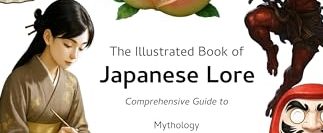
Carson Siu, The Illustrated Book of Japanese Lore: Your Comprehensive Guide to Japan’s Rich Culture, Tales, Mythology, Festivals, Folk Art and Urban Legends (Kindle 2025)
A comprehensive illustrated encyclopedia of Japanese lore
The book is an encyclopedia, codified into kami (gods and goddesses), yōkai (spirits and monsters), yūrei (ghosts), folktales and legends, rituals, festivals and customers, folk art and symbols and urban legends.
You will find in here absolutely every example of lore, from Momotarō to the 13th Floor, each listed with their names also in Japanese kanji and a manga-like colour illustration.
Nothing in human ghoststories could be spookier than Japanese yōkai and yūrei, and each type has a specific name—Rokurokubi (stretching neck), Hitotsume-kozō (one-eyed boy monk), Kuchizake-onna (slit-mouth woman).
Some of them derive from tales of females wronged in life or killed unjustly, like Okiku, the plate-counting girl, who in life was unjustly accused of losing her master’s plate and killed, destined throughout eternity to count for that tenth plate. Her counting ‘ichi-mai, ni-mai’, never reaching ten, drives humans mad. The enduring tales often illustrate Confucian or Buddhist principles such as good deeds bring rewards.
Japanese ghosts are class-based, too. Goryō (honourable spirit) are haunted spirits of samurai and noblemen.
Traditions like the Feb 3rd Setsubun are described, where people throw roasted soybeans (mamemaki) out the door, crying ‘Oni was soto. Fuku wa uchi’ (demons out, fortune in) and eat the same number of beans as their age.
These aren’t just old-time legends. Contemporary internet virals like Backrooms and The Ring are also terrifying and play on modern-day Japanese horrors like loneliness and urban decay.
And if you’re interested in further following the creature or custom in Japanese culture and history, each includes a paragraph on ‘cultural significance’.
This would be a useful resource for people playing video games that feature Japanese anime figures. Each entry includes a paragraph on ‘visual and behaviour’ characteristics, which would be handy for defining RPG powers. Pick your avatar. I’ll take Bake-danuki (shape-shifting racoon) or Teketeke (vengeful torso) or Tābo Baachan (Turbo Granny).
I lived in Japan during my twenties, and this book made me nostalgic. It’s educated me on a lot of things I saw then but knew little about at the time.
 Susie Helme