Tag: emily-bronte

  • Review: Belle Nash and the Bath Soufflé

    Review: Belle Nash and the Bath Soufflé

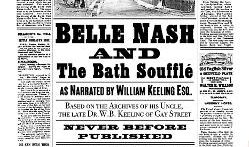
    William Keeling, Belle Nash and the Bath Souffle (Envelope Books 2022)

    https://www.goodreads.com/book/show/60416029-belle-nash-and-the-bath-souffle?ac=1&from_search=true&qid=gL73lqsKnQ&rank=1

    It’s 1831 in Bath, and Mrs Gaia Champion cook’s soufflé has collapsed. Belle is tying his cravat in preparation for the party, while his ‘cousin’ Gerhardt can’t take his eyes away from his own beautiful image in the mirror.
    Councillor Belle Nash of Gay Street is openly a ‘bachelor’. He joins forces with the astute widowed Gaia to upset the status quo.
    The soufflé failure reveals a conspiracy of political corruption, and the crew set off on a madcap and often nonsensical investigation. The substandard grocer Hezekiah Porter and the dastardly Magistrate Wood are up to something. Mrs Crust’s Pie Shop and the decidedly inferior Shirley Haytit’s tearoom become the spots for a stake-out. Add to the mix Molly Jenkins’ house of ill repute, some deadly crumpets and a royal pronouncement by Princess Victoria, and the day is saved. The soufflés of Bath will rise again.
    Satirical fun is poked at the social mores of 1830s Bath, and the characters are witty—the snooty Lady Passmore, who wouldn’t deign to arrive before lesser mortals; Gerhardt, who insists on wearing a wig, speaks English using German syntax and has an interest in regression therapy; Miss Prim, who takes her knitting everywhere she goes; Mr Quigley, who wears a tea cosy for a hat; the beautiful young clerk Lucius Lush—joined by a gaggle of amusing cooks, maids and butlers.
    The very idea of setting the failure of a soufflé as the inciting incident is genius. The writing is lush. The humour is educated, witty rather than ha-ha, peppered with clever puns and literary and historical references. It has an old-fashioned feel to it, serving to bring the reader right into the period.
    This hilarious Regency satire is Book 1 of the Gay Street Chronicles. I can’t wait for the next.
    This review first appeared in Historical Novels Review.

  • Review: My Husband Bar Kokhba

    Review: My Husband Bar Kokhba

    Andrew Sanders, My Husband Bar Kokhba (Gefen Publishing House 2003)

    https://www.goodreads.com/book/show/7520364-my-husband-bar-kokhba?ac=1&from_search=true&qid=dNaS5T6ONW&rank=1

    Michal, the (fictional) wife of Shimeon bar Kokhba, the man destined to lead the last great Jewish revolt against Rome (132-135CE), recounts her life story to her nephew Yose ben Halafta, who is writing the Seder Olam (the rabbinic view of biblical chronology). The story begins aboard ship en route to Cyrene, where Shimeon is convinced the revolt will begin.
    We follow the couple during the days of the earlier revolt, the Kitos War (115-117). We encounter other famous Jewish revolutionaries, Lucuas, Pappus and Julianus, but unfortunately, they never quite become characters, nor do the main characters.
    The rebels march from Cyrene for a prophetic forty days into Egypt. The aim is to effect ‘the ingathering of the Nations’, when according to the prophecies of Deuteronomy all the Jews of the Diaspora would return to Jerusalem to worship the One God. However, they never quite make it into Alexandria, held back by the class of rich Jews there who are happy with Roman rule.
    Atypically, Michal is invited in to listen in meetings of the menfolk, so we hear the arguments and the military strategy. The ideological battle within the Pharisees is still live, between Hillelites and Shammaiites like Shimeon, the Hillelites leaning toward appeasement, the Shammaiites leaning toward zealotry.
    There is a confusion of goals. Some want only to rebuild the Temple; some even believe Hadrian will be their ally in this. Some want to kill Roman soldiers; some want to kill Gentiles. Michal is unhappy that, without a clear order against it, innocents are being killed in the mayhem of war.
    The backstory exposition in the first chapter is awkward, with Bar Kokhba telling his wife about recent events that she would certainly have known all about. At a few points, we even head-hop into Hadrian’s point of view, which I don’t think works.
    There was very little in historical record for this work to draw upon. Despite the discovery of several letters from the Nasi to his commanders, almost nothing is known about the man. The book portrays the enormity of the ambition to defeat mighty Rome, all the while showing us as well what the womenfolk at home had to do to keep the home hearths burning. A final chapter, a sort of epilogue, recounts what happened to everybody after the defeat, which I found a bit extraneous.

  • Review: A Very Modern Marriage

    Review: A Very Modern Marriage

    Rachel Brimble, A Very Modern Marriage (Aria 2022)

    https://www.goodreads.com/book/show/59834542-a-very-modern-marriage

    On the occasion of Nancy’s wedding, Octavia and Louisa are discussing the future of their brothel on Carson Street.
    At his gentlemen’s club in Bath, William Rose discusses with other men the prospects for his textiles business. He is losing business due to his not being a family man. To truly succeed in the business world, he must have that token of respectability, he must have a wife.
    William visits Octavia at Carson Street, but what is the nature of this relationship?
    Octavia desires that aura of respectability, too; she yearns to be a ‘woman of business’. She wants to invest her hard-earned (though questionably-sourced) earnings in his Manchester mills. She also wants him to teach her the rudiments of business.
    The two enter into a mutually beneficial arrangement, but was falling in love part of the bargain?
    William is disappointed when Octavia doesn’t see his Manchester cotton mills as the havens of happiness he wants them to be. Octavia’s desire to forge a new life and leave the past behind is going to require more than just a ring on her finger and moving to a new city. For a true meeting of the hearts, William needs her to love herself as much as he loves her. All’s well that ends well, and the three ladies of Carson Street look forward to a new future with husbands on their arms.
    The characters in this story are credible and likeable, and the love story is interesting. However, the congenial society outlined here is a jolly fantasy. I believe it doesn’t reflect the depth of the social opprobrium meted out to whores in Victorian times, the hardships and the dangers they faced, nor the degree to which the whole idea of ‘women in business’ was frowned upon.
    This Victorian romance is Book 3 of the Ladies of Carson Street.
    This review was originally written for Historical Novels Review.On the occasion of Nancy’s wedding, Octavia and Louisa are discussing the future of their brothel on Carson Street.
    At his gentlemen’s club in Bath, William Rose discusses with other men the prospects for his textiles business. He is losing business due to his not being a family man. To truly succeed in the business world, he must have that token of respectability, he must have a wife.
    William visits Octavia at Carson Street, but what is the nature of this relationship?
    Octavia desires that aura of respectability, too; she yearns to be a ‘woman of business’. She wants to invests her hard-earned (though questionably-sourced) earnings in his Manchester mills. She also wants him to teach her the rudiments of business.
    The two enter into a mutually beneficial arrangement, but was falling in love part of the bargain?
    William is disappointed when Octavia doesn’t see his Manchester cotton mills as the havens of happiness he wants them to be. Octavia’s desire to forge a new life and leave the past behind is going to require more than just a ring on her finger and moving to a new city. For a true meeting of the hearts, William needs her to love herself as much as he loves her. All’s well that ends well, and the three ladies of Carson Street look forward to a new future with husbands on their arms.
    The characters in this story are credible and likeable, and the love story is interesting. However, the congenial society outlined here is a jolly fantasy. I believe it doesn’t reflect the depth of the social opprobrium meted out to whores in Victorian times, the hardships and the dangers they faced, nor the degree to which the whole idea of ‘women in business’ was frowned upon.
    This Victorian romance is Book 3 of the Ladies of Carson Street.
    This review was originally written for Historical Novels Review.

  • Review: In Shadows of Kings

    Review: In Shadows of Kings

    K. M. Ashman, In Shadows of Kings (Silverback Books 2014)

    https://www.goodreads.com/book/show/20810891-in-shadows-of-kings?ac=1&from_search=true&qid=LqrO1d5DVD&rank=2

    Rhodri ap Gruffydd, nicknamed Tarian (Shield of the Poor), has summoned his knights to a secret banquet. King Henry of England is dead, Edward Longshanks yet in the Holy Land, but more battles with the Welsh are in store on his return. Tarian and his knights are doubting the leadership of Prince Llewelyn.
    At Brycheniog Abbey, Abbot Williams, the man who murdered Garyn’s parents, discusses the transport of the True Cross to Rome. Garyn ap Thomas, the blacksmith’s son, joins his wife Elspeth for dinner, exhausted from rethatching the roof. His brother Geraint, missing the camaraderie of the Crusades, is about to leave on a journey aboard a ship commissioned by Tarian.
    Owen Cadwallader comes to the manor of the deceased Sir Robert Cadwallader to forge a marriage between Sir Gerald of Essex and the elder daughter, Suzette.
    Father Williams and the newly betrothed Sir Gerald seem to have it in for Garyn’s family and livelihood, and he has to flee. He joins the Blaidd (Wolves) mercenaries to fight brigands. The rescue of a kidnapped girl brings new information about the True Cross, leading Garyn to realise that he had been double crossed.
    Tarian’s flotilla disembark on a new world and battle with the natives, aided by the Mandan, a people who speak their language. They’ve come seeking the descendant of Madoc, who travelled three times to the New World.
    The characters are lively, the dialogue credible and the plot exciting, alternating interestingly between Wales and the new World. The writing is just archaic enough to pass, but without any embellishments. This is Book 2 in the Medieval Series, and Book 1’s backstory of the retrieval of the True Cross and the persecution of Garyn’s parents is handled skilfully. It keeps the promise of the ‘direction you will not expect’ promised in the Foreword.
    This review was originally written for Historical Novels Review.

  • Review: A Taste for Killing

    Review: A Taste for Killing

    Sarah Hawkswood, A Taste for Killing (Allison & Busby 2022)

    https://www.goodreads.com/book/show/60186466-a-taste-for-killing?ac=1&from_search=true&qid=vxUUUOGgTY&rank=1

    Master Godfrey Bowyer and his wife Blanche are arguing again, and throwing crockery, within earshot of the servants, Gode, Runild and Alwin, who will have to clean up the mess. But before anyone can retire, the Master and Mistress collapse vomiting, the Master to his death. The healer pronounces it a case of poison, and Serjeant Catchpoll is summoned, bringing along his journeyman Walkelin. The bow-maker was little liked, but who would go as far as murder?
    They report to the lord sheriff William de Beauchamp, and Catchpoll rides to inform lord Bradecote.
    At some point in the past, the Master’s roving eye had caught Runild, and the effect is beginning to show. Mistress Blanche had motive aplenty, but why would she have knowingly taken the poison, too? Godfrey had taken her bowl after she had thrown his against the wall, so it could be that she herself was the intended target.
    Godfrey’s brother Herluin the Strengere arrives, expecting to inherit the business. He had been seen a week earlier in private conversation with Gode, she gesticulating wildly and saying the word ‘loyal’. He had also had heated words with his brother at the door just before the fateful dinner. Both Herluin and Blanche have secrets in their past.
    We have suspicions from the start as to the identity of the murderer, but the unravelling of the evidence is interesting.
    A good mediaeval whodunnit. Clues are drip-fed as the lawmen interview person after person. There are numerous characters in the town, so we’re on our toes as to who might have had a hand in the murder. I’m not familiar with Worcester dialect, but the language has local flavour. It captures well the mediaeval times, where people rarely venture beyond their own manor or village, rank is all-important, and information spreads slowly.
    This review was originally written for Historical Novels Review.

  • Review: The Fallen Sword

    Review: The Fallen Sword

    A. J. MacKenzie, The Fallen Sword (Canelo Adventure 2022)

    https://www.goodreads.com/book/show/60668914-the-fallen-sword?ac=1&from_search=true&qid=K6ouDpln7A&rank=3

    While the English army besieges Calais, Philippa of Hainault, Queen of England, is in Bruges to broker a marriage between her daughter and the count of Flanders, currently a prisoner. The queen comes under attack, and five of her men are dead.
    The boatmen have been strangled, with catgut ligatures—probably by the musicians, suspected to be connected to the secret society of Pilgrims, mercenaries for hire.
    Simon Merrivale the herald and Tiphaine de Tesson the queen’s lady seek information on the renewed conspiracy against the English crown. Three men are meeting in secret: an English courtier to King Edward and two courtiers to King Philippe, John of Hainault and Guy de Béthune. The Englishman, the ‘man from the north’, plans “to redraw the map of Europe”.
    In an ever-widening spiral of conspiracies, the French crown, the papal throne and the throne of the Romans are all under threat. The Knights of St John also have a role to play.
    Across war-torn Flanders Merrivale and his allies dodge ambushes and conduct secret meetings in ruined castles. Neither are Paris nor Bruges safe from assassins’ knives.
    People betray their friends and switch allegiances, but in the end, the English take Calais, and the traitor’s identity is revealed.
    The cast of characters is huge, most real historical figures, but a list at the front of the book helps to keep track. I was almost lost by Chapter 6 and remained almost lost throughout. Right up to the dramatic conclusion, new characters are entering the picture. Even simply to know the identities, much less to understand the intricate political intrigues, of all these personages must have required prodigious research. The plot is as wonderfully complex as European history was at that time—and as difficult to follow.
    Book 3 in the Hundred Years’ War series.
    This review was originally written for Historical Novels Review.

  • Review: Resistance: Book 3 Fraternity

    Review: Resistance: Book 3 Fraternity

    Eilidh McGinness, Resistance: Book 3 Fraternity (Neilsen 2022)

    https://www.goodreads.com/book/show/71916725-resistance?ac=1&from_search=true&qid=lILaRxakM6&rank=1

    Sabine and her comrades are the brave Resistance operatives who kept the flag of Free France flying until the Nazis were expelled.
    For long periods, she is separated from her love, the dashing fighter Hérisson, who will only tell her his real name on their wedding day. She herself is hailed a hero, about which she feels conflicted, as she feels she gave up the job of courier out of cowardice.
    This book is set during the end of the Nazi occupation. Sabine, Hérisson, their comrades and relatives face persecution—a few of the women are bearing the children of rape by Nazi soldiers. They experience the massacre at Mussidan, one of the most serious atrocities of this war. A mission goes wrong, and Hérisson and his men are captured and narrowly escape the firing squad.
    Most enjoyable about this novel is the portrayals of everyday French life. We can smell the rabbit stew on the cuisinière and hear the crackle of paté being spread on rounds of baguette. The author lives in the south of France and we feel her love of the culture. The characters’ emotional arcs are very rich. We feel the fear of the men facing the firing squad and the tension of the men as they sneak around behind enemy lines. The feelings and the hardships of the women are excellently portrayed. The plot moves excitingly along, and yet time is taken to paint a rich portrait. Some chapters, devoted almost entirely to Sabine’s emotions, are gorgeous.
    Book 3 in the series.

  • Review: The Night Ship

    Review: The Night Ship

    Jess Kidd, The Night Ship (Atria Books 2022)

    https://www.goodreads.com/book/show/59366231-the-night-ship?ac=1&from_search=true&qid=6ozv5ao9rL&rank=1

    6 stars!

    Based on the true story of the sinking of the Batavia.
    1629 A girl named Mayken, with her nursemaid Imke, boards the Batavia, setting out to find her father who lives in a land where ‘the midday sun is fierce enough to melt a Dutch child’. Her mother has died ‘from the bloody flux’. Francisco Pelsaert is the upper-merchant, Jeronimus Cornelisz the under-merchant and Ariaean Jacobsz the skipper. In the next cabin is Lucretia Jansdochter and her maid Zwaatie. Jan Pelgrom, Pelsaert’s steward, helps her to go to the Below World, disguised as a cabin boy and calling herself Obbe, in which guise she delivers drugs for the butcher-surgeon. There’s some kind of monster down in the hold. Utter horror ensues after the shipwreck.
    1989 Gil, a boy mourning his mother, is placed in the care of his fisherman grandfather Joss off the Australian coast. His mother has died ‘from a mishap’. He meets Silvia Zanetti, wife of the foremost fisherman Frank, whose stepson Roper has a metal plate in his head. Silvia won’t take Gil inside her house because of ‘what he did’. The island has a ghost, a girl from the shipwreck of the Batavia—islanders leave gifts for her—and Gil has a pet tortoise. Scientists are digging up remains of the wreck of the ship that had ‘set sail with a psycho on board’. There’s are ancient feuds between Joss and the other fishermen that play out between Gil and the other boys,
    Gorgeously written, the Voices in this novel are remarkable. Mayken is stalwart, willing to courier drugs for the surgeon in return for being allowed to watch him amputate a sailor’s leg, willing to confront a monster to save her beloved nurse. The Batavia is so horrifying, crawling with rats and eels—we never know whether we’re inside one of Maykens’ nightmares. Gil is the loneliest of boys, persecuted by the island children and full of dark secrets.
    I was given this book by the Historical Novel Society because I had reviewed for them Anatomy of a Heretic by David Mark, which also treated the sinking of the Batavia.

  • Review: A Ration Book Victory

    Review: A Ration Book Victory

    Jean Fullerton, A Ration Book Victory (Corvus 2022)

    https://www.goodreads.com/book/show/60294332-a-ration-book-victory?ac=1&from_search=true&qid=Yv5uzIqDRE&rank=1

    Dressed in their Sunday best, 5-year-old Philomena (Queenie) Dooley attends church with her family in Kinsale, Ireland. Shunned as ‘tinkers’ they sit at the back, but a prosperous farmer’s boy catches her eye. She and Patrick become friends “for ever”. That was before Nora came between them and she married Fergus Brogan instead.

    Queenie Brogan barters grocery rations for eggs with Bernadine O’Toole. Though “just a shade over 21” Queenie is a grandmother.
    Queenie bursts in. Father Mahon has collapsed and is in hospital. Mattie McCarthy née Brogan has her suspicions about Granny and Father Mahon. Though he’s in the care of doctors, Queenie has faith in ‘spirits’.
    Jo Sweete, the second Brogan girl, bows her head in church, praying to be blessed with children as her sisters have been. Ida and Pearl are fighting. Billy knows. Aunt Pearl is his ‘real mother’. Pearl’s husband, a rich gangster, is a bad influence.
    Ida and Jeremiah are discussing their growing removals business, contemplating a move to East Ham and larger premises, when a V-2 shatters the entire street.
    The Brogan girls celebrate Victory in Europe in style in front of Buckingham Palace.
    Tommy and Jo are adopting a war orphan.
    A few issues around paternity are resolved. The deadly rivalry between Nora and Philomena (Queenie) plays out with tragic consequences. But surrounded by grandchildren, the Brogan family moves into the new post-war future.
    The easy dialogue and the colloquial style bring the good ole’ days of the war era to life. This is just at the end of the war, when the young women had waited so patiently and fearfully for their husbands to come home. The joy and catharsis of VE Day really comes across.
    This WWII family saga is Book 8 in the Ration Book series.
    This review first appeared in Historical Novels Review.

  • Review: Murder of a Doctor

    Review: Murder of a Doctor

    Tony Bassett, Murder of a Doctor (The Book Folks 2022)

    https://www.goodreads.com/book/show/61118068-murder-of-a-doctor?ac=1&from_search=true&qid=YFkx47ZiTg&rank=2

    Dr Scott Deeley, once a consultant on the TV soap, Morning Surgery, is out for a run on Foxwell Heath when he is found brutally murdered.
    There’s a host of suspects – a few dog-walkers, who discovered the body; Robert Brown, a man found near the scene who gives police a false address; the father of a boy who died when the doctor misdiagnosed his medical condition; and the dead man’s aunt, who has been suspiciously unavailable for interview.
    A surprising connection provides the clue that, in the end, enables Detective Sergeant Sunita Roy to crack the case.
    This is a thrilling and well written detective story. It’s refreshing to read a crime novel that recounts police procedures realistically and paints policemen as real people, though the complex plot leaves not a lot of time for character development, and I love that one of the author’s main protagonists is a non-Anglo woman. The case unravels realistically, as well; we learn clues piece by piece, making it fun for the reader to try and second-guess the heroes.
    Book 3 in the Roy and Roscoe series.