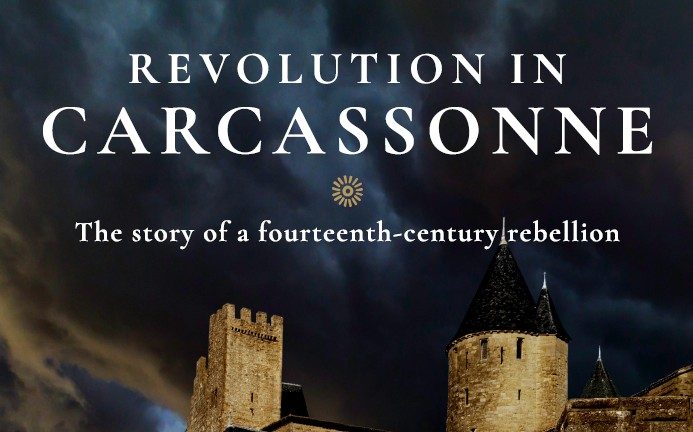
Elaine Graham-Leigh, Revolution in Carcassonne: The story of a fourteenth-century rebellion (Whalebone Press 2025)
https://www.goodreads.com/book/show/237965361-revolution-in-carcassonne?ref=nav_sb_ss_1_38
The inside story of a 14th century revolution
August 1303, 80 years after the French Crown had seized control of mediaeval Carcassonne during the Albigensian Crusade, the town rose in revolt.
Resentment had been building for 20 years, and the townsfolk had first hoped Philip IV would address their concerns. When the king ignored them, houses of town leaders suspected of collaborating with the Inquisition were sacked (the ‘destruction of homes’); mobs freed prisoners in the prison (‘the Wall’); Dominicans, responsible for staffing the Inquisition, were taunted with cries of ‘Cohac, cohac’ (the caw of crows). Town leaders took down the king’s ‘bags’ (in which he collected merchants’ taxes) and offered suzerainty of the town to Ferran, son of the king of Majorca (a ‘Barcelona/ Aragon alternative to Toulouse and France’). Radical Franciscan priest Bernard Délicieux gave fiery sermons in the streets.
Like her earlier The Southern French Nobility and the Albigensian Crusade, Graham-Leigh brings a complex history to life by focussing on specific individuals. The story of twelve men taking sanctuary in the Franciscan convent, accused by the Inquisition of ‘offend[ing] seriously and greatly’, culminates in the trial of Bernard Délicieux—convicted of treason in 1319. She provides a comprehensive glossary of all the individuals involved, with those who were witnesses at Bernard’s trial asterisked.
This is a Marxist analysis, and Bernard is placed within the context of the class forces involved at the time.
Graham-Leigh corrects some modern historians’ misunderstandings.
Modern interpretations of the Cathars as a competing sect of Christianity need revising. ‘Catharism’ was more ‘a response to Inquisition persecution, rather than a reason for it’—persecution was not a matter of bigotry but rather ‘a ruling class strategy’. ‘Jew’ or ‘heretic’ (the name ‘Cathar’ didn’t yet exist) in the 14th century referred more to lifestyle than to identity. Witnesses at Bernard’s trial did not ‘talk about spirituality or belief’.
Nor was the Languedoc a ‘lost Elysium’ as the troubadours would have us believe. Stephen of Tournai’s account of bands of foreign mercenaries disrupting an otherwise peaceful land is wrong; ‘feudalism itself was at issue in Languedoc’.
The Albigensian Crusade ‘hit Languedoc with a few centuries worth of feudalisation in a few turbulent years’. With the crushing of the Carcassonne revolution, they reinforced the screws, to include other minorities and marginals—the Templars in 1307 and lepers and Jews in the 1321 hysteria, which began in Carcassonne, over the supposed ‘lepers’ plot’.
Graham-Leigh’s superb research, which included examining original documents in Latin, shines through; and her writing style is exciting. Stories like the 1283 plot to steal the Inquisition’s registers are thrilling.
She has a talent for expressing the gist of politics in easily comprehensible language. She outlines in clear terms the relations of base and superstructure, pointing out that the clerical ruling class underpinned the feudal system as much as the secular powers.
The class struggle in these early years was more fighting over control of the extortion process than opposition to persecution per se. This explains why the Inquisition went after both rich and poor.

 Susie Helme