Tag: christianity

  • Review: The Road to Poitiers

    Review: The Road to Poitiers

    Jonathan Lunn, The Road to Poitiers (Canelo Adventure 2024)

    https://www.goodreads.com/book/show/202517754-kemp?ac=1&from_search=true&qid=yIXC8T2bZX&rank=1

    September 1356. Martin Kemp and his archers ride with the Black Prince and the Anglo-Gaston army, pillaging their way across France. Their aim is to rendezvous with the Duke of Lancaster’s forces at Châtellerault, but they find all the bridges across the Loire destroyed. Will Kemp be able to rescue his lady love Ysabeau and win her hand?
    The story begins right in the heat of battle—the enemy ‘less than a furlong behind him’—almost too exciting, because unless we’ve read Books 1-7 (this is Book 8 in the Arrows of Albion series) we’re not yet familiar with the protagonist.
    A rich period of history, many many characters. The varied viewpoints are hard to keep up with, in places, but they add to the feeling of breathlessness of pace and keep faithful to the real history.
    Besides Kemp’s’ sworn foe, the Chamberlain Geoffroi de Charny (owner of the Turin Shroud), whom he once enjoyed ‘p***ing on’, and my ancestors the Douglases, there are some surprises as to who is marching with the French.
    The genius loci is so good you’d be sure the author must have been there. We feel the hard-bitten partisanship, the ‘bile rocket[ing] up [their] gullets’; we hear ‘the jingle of crotal bells’ of the pursuing enemy. We learn details about mediaeval warfare and enjoy discussions of religious philosophy that were common at the time.
    The dialogue and the rough talk of the soldiers is vivid and believably of the time. The French calling English archers ‘les goddams’ referencing their constant cursing (e.g. ‘Go… fry mice, ye mumping carrion crow’); the English denying King Jean II’s right to the French throne by calling him ‘the Crowned One’.
    Fans of military fiction will love this. Spoiler alert: the English win this one, but the French eventually win the war.
    This review first appeared in Historical Novels Review.

  • Review: Saltblood

    Review: Saltblood

    Francesca de Tores, Saltblood (Bloomsbury 2024)

    https://www.goodreads.com/book/show/199689207-saltblood?ac=1&from_search=true&qid=BHXB0kfSU9&rank=1

    What a juicy subject for a historical novel—an infamous female buccaneer during the Golden Age of Piracy and her infamous shipmates, Anne Bonny and Calico Jack Rackham.
    Mary’s life begins in hardship. She masquerades as a boy to solicit financial help for her mother from her brother’s paternal grandmother. Making her way through early 1700s society dressed as ‘Mark’ in service as a footman, she is pulled toward that wildest of man’s worlds—the sea.
    A woman dressed as a man to become a sailor is a common theme in the mysogynistic world of bygone cultures, but this one goes deep into the psychology, as Read seeks a ‘name that fits her skin’. She marries and puts on a dress, and they run a tavern in Flanders. The men all now treat her differently, and Mary struggles to teach her husband that ‘the stuff between her legs is not the end of what she is’.
    All the while, the dampness that seeps into their floorboards threatens to reclaim her for the sea. Perhaps a sailor is something else, neither man nor woman but an identity unto itself. Read’s love of the sea, tinged with fear of its power, shines forth from the pages. The crow that follows Read around—a symbol of death—is an apt metaphor.
    This is a great work of literature, historically correct and beautifully written.
    The characters are richly nuanced—the ‘specimen’-collecting captain and his ‘invisible’ wife, the eloquent Jack, free-spirited Bonny, Read’s hard-bitten laundress mother. I loved the laundress’s ‘constant battle against colour’, beautiful metaphors like the ‘curved blade’ of a smile, ‘we wait like tubers for spring’, the ‘crabwise patience of shelled things’ and other gorgeous details of humanity, of ‘casual fond brutality’ and ‘gallows fellowship’, and of battle, death and pirates.
    The review first appeared in Historical Novels Review.

  • Review: Lidu’s Awakening

    Review: Lidu’s Awakening

    Valerie Bennett, Lidu’s Awakening (Kindle 2024)

    https://www.goodreads.com/book/show/209324860-lidu-s-awakening?ac=1&from_search=true&qid=xnqdOK6Oev&rank=1

    Young Paleolithic hunter Crik is over-anxious to prove himself in this test of manhood, his first solo hunt. If he could bring down a bison, he might look worthy in the eyes of his tribe to be their leader in the future as his grandfather was today. He notices wolves are stalking his prey, as well.
    Gatherer for the tribe, Lidu has made a Great Mistake. One day she accidently picks purple coloured berries instead of the blue ones, setting off a chain of events that changes her destiny. People get ill from eating the berries, and the women shun her.
    Kylo and his brother Aneko struggle for dominance within their pack of teen wolves, who are closing in on a herd of bison. Since he was a pup, Kylo had known that he was destined to one day be alpha.
    Crik creeps into position, eyeing the bison, when suddenly one of the wolves lets out a howl, spooking the herd into stampeding off.
    The wolves prepare for the big pursuit, Kylo and Aneko in the vanguard.
    Lidu, shunned by the other gatherers, goes out berry-picking on her own. She discovers that applied topically, the purple berries have healing qualities. A large cave lion surprises her, but leaves her alone.
    Crik continues his stalking. A wolf howls, but the bison are not spooked. Just as he throws his spear, the bison is spooked by something on its other side—two large wolves. Crik is seriously injured, gored by the terrified bison.
    The chase is on, and Kylo charges too soon, leaping into the air only to be met by a massive horn. Gored, Kylo fell to the ground. Nearby was Aneko and next to him an unconscious human boy.
    Lidu hears two howls, one from a boy, one from a wolf. She heals them both, winning respect first from the wolves, then gradually from the humans.
    This is largely the story of a Paleolithic hunt, told first from the humans’ point of view, then from the wolves’, and the events that followed that hunt. We see the primitive structure of the human’s society. Occasionally we glimpse the thinking processes of the wolves, which is quite interesting.
    The humans have to learn bigger lessons than how to make a successful kill. They learn the values of honesty, humility and gratitude, that there is possibility for individuals to step outside their assigned gender roles and that being a leader means more than showing off before one’s mates.
    The wolves learn—sometimes, humans can be trusted.

  • Review: Wuthering Heights

    Review: Wuthering Heights

    Emily Brontë, Wuthering Heights (1847; this edition Penguin Classics 2014)

    https://www.goodreads.com/book/show/32929156-wuthering-heights?ac=1&from_search=true&qid=TmryfBleJl&rank=1

    If such a novel were to come to me today, I’d critique it quite heavily.
    The society portrayed is so antiquated as to be almost incomprehensible to the modern reader. I found myself wondering, ‘Are Cathy and Heathcliff ghosts? Are they servants?’ ‘Are we talking about Catherine the mother or Cathy the daughter?’ I constantly lost track of who is living at the Heights and who at the Grange. I had to go to Wikipedia before I got the characters straight. It’s way too long; I had to skip the last 10 or so chapters.
    The twisted love affairs and ingrained resentments are revealed in a flashback through the voice of servant Nelly Dean’s filling in the new tenant Mr Lockwood on the family’s backhistory. The dark backstory goes on for most of the entire novel without so much as a breather to put a new log on the fire. In Chapter 13 the narrator POV shifts to Isabella, presumably a letter to Nelly Dean, with long passages unclear as to who is the ‘I’ referred to, and Mr Lockwood is only brought back into the story at the end of Chapter 14, leaving us to wonder ‘are we still in the backstory, or in present time?’. Structurally, it’s a mess, 2 out of 10 at best.
    However, I give it 10 out of 10 for mood and atmosphere. You can just hear the whistling wind of the desolate Yorkshire moors. It’s the most Victorian and most Gothic novel ever, complete with grave-robbing, ghosts seen in mirrors, haunted rooms in dark decaying manor houses with portraits of ancestors on the wall, crumbling gravestones covered in ivy, mothers languishing and dying of consumption or childbed, people lost on the moors at night in the rain and women left deceived and abandoned with child.
    And 10 out of 10 for character development; the characters are deeply intricate. The dialect-talk of the servant Joseph is almost entirely incomprehensible to me, but it is believed to be accurate for a Yorkshire dialect of the time, so, this work is also of anthropological value.
    Cathy is an entitled Little Madam, what we nowadays would call a Histrionic Narcissist, believing ‘though everybody hated and despised each other, they could not avoid loving me’; Heathcliff is a Malignant Narcissist. ‘The more the worms (his family) writhe, the more [he] wants to crush out their entrails’. Together they form a folie à deux, ruining everyone in their wake.
    From adopted child spoiled by the old master of Wuthering Heights, Mr Earnshaw, Heathcliff grows up resented by his brother Hindley, who marries Frances. Of the children at Thrushcross Grange, Edgar despises Heathcliff. Cathy loves him, though she marries Edgar, because Heathcliff is ‘so low’. Heathcliff loves Cathy, but he marries Isabella, just to spite everyone. These unions have children, and much vengeance is enacted.
    A recurring theme of storm and calm after a storm is a powerful metaphor for the battling civilised and wild sides of Man’s nature, and the bleak beauties of the Yorkshire moors are a perfect setting for it. Cathy, in her anguish, is desperate to open the window and feel on her face the wild wind of the moors, where she once roamed free with Heathcliff.
    At the time it was published, it made quite a stir, for its portrayal of cruelty and challenges to classist assumptions. It was criticised for ‘vulgar depravity and unnatural horrors’. Dante Gabriel Rossetti, who loved the book, called it ‘an incredible monster’.
    What a contrast to Jane Austen, where intricate emotions have to be delicately winkled out, imbedded in elegant, wordy conventions of social politeness. Here, all the beastliness of Man’s nature (and mind you, there’s no sex) is exposed on the surface like festering wounds.
    In that sense, it reminds me of the 1975 film ‘Mandingo’ about the depravities of slavery, which upset me so much that I vomited after leaving the cinema, and since that day I refuse to watch any film, documentary or read any book about slavery unless I am promised some kind of happy ending.
    I had to force myself to read it, but I’m glad I did. This is not a love story; as Cathy dies Heathcliff curses her soul to ‘live in torment’. Yet it’s one we will never forget. A dark masterpiece with no happy ending, may induce vomiting.
  • Review: Elliefant’s Graveyard

    Review: Elliefant’s Graveyard

    em.thompson, Elliefant’s Graveyard: The Curious Case of the Throatslit Man (Eccentric Directions 2024)

    https://www.goodreads.com/book/show/213902172-elliefant-s-graveyard?ac=1&from_search=true&qid=6giyOM58ED&rank=1

    Rookie PC Heather Prendergast and her ‘guv’ are on their way to give bad tidings to a relative. DI Cummings, as is usual in these stories, is terrible at detecting and unwilling to grant his smarter underling a voice.
    It’s a run-down shop along Holloway Road, and it appears the bereaved widow ain’t so bereaved as all that. Ruby Fantoni gives them a good lashing of colourful dialect, until she snuffs it, too. Daughter Ellie, a wiz at repairing broken appliances, is devastated. She drives her repair van to the Fantonis’ native Huddersford, planning to end it all. But then, she meets a quirky family who needs her help.
    Prendergast of the Yard is cleverer than her boss gives her credit for, and she decides to solve it on her own—the Curious Case of the Throatslit Man and his Tumblestairs Wife. She, too, travels to Huddersford, where she uncovers a web of corruption and all sorts of wackiness.
    Prendergast has quite a ‘mouth’ on her, and her sassy dialogue with her boss, with service people and suspects, is hilarious. Even the way she goes about investigating the crime is funny. She purports to being a cookery journalist researching a piece on Sicilian gnocchi smuggling. We almost lose track of the murder investigation amongst all the silliness, but we pick it back up toward the end.
    Thompson has a distinctive writing style, very creative with vocabulary. He makes mashups of metaphors and legends like ‘try, try again like Spiderman the Bruce’. He takes verbs and makes them into adverbs, nouns are turned into verbs ‘coupdegrassed’, ‘marmaladed pride’, ‘longmarried sufferance’, ‘houdinied’, ‘bruiseyfruit and festerveg’ and ‘shrivelcuts’ of meat.
    A desk is ‘overflowing with in-trays, out-trays, pending-trays, tea-trays, post-it notes, forget-it notes, f***-it notes and this-high stacks of paperwork’. ‘Hippopotomonstroseqipidaliophobia’ is apparently the fear of long words, and in case you’re wondering, is equilettered (hey, I can invent words, too) to ‘supercalifragilificexpialidocious’.
    I normally say that this sort of cleverness should be done sparingly. Too many gorgeous metaphors and complicated adjectives can become ‘purple prose’, which, however artful, is not pleasant reading. Here, the humorous word gymnastics has become the thing itself. Sort of Alice in Wonderland, but more quippy than trippy. Sort of Hitchhiker’s Guide, but more pun-cracky than wacky.
    The result of all this inventive word-play is a lot of humour, at the same time telling a madcap story with a twisty plot. Funniest book I’ve read in a long while.
    The hardback format features adorable/beautiful full-colour drawings and collages.

  • Review: The Traitor’s Son

    Review: The Traitor’s Son

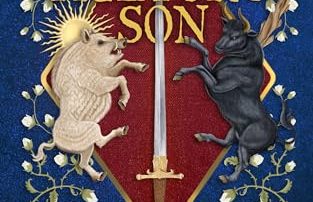
    Wendy Johnson, The Traitor’s Son (MadeGlobal Publishing 2024)

    https://www.goodreads.com/book/show/208871994-the-traitor-s-son?ac=1&from_search=true&qid=8uwQnrRbQ5&rank=1

    Beautiful Wars of the Roses bio-pic of Richard III as good guy

    Richard Plantagenet, later to be crowned the IIIrd, grows up in Baynard’s Castle. His brother Edward sees three suns in the sky, portents of a York victory.
    Fleeing Marguerite, the Red Queen, he and his brother George are sent to safety in the Low countries. He is driven by a desire to disprove the Red Queen’s slander that his father was a traitor.
    When Edward is crowned, everything changes—titles, palaces, ceremonies, servants, gifts. Yet new jealousies fester among the brothers York. Everyone is up in arms over the secret marriage to the Lancastrian widow Elizabeth Wydeville, yet Richard feels a surprising empathy. Edward’s court is ‘blighted by the stink of treason’.
    Entrusted to his cousin Richard Neville, earl of Warwick, he forms a bond, but his loyalties are tested. Will he support his royal brother or his cousin, later to be nicknamed the Kingmaker?
    This novel contains some beautiful time and place appropriate metaphors—his parting with Warwick is ‘as final as the raising of a drawbridge’. He remembers his father’s last embrace, ‘a sweep of heavy wool, breathing scents of oily leather’.
    Maligned by Shakespeare and by the Tudors, we tend to think of Richard III as a hunchbacked monster. Johnson’s Richard is honest, filial and eager to please as a child, struggles to keep his spinal condition secret as a youth and is utterly loyal to his brother king. Indeed, Johnson was one of the leading lights in the movement to rehabilitate Richard which culminated in finding his skeleton underneath a Leicester carpark in 2012.
    A wealth of information on the noble Yorks and Lancasters is available; Johnson adds subtlety and a personal touch, full of drama, free of info-dump. For all our familiarity with this history, Johnson’s puts personalities and emotions into the picture. The characters are sympathetic, especially Richard, and the mediaeval lifestyle well painted.
    This review first appeared in Historical Novels Review.

  • Review: Been There, Done That, Got the Scars

    Review: Been There, Done That, Got the Scars

    R. Frederick Gridley, Been There, Done That, Got the Scars (2024)

    https://www.goodreads.com/book/show/221912914-been-there-done-that-got-the-scars?ac=1&from_search=true&qid=Ea1ru0fSBT&rank=1

    Amusing real-life anecdotes about boating, diving and piloting experiences


    This is a collection of amusing short stories and anecdotes that really happened. They are based on the author’s experience as a boating enthusiast, diving expert, pilot, parachutist and electronics engineer, both military and civilian.
    Story titles like ‘Sideways at 70mph’, ‘Buckingham Oops’ and ‘Acetylene and Condoms’ give a bit of the flavour.
    Every story rewards you with some clever or adorable punchline ending.
    Not being a boater myself, some of the details were Greek to me (e.g. ‘5 miles off the 130 radial from page field’) but if you’re a pilot or boater these tales will ring true.
    If you’re ever in any similar situations, you could learn something here, too. You learn ‘Tree Landings 101’, for example, and how to make emergency equipment out of condoms.
    The tone is light, colloquial, a bit cynical, nevertheless maintaining a consistent youthful enthusiasm for life and its vicissitudes. The joy of the experience really comes through. The pace is non-stop as Fred gets himself in and out of sometimes life-threatening scrapes. But even if you don’t find potentially life-threatening situations amusing yourself, you can get a kick out of these stories.

  • Review: The Sentinel Athlete Conspiracy

    Review: The Sentinel Athlete Conspiracy

    Sharon Broome, The Sentinel Athlete Conspiracy (Inspiring Publishers 2024)

    https://www.goodreads.com/book/show/221872204-the-sentinel-athlete-conspiracy?ac=1&from_search=true&qid=g9FeFyqMDR&rank=1

    High-octane scientific thriller


    Michael’s jeep blasts through the security gate at a private airstrip in Morocco. Two jeeps are after him, and they have automatic rifles. Bullets are flying, clinking off the planes in the hangar, big explosion, and Michael is burned to a crisp.
    The man watching the drone video says, ‘Get me another list of top athletes.’
    One year later, in Brisbane, top archer Carmen is in a bad car accident. The man in the Armani suit says, ‘It’s done.’ Five other top athletes across the world have had equally devastating accidents.
    The International Sports and Wellness Centre in Morocco seems to offer miraculous recovery and retraining rates, but Dr. Andrew Christian’s ‘Sentinel Serum’ may be more than a miracle drug. Just what is behind the ‘Restricted Access’ door? Dr. Christian is a dastardly mad-scientist villain with evil plans for world domination.
    The action and the violence ramps up very quickly, as Carmen and the other athletes are roped into a nefarious conspiracy. The CIA is involved, too. They must thwart the doctor’s plans to make it out alive.
    Biochemical engineering provides a thrilling subject matter. It opens with a bang and quickly escalates to high-octane, super-violent action, with scarcely a moment to sleep or eat lunch, hardly a moment to breathe.
    The fate of ‘the Facility’ as well as the athletes’ lives are in the balance in a heart-throbbing ticking-time-bomb (literally) plot. The science bits seem (to me, at least, not being a biochemical engineer) to have been pains-takingly researched. I kept saying, ‘OMG’ as I read.
    Contains some pretty gory injuries and pretty shocking violence. Would make a fantastic James-Bond-Bruce-Willis-style Hollywood action movie.

  • Review: Undetected

    Review: Undetected

    Jeffrey Marshall, Undetected (Dog Ear Publishing 2019)

    https://www.goodreads.com/book/show/52123874-undetected?ac=1&from_search=true&qid=sZjHmdYn4h&rank=2

    Suzy is on the run, hiding out in a downscale motel in Nashville (hey, I’m Susie from Nashville. I think I know that motel), on her way to Little Rock. She’s recently buried her husband Avery, whom she killed. Now, she is married to Dean, Alex’s dad.
    Alex has trouble communicating with his teenage son Jason—not so much his daughter Jennifer.
    Alicia and her husband are getting a divorce. Brian is walking out of her life just like her mother Tina did 21 years ago. Her daughter Alison is defending her friend Suri against racist trolls on Facebook. ‘It must have been hard for you not to be able to talk to your mother like this,’ she says.
    Jennifer’s leg is badly hurt in a hockey game, and Suzy’s reaction to this tragedy is bizarre.
    Then one day in New York, Dean and Suzy are having lunch at the Ritz, and a woman comes up and calls Suzy ‘Tina’.
    Sally in Little Rock has kept up an email correspondence with Tina since they were 16, since the day Tina broke her tibia being chased by her drunken father.
    Alex and Jason help Dean clear out some boxes in the garage. They find an old obit which sets Alex on a mission to uncover his step-mother Suzy’s secrets. Alex meets another stepson, who admits he and his siblings grew up ‘like mushrooms, kept in the dark’.
    There’s a sense that this sort of thing could happen to any family. Time separates people, and you don’t always get the chance to check up on everyone. In this case, led by Alex, this family starts to put their heads together and figure out what’s going on.
    There is admirable attention to verisimilitude when it comes to the process of changing identities, murders going undetected, etc. I think it might have been more exciting if we’d had some kind of ticking timebomb. There’s a good build up of suspense, though, a drip feed of new information as each member of the family adds their own bit to the puzzle.
    Except for the prologue/chapter 1, which lets us know Suzy killed her husband Avery, it takes a few chapters to figure out what the book is going to be about. The snake on the (absolutely gorgeous) cover is a hint. By Chapter 11 we understand that it’s a mystery around Suzy’s identity or her past. The ending is not what you expect.

  • Review: The Cursed Shore

    Review: The Cursed Shore

    J. D. Davies, The Cursed Shore (Canelo Adventure 2024)

    https://www.goodreads.com/book/show/208903170-the-cursed-shore?ac=1&from_search=true&qid=hympTarn5j&rank=1

    Privateers, naval battles and the French Revolution—a story of huge scope


    This is a story of huge scope—the international and class relations between revolutionaries and bourgeoisie involved in the failed Quiberon expedition of 1795.
    Lord Wilden is summoned by the PM William Pitt. Would my lord favour an invasion of France to back the beleaguered royalists? His Majesty at Kew Palace is keen.
    Leonore Kermovant, having sent her husband to the guillotine, awaits at Château de Brechelean the return of the Vicomte, his brother Philippe. Despite her political leanings, she takes in a wounded Chouan royalist officer Georges Cozanet.
    Wilden is ashamed to find his crewmen are more seaworthy than him, and that is what wins the sailors’ respect.
    Philippe accepts captaincy of a privateer. He conflicts with the son of the ship’s owner, Heinrich fils, over his orders concerning a crewman Marcus Drever. A sealed letter from Heinrich père reveals a new mission, promising double pay, which the matelots vote to accept. The new mission takes Philippe to a remote island west of the Orkneys, sailing under the false colours of his birthplace, the new United States of America.
    But it seems the Heinrichs haven’t told the whole truth, and the mission ends unpredictably. Furthermore, Philippe finds in that remote place the man who murdered his Russian wife and child.
    Wilden enters Quiberon Bay aboard the captured Pomone, but squabbling in the ranks between the counter-revolutionary émigrés and the Breton Chouans leads to failure.
    The author’s expert knowledge on the 17th century navy informs his historical fiction. And yet it is the people who shine in this story. Their personalities, and their cultural assumptions about class, rank, revolution, are beautifully drawn. Even the ships have individuality. Many of the characters are historical, and the fictional ones are drawn from historical persons.
    Will appeal to fans of Hornblower and Poldark.
    This review first appeared in Historical Novels Review.