Tag: book-review

  • Review: Death by Placebo

    Review: Death by Placebo

    Nelson K Foley, Death by Placebo (San San 2025)

    https://www.goodreads.com/book/show/230821260-death-by-placebo?ref=nav_sb_ss_1_16


    The President needs a liver donor, live or dead
    The President (dictator) of (fictional near Eastern country) Balarutan, Viktor Rachmanil, needs a liver transplant. But the patient is a ‘self-destructive denier’ and an ‘entitled demander’. Drs Rybak and Romanchuk steel themselves for dropping the bombshell with a vodka.
    Going abroad for the op might have been an option, but Rachmanil is cautious about the power vacuum he’d leave behind. The only person he listens to is his press secretary Natasha, and his ferret Snowflake, is a constant companion.
    The search is on—for a live donor or a brain-dead donor. The hospital checks out his three children as possible donors, but there is a ‘problem’ with Danica. To find a dead donor, Rachmanil contemplates ‘seeking out a suitable donor in advance’. Marcus Trubila, a member of his security service, knows what he means.
    There is an international conference of liver specialists in Vienna, and the hospital hopes to recruit foreign talent for the surgery. Danica goes along and spends time with Dr Andea Mancini.
    I do like it when plot intricacies are spelled out a bit, but the fact that the President is looking for a liver donor is repeated too, too many times.
    There’s a great twist at the end.
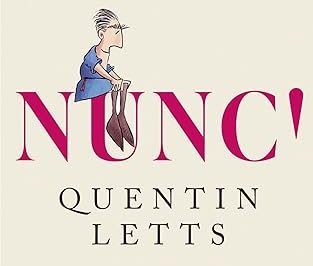
  • Review: Nunc

    Review: Nunc

    Quentin Letts, Nunc! (Constable 2025)

    https://www.goodreads.com/book/show/221179105-nunc

    This is a fictionalised retelling of ‘Nunc Dimittis’, ten verses in Luke’s Gospel about the elderly prophet Simeon who waited for the baby Jesus in the Temple. After declaring ‘mine eyes have seen thy salvation’, he can finally die in peace.
    2000 years ago, in Jerusalem, old Simeon’s wheelchair collides with a rubbish heap, providing entertainment for the occupants of Deuteronomy Square.
    It’s not plot-driven. Instead, we have a series of short stories, incidents in the lives of the inhabitants of the square, as Benjamin’s mule-cart takes us from place to place. The tone is not so much humorous as affectionate. The bits about Jesus are refreshingly devoid of the usual obligatory reverence (the magi following the star are ‘three blundering eejits’; the hiding of Joseph and Mary from Herod’s persecution is almost slapstick).
    I get the impression journalist-turned-novelist Quentin Letts, let off the leash from journalistic style constraints, is now free to use puns, emotive dialogue, juicy adjectives, colourful description, characterisation. The result is a flowering of creative expression. The characters are quirky and delicious. The settings are colourful, illuminated by almond blossoms, pistachio trees and bougainvillea. Artisans sell their aromatic wares, and merchants ply their trade.
    The blend of modern anachronisms and ancient Palestine is cute (‘Thanks, Mum, said Caleb in the voice teenagers have used since Noah’s flood’). We’re tantalised by first century intimacies (the ‘different types of Pharisee’; the problem of cleaning the Holy of Holies—‘when the high priest enters, you don’t want him smothered by cobwebs. The dust might set off his allergy’) and glimpses of people we will meet in the Gospels (that little boy next to Aretas’ verandah will grow up to crucify Jesus).
    Would also suit a YA readership. Non-Christians will love it, too.
    An adorable book, 6 stars, a real pleasure to read.
    This review first appeared in Historical Novels Review.