Tag: bible

  • Review: The Splendour Before the Dark

    Review: The Splendour Before the Dark

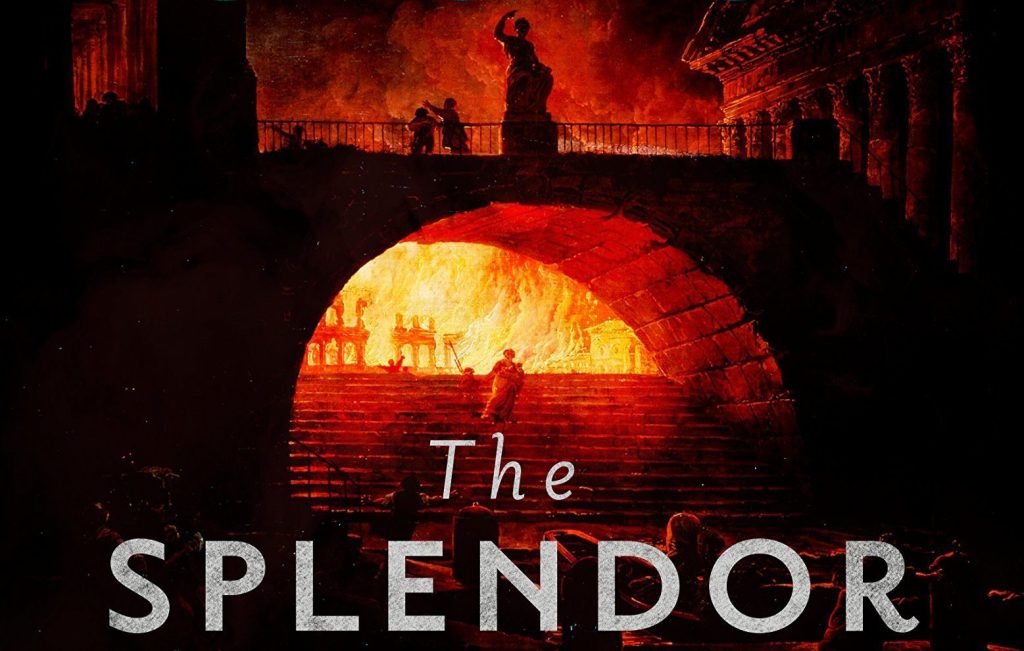
    Margaret George,The Splendour Before The Dark (MacMillan 2018)

    https://www.goodreads.com/book/show/42610157-emperor-nero?ac=1&from_search=true&qid=a10aegZt6C&rank=1

    The story of the musical charioteer emperor Nero, rehabilitated


    Nero awakes at his seaside villa in Antium. The previous night he had performed his epic on the Fall of Troy. He longs to be a professional musician or competitive charioteer. Alas, as his mother had finagled, he is emperor of Rome. The sybil at Cumae told him ‘fire will be your undoing’, but there’s no fire at the racetrack or the theatre. A messenger brings the news, Rome is on fire.
    A legend is going around that Nero had played his cithara ‘while watching Rome burn’.
    After the fire, Nero’s vision of a new city is realised. The construction of the Domus Aurea takes up a large part of the book. It would cost 22,000 million sesterces. He conceives the idea of selling citizenships to wealthy freedmen. Despite the emperor’s good efforts, he is blamed. So, they look for a scapegoat, and Caesar finds it in the writings and apparent confessions of the Christians. They go willingly to their martyrdom.
    Two events shake Nero’s happiness. He uncovers a broad conspiracy to kill him and replace him with Gaius Calpurnius Piso—the Pisonian Conspiracy. Some of his best friends are implicated. And his beloved Poppaea Sabina and unborn child die—George paints it as an accident.
    Contains a breath-taking account of a chariot race, including how it feels from the charioteer’s point of view.
    This presents a more hagiographic picture of Nero than I’m used to—even the relationship with the poor catamite Sporus is portrayed as consensual—apparently he castrated himself. Taking other liberties with the story, too, it veers considerably from the primary sources.

  • Review: Creating Christianity

    Review: Creating Christianity

    Henry Davis, Creating Christianity – A Weapon Of Ancient Rome (Independent Publishing Network 2021)

    https://www.goodreads.com/book/show/59829661-creating-christianity—a-weapon-of-ancient-rome?ref=nav_sb_ss_2_36

    The delicious Jesus-never-existed conspiracy theory

    This work develops the Jesus-never-existed conspiracy theory. It’s based on a conundrum all who have compared the works of Flavius Josephus and the New Testament can’t help but notice. The Gospels write about stuff that supposedly happened during Jesus’s lifetime, in the 30s, and Josephus writes about the same stuff happening during the Great Revolt, in the 60s. I mean, exactly the same. Davis lists over 44 parallels, and I myself have come up with more.
    The words and phrases used are almost word for word identical; the geography matches; even the body counts tally.
    To cite just two examples:
    In the story of the Good Samaritan, robbers stole the man’s clothes and goods and left him half dead. At Beth Horon, in Samaria, the rebels stole the legion’s mules, clothes and goods, and left them half dead.
    In the story of the Gadarene swine, Jesus casts out the demon named ‘Legion’, who hides in a tomb, into 2000 pigs who run off a cliff. At Gadara, a legion of Jews have a demonic (rebellious) spirit. The leader hides in a tomb. Jews are ‘swine possessed by demons’, they run off a cliff, 2000 are dead.
    Many chapters are devoted to arguing that the royalty of Rome and the royalty of Judaea were interconnected genealogically, but I do not find that scandalous at all. Royalty intermarried all over the place. I do not think this means, however, that writers of histories were using secret nicknames in order to obscure their familial connections. I certainly don’t think it implies, as Davis believes, that Flavius Josephus never existed because he was secretly Arrius Calpurnius Piso in disguise.
    I skipped over the chapters on onomatology (the etymology of names) because like gematria (numerology), you can manipulate letters or numbers to say anything you want. Using these wacky techniques ‘I am the Alpha and the Omega’ of Revelation 1:8 translates as ‘I am Arrius Calpurnius Piso’. I mean, really?
    If you’ve read Revelation you know the gospel writers were using some kind of code, but I don’t think this was it.
    Everyone in post-70 CE imperial Rome and Herodian descendants take on new pseudonyms, and it’s all great fun, but after a while, my eyes glaze over. If person x was secretly the same person as y—e.g. if Publius Clodius Thrasea Paetus and Gaius Calpurnius Piso and Caesinni Paeti were all names for the same person, then people would have to have had more wives and children and much longer CVs than Suetonius, Tacitus et al say they did. One can always invent fictional wives and children, or conceive that when Tacitus wrote x he really meant y, but it’s applying common sense to the CVs—would person x really have done what person y did?—that we start debunking.
    I’m crazy about ancient history conspiracy theories, especially ones that involve ‘Jesus’, like the ‘Bloodline of the Holy Grail’. This is similar. The Bloodline theory posited an imaginary Dagobert III, whose descendants supposedly carried the bloodline of Jesus and Mary Magdalene through the Merovingian kings.
    It’s rather specious to suggest that Josephus invented Christianity. This is the same man who devoted most of his writing to proving to his Roman and Jewish readers that Titus the destroyer of Jerusalem was the Messiah.

  • Review: A Palette of Magpies

    Review: A Palette of Magpies

    Soulla Christodoulou, A Palette of Magpies (Kingsley Publishers 2023)

    https://www.goodreads.com/book/show/197080981-a-palette-of-magpies?ac=1&from_search=true&qid=c7Ct51U78m&rank=1

    Painting the return back to joy

    Judith receives a second picture postcard, colourful watercolours—a pair of magpies, ‘Two for joy.’—no stamp, no signature. The first had been ‘One for sorrow’. An art teacher and collector, she admires the brushwork. Someone was watching her. Would her best friend Louise across the Cotswolds lane have seen anything? She didn’t ask the gossipy ladies at the post office.
    She’d left home young, after ‘the dreadful incident’. She inherited the cottage after her parents’ death, but retirement was boring until these cards started coming. Now, with endless time to paint, she has no inspiration. This is her ‘new timetable of life’, says Lou.
    Kerry remains locked in her room, grieving after a miscarriage. Judith had lost a child, too. She cheers her up with a basket full of paints. Judith forms the belief that the postcards are instructing her to give people joy.
    Another postcard. ‘Three for a girl.’ She identifies her next beneficiary—Maja, the depressed Polish teenager.
    ‘Four for a boy’. Next is the vicar and his unconventional family. Judith begins to take her own advice to ‘escape the unkind, hard-shelled chrysalis of [her] own making’.
    ‘Five for silver. Six for gold.’ Relationships among the villagers develop at the Summer Fête.
    ‘Seven for a secret never to be told.’ Old secrets are revealed, and something new happens in Judith’s timetable of life. Someone is determined to give Judith back her joy.
    Beautiful writing, languid life in a sleepy village, poignant and psychological, full of love. Judith notes: ‘Grief stay[s] with you, under your skin, behind your eyes, in your heart and in your thoughts.’ In (semi) retirement myself, I got into this protagonist. Her emergence from the chrysalis is profoundly satisfying.

  • Review: The Illustrated Book of Japanese Lore

    Review: The Illustrated Book of Japanese Lore

    Carson Siu, The Illustrated Book of Japanese Lore: Your Comprehensive Guide to Japan’s Rich Culture, Tales, Mythology, Festivals, Folk Art and Urban Legends (Kindle 2025)

    https://www.goodreads.com/book/show/237356356-the-illustrated-book-of-japanese-lore?from_search=true&from_srp=true&qid=1pcbmrSyXG&rank=2

    A comprehensive illustrated encyclopedia of Japanese lore

    The book is an encyclopedia, codified into kami (gods and goddesses), yōkai (spirits and monsters), yūrei (ghosts), folktales and legends, rituals, festivals and customers, folk art and symbols and urban legends.
    You will find in here absolutely every example of lore, from Momotarō to the 13th Floor, each listed with their names also in Japanese kanji and a manga-like colour illustration.
    Nothing in human ghoststories could be spookier than Japanese yōkai and yūrei, and each type has a specific name—Rokurokubi (stretching neck), Hitotsume-kozō (one-eyed boy monk), Kuchizake-onna (slit-mouth woman).
    Some of them derive from tales of females wronged in life or killed unjustly, like Okiku, the plate-counting girl, who in life was unjustly accused of losing her master’s plate and killed, destined throughout eternity to count for that tenth plate. Her counting ‘ichi-mai, ni-mai’, never reaching ten, drives humans mad. The enduring tales often illustrate Confucian or Buddhist principles such as good deeds bring rewards.
    Japanese ghosts are class-based, too. Goryō (honourable spirit) are haunted spirits of samurai and noblemen.
    Traditions like the Feb 3rd Setsubun are described, where people throw roasted soybeans (mamemaki) out the door, crying ‘Oni was soto. Fuku wa uchi’ (demons out, fortune in) and eat the same number of beans as their age.
    These aren’t just old-time legends. Contemporary internet virals like Backrooms and The Ring are also terrifying and play on modern-day Japanese horrors like loneliness and urban decay.
    And if you’re interested in further following the creature or custom in Japanese culture and history, each includes a paragraph on ‘cultural significance’.
    This would be a useful resource for people playing video games that feature Japanese anime figures. Each entry includes a paragraph on ‘visual and behaviour’ characteristics, which would be handy for defining RPG powers. Pick your avatar. I’ll take Bake-danuki (shape-shifting racoon) or Teketeke (vengeful torso) or Tābo Baachan (Turbo Granny).
    I lived in Japan during my twenties, and this book made me nostalgic. It’s educated me on a lot of things I saw then but knew little about at the time.

  • Review: The Shattered Truce

    Review: The Shattered Truce

    Donna Brown, The Shattered Truce (Starling Wood Press 2024)

    https://www.goodreads.com/book/show/219475967-the-shattered-truce?ref=nav_sb_ss_1_19

    A psychological olde-world tale of three families, a witch and a dragon


    Ebba and Hilda, prospective mothers-in-law, negotiate a betrothal between Elsa and Gareth, son of the chief who’d killed Annerin’s husband, who’d cast them out of March, a ‘poor little backwater clinging to a legend because it had nothing else’.
    Annerin tells the children the story of the sword with the black rose. Was it the lost sword of Glendorrig? No, the rose would have been red. I understood much too late that there were, in fact, three swords.
    Annerin urges Fran to speak his feelings for Elsa before the betrothal is official.
    Maya believes there is a dragon in the forest. Annerin encounters the beast and scares it away with the sword. Gareth is lying unconscious. Fran rescues them, but Annerin worries that no one will believe her. Gareth’s father Lukas clearly does not, and Fran raises the sword as if to defend his mother Annerin against the perceived threat. Ebba is afraid ‘blood will be spilt’.
    As old grievances coincide with new, it is the innocent who pay the price, and suspense heats up as Gareth and Fran both try to sort everything out ‘once and for all’.
    There is heavy backstory conflict between the families, which we are fed skilfully, bit by bit. Likewise, we learn the story of when Arete the witch came to the gate. And there’s some mystery about what’s in the ‘packet’. I love how it doesn’t tell us too much, waiting for the emotional impact to hit.
    I felt the dragon was a metaphor for the unspoken hostility, the ‘unfinished business [that] stalked March’. Only little Maya tells the truth. Then, the dragon, too, becomes a character involved in the drama.
    It’s well written, and once you get the hang of who belongs to which family, you get hooked into the drama.
    This is the Chronicles of Eruthin Book 1, and I’d love to read the sequels.

  • Review: By Force of Reason

    Review: By Force of Reason

    Stanley Sauerwein, By Force of Reason: A John Mason Thriller (Kindle 2025)

    https://www.goodreads.com/book/show/237846497-by-force-of-reason

    A Middle East cabal and an alliance of survivalists threaten the US power network


    Terry Hilliker sneaks into the University of Montana computer lab, inserts a thumb drive into the network. Jamal Hourani, a spy for the Al-Aqsa Martyrs’ Brigade, meets with representatives from Arab nations.
    Canadian CSIS agent John Mason and Janice are off to Washington. Major Boyd, Pentagon tech guy, tells them there’s a virus ‘cute as a button’ posted on the Internet which could bring down the country’s networks.
    Predrag is recruited by Hourani to head a new computer consultancy in Paris.
    The Montana Military Militia is upping its ops. The Power Grid, missile silos and petroleum refineries are all targets. Unfortunately, the bad guys are just as clever as Mason, and they run him a nail-biting chase.
    The conflict between the characters is vaguely set against a background of Middle Eastern political conflict. It’s well written, great pacing and suspense, full of set-backs and double-crosses. The ticking time bomb starts as early as chapter 45, hopping all over the globe. I love how the first strike is by low-tech weapons. I love the big stakes, and the government bigwigs seem realistic.
    I enjoyed examining the structure. Typical of a thriller, it begins with chapters from different characters’ points of view, then in subsequent chapters we learn how those characters connect, while learning motivations and stakes. By chapter 26 we’re still meeting new POV characters, which I found confusing, and the fast-paced plot leaves little time for character development. The dialogue is full of military and computer jargon, which is sometimes hard for a layperson to follow, but it sounded fantastic.
    I love the description of the Texas sunset as ‘stretching shadows long and mean’ and the metaphor ‘stir the pot and wait for the cook to come check the soup’. I love how the bad guys’ playing with ‘American paranoia’ and ‘the illusion of order’ is part of the scheme. Love the phrase ‘everything felt one button press away from wrong’—so Dragnet.

  • Review: Tales told around a Strange Fire

    Review: Tales told around a Strange Fire

    Bud Templin, Tales told around a Strange Fire (BookBaby 2025)

    https://www.goodreads.com/book/show/236380072-tales-told-around-a-strange-fire?ref=nav_sb_ss_1_32

    Other-worldly tales told around an other-worldly fire


    Though these stories are all different and are not connected in terms of plot, the scene keeps returning to the Firefeeders’ Fire, where workers throw cart-loads of ‘stuff’ into an other-worldly fire, and the stories they tell while they work. The ‘chapters’ alternate between a story around the Fire and a story told around the Fire. The final chapter finally tells us how the Fire started.
    These stories offer wonderful examples of good writing. A skilful, exciting style, and not same-y; each story is different. Different not only in content but in style as well. Superbly innovative ideas. I was impressed by the Intros of all these stories—the first lines and first paragraphs immediately hook you. Not only is the dialogue excellent, it conveys each character, each narrator brilliantly. I really admired the use of dialect to render the Voice of the old men in ‘Waitin on Satan’.
    I loved the metaphors: ‘makes Sodom and Gomorrah look like Sesame Street’, ‘truck horns, like the vanguard of a barbarian horde’, ‘strong and bad as a Tyrannosaurus Rex’, ‘he felt as grand as the Tetons, as lucky as Luciano’.
    I have loved ones who are hoarders, and all the references to cart-loads of ‘stuff’ was a bit triggering, not that it put me off the stories.

  • Review: The Client

    Review: The Client

    Kate Goss, The Client: A Domestic Psychological Thriller (Hylosis Publishing 2025)

    https://www.goodreads.com/book/show/231652804-the-client?ref=nav_sb_ss_1_15

    Who is that man beside you?

    Newly-weds line editor Natalie and film editor David have been fighting—fighting about money. Natalie has lost her biggest client, Alan, and the couple’s finances are strained. They have even lost their home. In between job searching, she works on her novel, but her confidence is shattered. She even begins to have doubts about David. Her dog Barley and her husband do not get along.
    Alan’s wife Amanda contacts her for information, and she learns that Alan hasn’t just ghosted her, he’s disappeared. For some reason, David is suspicious. Why had Alan been sending her travel pieces to edit, Amanda said he never travelled? A budding friendship with Amanda is stymied when Amanda accuses Natalie of ‘having an affair’ with her husband. That’s crazy, Natalie thinks, I’ve never even met the man in person, only emails.
    I chuckled at Natalie’s comment: ‘How was I to know he never published any of the work he sent me?’ Since 1998 haven’t we all immediately Google searched every name we come across?
    I thought the dog not liking David was a lovely bit of foreshadowing.
    For many chapters, nothing much happens, then about 62% in, you sense a twist is coming. At 73%, it hits, and Amanda’s bizarre accusations begin to make sense. The twist is satisfying. Can you really trust that man beside you?
    I didn’t, in the end, understand why Alan ghosted her.
    A really fabulous cover, except that it looks like a cat, and her pet is a dog.

  • Review: Man, God and the Man-gods of Antiquity

    Review: Man, God and the Man-gods of Antiquity

    Adamos Zagara, Man, God, and the Man-gods of Antiquity (Archway Publishing 2023)

    https://www.goodreads.com/book/show/192793592-man-god-and-the-man-gods-of-antiquity?ref=nav_sb_ss_1_56

    Hominids knuckle-dusted around for millions of years; then, comparatively suddenly, towns and civilisations appeared. Were the heroes in the Sumerian and Egyptian kings lists descendants of gods?
    As early as 5500 BCE in Mesopotamia, we began writing down creation stories, but they had been circulating orally for 1000s of years before that. The ancient ‘temple’ of Gobekli Tepe dates to at least 9000-9500 BCE. Why didn’t we write stuff down then?
    There were stories of a Great Flood. We know there was big one around 12,500 years ago when a sharp rise in global temperature melted ice caps (Zagara wrongly places the Biblical flood here—the Biblical flood dates more recently than that, probably 3600 BCE), with another dramatic global warming around 14,700 years ago. Hominids struggled during the intervening cold Younger Dryas Period, but they did not go extinct.
    Where is all this leading? By about page 28 I figured where we were headed: 6000-12000 years ago God meddled with our DNA, or it was aliens.
    The cited evidence reveals a metaphysical idealism approach, comparing dates of civilisation with dates of flood stories, yet neglecting to compare them with dates of agriculture, metallurgy.
    Zagara says that the Sumerians had it right. Man was created ‘to serve the gods’, neglecting to mention that that was what defined human to human relations back then.
    I agree with him on one point. The stories of ‘giants’ at the time of Noah could be our ancestors’ cultural memories of Neanderthals, who, yes, genetic research has proven, did mate with the daughters of men. And I am still attracted to the notion that pyramids were some kind of power-generating devices.
    A global catastrophe—such as an asteroid hitting earth, a supervolcano eruption—could happen tomorrow. Will we be ready? Will we ever see God?
    I love ancient history conspiracy theories, but for me, they need to be a bit better researched. There are all sorts of mysteries of the ancient world that are still unsolved, but it’s much more interesting to search for scientific explanations.