Tag: artificial-intelligence

  • Review: The Confessions of a Young Nero

    Review: The Confessions of a Young Nero

    Margaret George, The Confessions of a Young Nero, (Main Market, 2018)

    https://www.goodreads.com/book/show/63279259-the-confessions-of-young-nero

    Uneasy lies the much maligned head

    Young Lucius (Nero) is deposited age 3 with an aunt when Caligula exiles his mother. When Claudius comes to the purple, they are reunited, but the relationship is strained. He hears over and over that he is descended from the great Augustus, destined for something greater than happiness.

    When Agrippina marries Crispus, the boy is left for a while in the villa with his Greek tutors, and he experiences a period of freedom. He loves the cithara and chariot racing and everything Greek. He dreams of winning the cherished periodonikes, a victor’s crown in each of the four major Greek games.

    We see the setting and culture through the eyes of a youngster, enabling exposition without Telling through the protagonist’s viewpoint.

    With a title like The Confessions of… we expect that the book will be Nero owning up to all his sins. Did he really commit incest with his mother? Did he poison his half-brother Britannicus? It’s more a tale of justification. Nero is the narrator as well as the protagonist, so he can’t be expected to present himself in too bad a light.

    Lucius the boy Nero is utterly adorable, is respectful to slaves, does well in his schooling, obeys his mother, doesn’t use his high birth to influence unfair advantage at wrestling. Gradually, he gets an education. He witnesses his mother’s poisoning his beloved stepfather Crispus, her calculating seduction of Claudius. He’s forced to marry his sister.

    He struggles between two selves. ‘the Augustan one of public duties and Roman virtues and the Apollon one of music, art and poetry’, but where Mother comes into it, ‘a darker one emerges’.

    George says that Nero was much maligned, and unfairly so. According to this view, he was an artistic soul who was beloved by the people, if not the senators. Recently published non-fiction histories make the same point.[1] Our ancient sources—Tacitus, Suetonius, Cassius Dio—all had personal axes to grind and did not possess the modern historian’s propensity for factual truth. George’s Nero is a thoroughly nice guy, pushed into doing what he did by the debauched, corrupt, backstabbing environment he found himself in.

    The hagiographic portrayal continues in Book 2, Emperor Nero.

    If we are not chortling over the scurrilous gossip, if it’s to read fictional justifications of someone whom we know was guilty of at least some of the stuff he was accused of, is that interesting enough?


    [1] Thorsten Opper’s Nero: The Man Behind the Myth; Anthony Everitt’s and Roddy Ashworth’s Nero: Matricide, Murder and Music in Ancient Rome; Osric W Fenmere’s Nero biography.
  • Review: The Art of War

    Review: The Art of War

    Manda Scott, The Art of War, (Transworld Digital, 2013)

    https://www.goodreads.com/book/show/15799175-rome

    Rome 69 CE. The Year of the Four Emperors, treachery and intrigue around every street corner.

    Vespasian, our first narrator, is in his tent in Judaea. The spy Pantera has just foiled a would-be assassin sent by Vitellius’ brother Lucius. Vitellius had been ‘everyone’s second choice’ for emperor. Vespasian’s legions hail him Imperator. He sends Pantera to Rome to protect his son and his mistress.

    Centurion under Vitellius, Sextus Geminus, our next narrator, is promoted to the Praetorian Guards. He is ordered to kill Pantera, his friend Juvens ordered to kill Trabo.

    Trabo is the third narrator, like Pantera now an outlaw, a man loyal to the memory of Otho.

    Jocasta, ‘the Poet’, fourth narrator, summons Pantera to the house of Seneca’s widow. Both had been students of Seneca’s spycraft.

    Seven more narrators follow, each allied to one side or another. All these forces are intriguing against, spying on and double-crossing each other. All this is complicated, as Jocasta puts it: ‘Lucius thought he owned Trabo and Pantera thought that Lucius thought it while Pantera was the true owner. And I knew that Pantera thought so and was wrong.’

    There is a traitor close to Vespasian’s cause, and two different armies are marching toward Rome. There’s a price of eight sestertii on Pantera’s head as he plots sedition and subterfuge to bring Vespasian to power.

    The climax of the story, when Vespasian’s forces win him the throne, taking place, to add excitement, during the Saturnalia, is nail-biting.

    Central to the plot is the idea that there are organised ‘messenger networks’—of course, there must have been, and Scott recreates them in juicy detail. Complete with lists of undercover agents, hired assassins, under the table bribes, gutter boys all named Marcus whistling warnings from rooftops, passwords and call signs, secret letters in code, assassinated men’s heads in sacks.

    The head-hopping between narrators from chapter to chapter is confusing, but it does make the story seem immediate. We see the same scenes from multiple viewpoints.

    The five parts of this book are the five classes of spies as defined in Sun Tzu’s Art of War: local spies, internal spies, double agents, doomed spies and surviving spies.

    I was impressed that each of Scott’s four books in the series have slightly different structures. Some are third-person omniscient, some narrated. One is mostly soldiers and battles; another is mostly spies and secret messages. All are characterised by beautiful writing.

  • Review: The Eagle of the Twelfth

    Review: The Eagle of the Twelfth

    Manda Scott, The Eagle of the Twelfth, (Transworld Digital, 2012)

    https://www.goodreads.com/book/show/12515759-rome

    Demalion of Macedon and the Eagle standard, beautiful writing about ancient Rome

    Feb 57 CE, Hyrcania on the Caspian Sea. The Vth Macedonica faces Vardanes II and seventeen client kings. Demalion of Macedon, our narrator, clerks for Sebastos Abdes Pantera, his commander. Pantera shoots an arrow killing Vardanes, allowing Vologases to reclaim the throne of Parthia. Pantera gets Demalion and Cadus promoted to positions in the XIIth.

    They dye their tunics with madder to mark a successful training manoeuvre in the mountains, giving their cohort a nickname, the Bloody First. They come under the command of Corbulo, governor of Syria, a good leader; then Lucius Caesennius Paetus, governor of Cappadocia, a poorer one. Paetus sends them into a Thermopylae-like defeat at the Battle of Rhandeia.

    Book 2 left us breathless with a new king of Israel anointed and Roman legions on the march.

    Now, Demalion and the disgraced XIIth suffer another devastating defeat at Beth Horon in Judaea under Cestius Gallus, another poor general. What’s worse, the rebels have stolen their eagle standard, the symbol of their military pride. Retrieving it is almost more important than victory.

    Three-fourths of the book follow Demalion’s military life, then the last fourth brings Pantera back into the story. I found this disjunct a bit disconcerting, and after all those pages, we’d forgotten Pantera’s motivation.

    As with the first two books, Scott crafts the known history into an entirely new plot, with deep understanding of the culture.

    I’m not normally a fan of ‘military fiction’, but the gorgeous writing makes it worth it, full of drama and emotion, like: ‘looking down on to the tops of their helmets… they seemed to ooze towards us, thickly, like so much mercury poured into a dish; a river of shimmering metal, dancing under the sun’; ‘the parade ground did not so much rock to our entrance as titter, and it was clear that at night we would be cold for lack of men around us.’ I loved Pantera’s assessment of Britannia, ‘a swamp surrounded by sea and full of women who fight like harpies’.

    I’m excited to finally find a historical novel about the Jewish Revolt, albeit, unlike my novel,[1] one from the Roman point of view.


    [1] The Lost Wisdom of the Magi

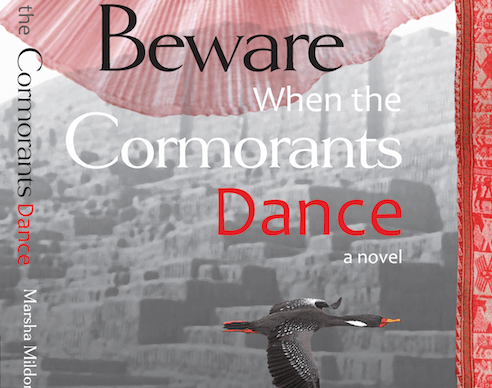
  • Review: Beware When the Cormorants Dance

    Review: Beware When the Cormorants Dance

    Marsha Mildon, Beware When the Cormorants Dance, (2025)

    marshamildonwriting.ca

    A vibrant archaeology mystery story, and a marinera dance

    Carlos is loading his horse Kuntur into the trailer to chase his dream of winning the National Marinera Championship in Trujillo, while Kelly films them for a documentary. His mamá Rosa worries—so far away from their safe mountain hacienda in Mayutambo. She’ll be dancing again. She has an archaeology doctorate now, but did five years for ‘terrorist offenses’ in the past, and policía might still be looking for her.

    As red-legged cormorants fly overhead, Atoq excavates the ancient Huaca del Llutas (Pyramid of the Birds), recently damaged in the El Niño floods. He hates Mamá’s brother Tío Joaquin, but likes the money he pays him for recommending places to dig, wants to give some to Mamá for his sick baby sister. Atoq has a secret tunnel Tío doesn’t know about. He finds a portrait pot, sells it to Carlos.

    Rosa goes to consult Dr Espinoza in Lima about the pot, Kelly filming. There’s a mystery around that huaca, and there’s something peculiar about the portrait pot, and the archaeologists take time away from the marinera festival to solve it.

    Facing aggro from evil Tío and Rosa’s old nemesis Judge Nuños, Rosa, Kelly and especially Atoq, truly—dance outside the bounds of their comfort zones, into a future their ancestors would have been proud of.

    As well as the vibrant story, which alternates between the dig at the huaca and the competition in Trujillo, we learn all about pre-Columbian ceramics and archaeological ‘looting’ and forgery, and the marinera dance. I loved the factoid that ‘chicken manure does the best job of making ceramics look old’.

    We are immediately hooked into the characters and their world. I loved Rosa’s anger ‘Money doesn’t whiten indigenous people’ and Atoq’s assessment of the archaeologist’s work, ‘steal[ing] things our ancestors left for us’.

    The descriptions of the settings are beautiful—the ‘brilliance’ of the light near the equator. The details of the culture are wonderful—the querencia, the place in a bull ring the bull keeps returning to. You can just taste the alfajores and chicha. Passionate love for Peru shines through this novel, as with Mildon’s Book 1, Dance Me a Revolution.

  • Review: The Coming of the King

    Review: The Coming of the King

    Manda Scott, The Coming of the King, (Transworld Digital, 2011)

    https://www.goodreads.com/book/show/19183790-rome

    Christian legend and Jewish history in a new, surprising plot

    Saulos convalesces among the Berbers after the Fire, the skin on his burned feet growing back. He plots revenge on ‘the entire Hebrew people’. He brings Iksahra to Caesarea, accompanied by her cheetah and four hunting birds, to tend King Agrippa (II)’s beasts.

    Pantera arrives with Mergus. The message-birds had told them Saulos was travelling, and he knows they are. They travel with a Sabaean camel train, looking to sell their beasts to Yusaf ben Matthias.

    Hypatia has a gift for Berenice from Poppaea.

    The story brings the enmity between Pantera and Saulos from Book 1 to Judaea. The task at hand now is to save Jerusalem. Syrians and Hebrews riot nightly over the issue of a synagogue. Rebellion is in the air.

    The references to Christian legends and names and events from Jewish history—Yusaf ben Matthias, Menachem ben Jehudah, Ananias ben Ananias—are tantalising, and they are crafted into a new, surprising plot.

    Secret letters in code, graffiti symbols scratched into stone, passwords and countersigns, oracles and prophecies, message-doves intercepted by hunting falcons, tunnels with listening spaces inside palace walls—the plot is full of intrigue and drama. It ends on a cliffhanger, leaving us certain to buy Book 3.

    The intricate cultural detail and subtlety of writing pulls you in. The understatedness of the language makes it sound believably ancient.

    Beautiful writing: ‘[She] smiled at them covertly across the sea of strangers’ faces, and their smiles, covertly returned, had felt like splashes of colour in a grey winter’s day’; ‘a certain kind of individual, having met Pantera, was inclined to follow him closely, if not out of desire or admiration, then in the understanding that where he went, life was always interesting.’; ‘he was walking round and round the gold like a hen who has hatched her first egg and found she has given birth to a harpy.’

  • Review: The Emperor’s Spy

    Review: The Emperor’s Spy

    Manda Scott, The Emperor’s Spy, (Transworld Digital, 2010)

    https://www.goodreads.com/book/show/6940527-rome

    Historical thriller with fabulous characters set in Nero’s Rome

    Sebastos was twelve years old when he discovered his father was a traitor. The almonds were in bloom. He watched from a rock as his father the decurion led the three Hebrew women to the tomb. A rabbi and a Galilean Sicari followed.

    ‘He’s alive,’ the women reported to them. The Sicari produced silver from his purse.

    ‘The Galilean was everyone’s hero, even though he was an enemy.’

    Pantera bears scars from his time in Britannia. Sent to battle Boudica, he instead joined the rebels.

    A grubby urchin named Math watches the people off the ship in Coriallum and their belt-pouches. Math is apprenticed to Ajax the charioteer, and dreams of becoming a driver; he is mothered by Hannah the healer. He has been paid an entire sestertius to follow a man, oak-brown hair, eyes the green-brown colour of a river—Sebastos Abdes Pantera.

    With an entire denarius, Pantera and the philosopher Seneca turn the boy to spy for them. There is a Sybilline prophecy, predicting that Rome will burn.

    The entire Green chariot-racing team is taken to Alexandria, then Rome, to run for Nero.

    The characters are from all corners of the empire. It was especially juicy to recognise some from Christian legend—the Galilean in the tomb, Saulos the Idumaean, Shimon the Zealot, the Sicari. They are twisted brilliantly and unexpectedly into the story of the Great Fire.

    The writing is beautiful, subtle, with gorgeous metaphors like ‘Nero’s progress was that of a scythe through corn, leaving untidy rows felled in his wake’; ‘his hair…. was the white of old snow as it rots in spring, flat and greyly stained with the colours of his earlier life’. Scott demonstrates wonderful knowledge of the ancient Roman world; tantalising details are woven into the scenes, things I had not known before.

    It’s hard to believe anyone ever dared write another novel about Nero’s Rome after this one.

  • Review: Forgiving Nero

    Review: Forgiving Nero

    Mary Ann Bernal, Forgiving Nero, (‎Whispering Legends Press, 2021)

    https://www.goodreads.com/book/show/57097873-forgiving-nero

    The story of two star-crossed romances, with some liberties taken with history

    (The fictional) Traian Aelius Protacius, guards the boy Lucius (Nero), sent to live with his aunt Lepida during the rule of Caligula while his mother Agrippina is in exile. Attending the boy is slave woman Vena, a secret Christian, to whom Traian is attracted.

    Nero asks for a tutor to teach him the lyre (cithara). He performs for the children of slaves and freedmen. He longs for a world where he can play his music and marry Acte, but Agrippina sweet talks Claudius into betrothing him to his daughter Octavia, Nero’s adoptive sister.

    Seneca tutors him in other studies. Paul of Tarsus visits Vena’s Christians.

    This is the story of two star-crossed romances. Nero can’t marry Acte because his family demands his dynastic marriage to Octavia. Traian marries Vena, but it must be in secret due to her class as slave.

    It twists history as we know it on quite a number of points: treats Octavia as in love with Nero (they hated each other); Nero’s music as proficient (his talent was described as mediocre); Nero trusts in his mother’s goodness (he banished her to rid himself of her influence and had her murdered); Camulodunum is a picture of peaceful assimilation (the Boudicca revolt showed, viscerally, how much the British tribes hated the invaders); Claudius is killed by his wife giving him poisoned mushrooms (that was Augustus); Britannicus is killed by poisoned water (it was hot soup that was cooled down by adding poisoned water); Domitius Ahenobarbus is some guy who gives Nero a villa (he was his biological father); Acte wants to be empress (Nero’s interest in her was already replaced by Poppaea by the time he rid himself of Octavia); Acte is interested in Christianity (that was Poppaea, who was interested in Judaism); Domitia Lepida generously offers her villa to Acte (there seems to be no reason for inventing this in either woman’s character arc); Agrippina burst through the curtains of her hidey-hole onto the Senate floor, shouting what was to be done (this was too outrageous even for Agrippina); Poppaea suddenly gets a brainwave that she needs to bear Nero a son (everyone would have known that the emperor needed an heir); Nero rejects proposals by midwives to perform a Caesarean section in order to save Poppaea’s life (Lex Caesarea prohibited performing the operation unless the mother was dead or dying, and the mother was not expected to survive).

    I don’t mind non-historical invention in historical fiction, but there should be some point to it, some reason for the storyline to be different from what we are familiar with. This history is juicy enough without outright inventing stuff.

    The alternating references to the emperor as Lucius or Nero are confusing. I get it that he changed after becoming emperor, but he should be referred to by one name in each timeframe.

    The writing style tends to the Telling rather than Showing, the dialogue quite stilted. For such a familiar story, we really need the writing to offer something special. It gets poorer as the pages progress.

  • Review: Tyrant

    Review: Tyrant

    Conn Iggulden, Tyrant, (Michael Joseph, 2025)

    https://www.goodreads.com/book/show/220160369-tyrant

    Nero’s rise, from his mother’s wedding to her murder

    On the emperor’s wedding day, Praetorians smash into the home of Junius Silanus Torquatus, accusing him of incest with his sister. He is Agrippina’s first persecution. She aims to wipe out the bloodline of Augustus. Claudius is officially adopting her son Lucius (Nero).

    Nero and his friends torment their tutor to death with a wasp’s nest. He gets a whipping and a new tutor—Seneca. Agrippina gets Rufrius replaced as Prefect of the Praetorians by her favourite Burrus. The slaves address her as ‘empress’, and she calls herself ‘Augusta’ on coins. Nero dons the toga virilis, a year early, but his virilis ceremony is dominated by the whispers over his mother’s self-appointed title.

    Agrippina sweet-talks Claudius into betrothing Nero to Octavia, his sister by adoption.

    Nero is crazy for chariot-racing. He’s the son of Ahenobarbus, after all. At the races, he is smitten by the pale-skinned Greek freedwoman Acte. With Claudius away in the provinces, Nero sits some legal cases, with some wisdom. Among them are some Jews, followers of Iesus.

    Agrippina poisons her husband just in time to raise her son. Nero comes to the purple and sends his mother to live in Misenum.

    My favourite feature of Iggulden is the relationships. The dialogue on Nero’s and Octavia’s wedding night is heart-breaking. The conversation between his friends and him at the mock naval battle is full of psychological intricacy. The relationship between him and his mother is complex.

  • Review: Nero

    Review: Nero

    Conn Iggulden, Nero, (‎Penguin, 2025)

    https://www.goodreads.com/book/show/198344721-nero

    The story of Nero’s origins, surviving three emperors and a horrible family

    Barbo (Gnaeus Domitius Ahenobarbus) is readying his team of horses to ride for Rome. His wife (Agrippina), though pregnant with his child, finally, after nine years of marriage, hates him.

    Sejanus is before Emperor Tiberius, pleading for his life. The corrupt prefect is thrown down the Gemonian stairs. Tiberius is dying.

    Gaius (Caligula) takes his sister Agrippina by the arm, a bit too roughly. He wants to reminisce about their childhood, when he was happy. He seems scarred from his years on Capreae. The last living heir to the throne, he senses enemies all around him.

    Caligula becomes emperor and wants his sisters by his side, to the dismay of their husbands. His megalomania increases by the day, until finally he pushes the Praetorians too far, and they assassinate him, choosing Uncle Claudius to replace him. Eventually, Agrippina gets her hooks into Claudius, and Nero becomes the emperor’s stepson. Nero’s relationship with his mother is strained from the beginning.

    The only thing I didn’t like about this novel was the title. Lucius (Nero) is a child, shoved off into adoption in the slums; he survives three emperors and doesn’t re-enter the story until page 197.

    The characters, monsters to a man (except Claudius, who is at least smart), are all believable, the intricacies of relationships are handled with subtlety, and the dialogue is good. We know them from history, but here we know them personally. We see the invasion of Britain also from the British tribes’ point of view.

    The women are equally vicious, though more sympathetic. Messalina, upon Claudius’s inauguration, ‘pressing her hands together over her womb, like a little girl waiting for presents’. Agrippina, upon seeing her son again after her imprisonment, ‘her hands opening and closing like flowers at her side’.

    I never tire of hearing the story of Rome’s emperors, and Iggulden tells it well.

  • Review: When the Walls Fell

    Review: When the Walls Fell

    M. Hadassah Wells, When the Walls Fell, (‎School of Hope Publishers, 2025)

    https://www.goodreads.com/book/show/239223215-when-the-walls-fell

    This book tells the story of the legendary* ‘fall of Jericho’, closely following the Book of Joshua.

    Rahab the harlot plies her trade in the streets of Jericho; her heart beats. The Israelites are coming; their God ‘burned mountains, cracked seas, and swallowed cities in silence’.

    Joshua is outside his tent in the camp at Shittim in Moab, remembering his leader. Moses was dead. But Joshua hears the command of the Lord, too. He sends two of his men, Salmon and Haziel, to scout. Rahab lets them in. She lets them down the walls with her scarlet cord.

    ‘The broken idols piled like refuse… stone shoulders chipped, heads shattered, empty sockets staring at the sky’ provide a gorgeous metaphor for what is soon to befall Jericho—to be defeated by the one true God.

    Suspense for the big tumblin’ down moment is built by going through the arguments Rahab has with her family and neighbours, as she becomes a kind of spiritual leader for her community. I’m not a Christian, but the theology here seems sound. Within and without the walls, people are measured by whether they believe. ‘It won’t be the walls they fight,’ Rahab warns her brother, ‘it will be our hearts.’

    Loved: ‘His fingers twitch like they still crave gold’, ‘And Rahab, the woman no one respected… stood in the moonlight and waited to be remembered’, ‘You’ve waited forty years for this’, ‘smoke rising in ribbons that braided into the pale sky’.

    It’s beautifully written. Christians will find the expressions of the triumph of faith thrilling, but non-Christians, too, can appreciate this epic tale. The settings are beautifully described; the culture and way of life of the Late Bronze Age Levant comes alive. The characters have fully-formed arcs, and it’s full of emotion.

    It is not the right time after the year we’ve had to be celebrating victories of the Israelites, whether legendary or historical. Just tell yourself—it’s a great story. I loved it.

    * (and, incidentally, completely fictional, according to the archaeological record)