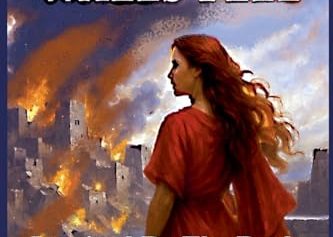
M. Hadassah Wells, When the Walls Fell, (School of Hope Publishers, 2025)
https://www.goodreads.com/book/show/239223215-when-the-walls-fell
This book tells the story of the legendary* ‘fall of Jericho’, closely following the Book of Joshua.
Rahab the harlot plies her trade in the streets of Jericho; her heart beats. The Israelites are coming; their God ‘burned mountains, cracked seas, and swallowed cities in silence’.
Joshua is outside his tent in the camp at Shittim in Moab, remembering his leader. Moses was dead. But Joshua hears the command of the Lord, too. He sends two of his men, Salmon and Haziel, to scout. Rahab lets them in. She lets them down the walls with her scarlet cord.
‘The broken idols piled like refuse… stone shoulders chipped, heads shattered, empty sockets staring at the sky’ provide a gorgeous metaphor for what is soon to befall Jericho—to be defeated by the one true God.
Suspense for the big tumblin’ down moment is built by going through the arguments Rahab has with her family and neighbours, as she becomes a kind of spiritual leader for her community. I’m not a Christian, but the theology here seems sound. Within and without the walls, people are measured by whether they believe. ‘It won’t be the walls they fight,’ Rahab warns her brother, ‘it will be our hearts.’
Loved: ‘His fingers twitch like they still crave gold’, ‘And Rahab, the woman no one respected… stood in the moonlight and waited to be remembered’, ‘You’ve waited forty years for this’, ‘smoke rising in ribbons that braided into the pale sky’.
It’s beautifully written. Christians will find the expressions of the triumph of faith thrilling, but non-Christians, too, can appreciate this epic tale. The settings are beautifully described; the culture and way of life of the Late Bronze Age Levant comes alive. The characters have fully-formed arcs, and it’s full of emotion.
It is not the right time after the year we’ve had to be celebrating victories of the Israelites, whether legendary or historical. Just tell yourself—it’s a great story. I loved it.
* (and, incidentally, completely fictional, according to the archaeological record)
 Susie Helme
Leave a comment