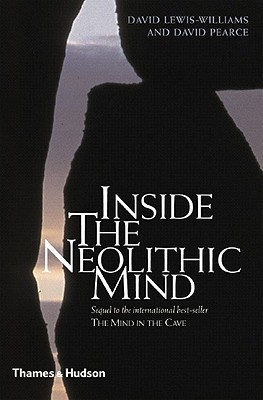
David Lewis-Williams and David Pearce, Inside the Neolithic Mind (Thames & Hudson 2005)
https://www.goodreads.com/book/show/967815.Inside_the_Neolithic_Mind?ref=nav_sb_ss_1_25
This is the book I have been waiting for. Finally, an explanation of stone circles and cave art that makes sense. I’ve heard explanations from stupid to stupider. The red handprints were people planting their mark ‘I wuz ‘ere’ or letting their kids muck around with the paint while they drew bison.
No, this book says, they were representations of early humans’ spiritual experience, attempts to portray altered states of consciousness and get closer to god. That’s why the horses seem to be floating in air; they were paintings of the horse’s spirit animal. That’s why the bison are sometimes left half finished, as if they’re crawling out of the wall; the wall was seen as a membrane into the spirit world.
This ‘neuropsychological model’ explains the ubiquity of designs—spirals, lozenges, zigzags, cups and rings. It could be that the descendants of Palaeolithic artists in France migrated into Britain, learning megalithic architecture and artistic norms from their ancestors. Or the artists were painting or carving from a similar experience as that of their forebears, one that is hardwired into homo sapiens’ brains, sometimes aided by hallucinogens or other means of altering consciousness. In fact, subjects in altered states of consciousness under laboratory conditions have produced similar images.[1] Or it could be, I think, a bit of both.
This explains the abstractness, the mishmash of images, why there is no overall composition. They weren’t creating an artwork to be viewed; they were depicting an experience. Much of this is in places too inaccessible for the whole midwinter solstice crowd, deep inside dark passage tombs; it would have been the purview of the shaman or seer.
It follows an idealistic analysis, proposing that religious ideas preceded the material realities and social relations they expressed. Clearly, humans had religion before they developed agriculture, as Göbekli Tepe shows. Aurochs (wild bulls) were important in Neolithic religion before the domestication of cattle. But I think any argument that ideas precede realities is illogical (and unMarxist). But that is my only criticism.
It does not examine astroarchaeology (the alignments of stone circles toward solstices), but that is not a criticism. Other books do that. In the light of this analysis, however, I have revised my view of stone circles as ‘calendars’. Their import was probably more religious than as date predictors. The purpose was more to convey the consistency of the cosmos and to symbolise the stability provided by the rule of the religious elite—as above, so below.
The book analyses in detail major Neolithic sites in the Near East and British Isles. With B/W drawings and colour photos.
Richly scholarly, densely footnoted. It explains complex philosophical concepts quite cogently (though with some big words).
[1] See Fig 64 p 262.
 Susie Helme
Leave a comment