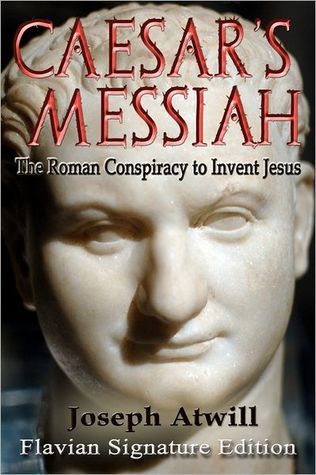
Joseph Atwill, Caesar’s Messiah (Ulysses Press 2005)
This is an interesting exposition of the Jesus-Never-Existed (JNE) conspiracy theory.
Anyone who has compared the works of Flavius Josephus and the New Testament can’t help but notice. The Gospels write about stuff that supposedly happened during Jesus’s lifetime, in the 30s, and Josephus writes about the same stuff happening during the Great Revolt, in the 60s. Exact parallels, even the same words and phrases are used. What’s going on here? There are at least 115 parallels between the Gospel stories of Jesus in the 30s and Josephus in the 60s. It is very tempting to believe that one of them must have copied from the other.
Atwill’s answer is—a big conspiracy. The Romans (specifically, their adopted historian Flavius Josephus) invented Christianity as a big con game.
Typical of conspiracy theories, the basic idea is, on the face of it, credible—it just sounds like something ‘they’ would do. But when you get to the detail, all sorts of silliness ensues. Motive, also—according to Atwill it was either to ‘tame messianic Judaism’ or to ‘prove how clever they were’—is silly.
The puzzles are ‘solved’ by means of ‘typology’ (peshers) to transfer one story to another to show the hand of God at work. The parallels between Jesus and Titus begin with vocabulary—the word for gospel is ‘euanggelion’ (good news), the same word Titus uses for his military victories—continuing through to dating according to the ‘70 weeks of Daniel’.
That the Flavians and the Herodians may have mixed genealogically is highly credible. Royal families intermarried all the time, and Herod the Great was keen on marrying kings of the neighbouring ‘Nations’ with his daughters and granddaughters. For generations, Herodian princes had been educated in Rome side by side with the Caesars. Princess Berenice was infamously the long-time mistress of Titus. After the destruction of Jerusalem in 70CE, the entire Judaean royal family moved to Rome, and the reading of post-war brides of various noble Romans as descendants of Herod the Great is more than reasonable.
Unfortunately for these juicy-sounding hypotheses, the Arria the Elder and Arria the Younger, proposed by JNE as being Herodian descendants, had well-attested Roman pedigrees.
The parallels are really remarkable. I do not subscribe to this theory, however. I believe the concurrences can be understood as the authors referring to a common cultural and literary tradition. The evangelists and Josephus all had cultural memories of the war and were party to myths and legends which circulated at the time, a number of which involved characters named Jesus.
 Susie Helme
Leave a comment