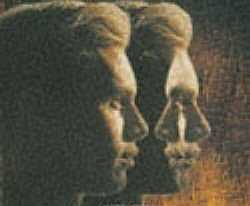
Ken Follett, The Third Twin (MacMillan General Books 1997)
https://www.goodreads.com/book/show/92373.The_Third_Twin?ac=1&from_search=true&qid=6RcMVplLNA&rank=1
Pacey technothriller plays with the dramatic possibilities of DNA manipulation.
Genetics researcher Jeannie discovers two genetically identical twins, born to different mothers, Steve, a law student, and Dennis, a murderer. She finds evidence of a conspiracy involving a biotech company, big politicians and her own university.
Intriguingly, we begin inside the point of view of the murderer, as he rehearses his cruel fantasy.
Biotech CEO Berrington, Jeannie’s boss, is trying to talk his partners Preston and Jim into accepting a takeover bid. They want to make perfect genetic babies for the rich and sterilise the poor. Jim wants to run for president.
Stephen’s mother swears he was not adopted. When Jeannie’s colleague Lisa is raped, Stephen becomes a suspect. In real life, I think maybe Stephen would have been exonerated by examining his hands for lack of evidence of setting the fire, but for dramatic purposes, he is fitted up due to his DNA matching the perp’s.
This mystery of the identical twins whose mothers claimed natural births could be explained by a switcheroo in the maternity ward. Or IVF implementation of two different women by semen samples from the same donor.
For his own nefarious reasons, Barrington is trying to quash his own company’s study. He intentionally gets Jeannie in trouble by leaking her project to the press. They get the idea that Jeannie’s study involves ‘accessing medical records’ and raise a hue and cry over her ethics.
I feel sure that a big-name author like Ken Follett would do his research, but there were so many details where I wondered whether or not they match reality. Do police really interview criminals in front of other criminals? Do they really tell suspected rapists the address of their alleged victim? Would a rape victim be emotionally capable of interviewing her rapist’s identical twin? It would certainly be unethical in real life for the researcher to begin dating one of the study’s subjects.
However, I loved all the details about DNA analysis.
Although this was back in the age of floppy disks when computer science was less advanced, the riddle of the identical twins whose mothers didn’t know is solved by a technological innovation that was brand-new back when this was written.
Well-structured and exciting, but Follett is not of the ‘less is more’ school of writing. We get every detail–down to what type of car everyone drives.
 Susie Helme
Leave a comment