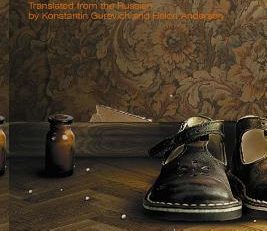
Pavel Sanaev, Bury Me Behind the Baseboard (1996, this edition CreateSpace Independent Publishing Platform 2014)
Eight-year-old Sasha introduces himself thus: ‘My mother abandoned me for a blood-sucking midget and hung me around Grandma’s neck like a god-awful heavy cross.’
Grandma alternates between horrible verbal abuse—Sasha ‘stinks’ and is a ‘bastard’, destined to ‘rot away’ before he is 16—and excessive suffocating attention—she picks the seeds out of his grapes; he has to stand on a chair while dressing so his feet won’t get cold and wear woollen tights even in bed; he has to take homeopathic pills; and Grandma is terrified that he might sweat. He is taken to the doctor more often than school. According to Grandma, he has maxillary sinusitis, golden staph, colitis, chronic pancreatitis and intracranial hypertension. He has to take Ephedrin, Conium, colloidal silver, albucid and olive oil.
She says Grandpa will ‘rip out his arms and legs’ if he goes to play at the MREC again. Grandpa, however, is fully hen-pecked and depressed over his situation, unable to escape the harpy’s tongue.
All Sasha lives for is to see Mom, a rare occurrence. She has taken up with a boyfriend, whom Sasha is encouraged to view as an ogre. And fighting with Grandma takes up so much of the time he is allowed to spend with her. When he dies, he wants to be buried not in the cemetery, which frightens him, but behind her baseboard, so he can always see her.
The child’s-eye view of Sasha’s Voice is adorable. It’s Russian, but not overbearingly so and funnier than Dostoyevsky, containing some dream-like magical realism bits.
The truly insane behaviour of Grandma is told through the helpless eyes of the child. I have seen behaviour/parenting like this, which I term ‘crazifying behaviour’, and I’ve struggled to effectively represent it in writing. This parenting style is so crazy that I think Sanaev’s open-eyed, innocent approach is the only way to portray it. This approach stands back, uncommenting, and allows the reader to exclaim, ‘OMG, how insane!’
Though happily Sasha is eventually rescued, it kind of ends with a thud.
It is written in a distinctive style and has been beautifully translated by Konstantin Gurevich and Helen Anderson. The original publication apparently sold over a million copies in Russia, won literary prizes in Russia and Italy and was made into a movie in 2009. It won first in World Literature Today’s November 2014 readers’ poll ‘25 Books That Inspired the World’. This review first appeared in Reedsy Discovery.
 Susie Helme
Leave a comment