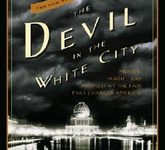
Erik Larson, The Devil in the White City (Crown Publishers 2003)
https://www.goodreads.com/book/show/397483.The_Devil_in_the_White_City?ref=nav_sb_ss_1_27
Two men, an architect and a serial killer, find their fates linked at the great Chicago World’s Fair of 1893.
Daniel H Burnham, designer of famous buildings like Washington DC’s Union Station, and his partner John W Root are tasked with designing a fair that would rival Paris’s 1889 Exposition Universelle, symbolised by the iconic Eiffel Tower.
One challenge was building on top of soil so soft they called it gumbo, with a bedrock 160 feet down, too deep for human workers. There was a constant conflict between the desire to make the fair grand and beautiful and the drive to save money.
In the same city, at the same time, while Jack the Ripper was on the rampage in London, Holmes began construction of a building—‘the castle’—which would include a purpose-built torture chamber in the basement.
Holmes opened a pharmacy on the ground floor of his new building, and his female clerks and supposed wives kept disappearing.
Problems arose with the White City. Opening day was lacklustre, with poor weather, unfinished exhibits, the Ferris Wheel half-finished and buildings and attendance below target.
Holmes opened his torture building as a hotel, where numerous young women seem to have checked out without paying. He promised marriage to Julia, now pregnant, but instead bumped her off, selling her cadaver to medical students.
Holmes was finally nabbed by Detective Frank Geyer, ‘America’s Sherlock Holmes’. Geyer finally found the bodies of Holmes’ former partner Pietzel’s daughters, and a search of ‘the castle’ uncovered bones and numerous macabre details. On the inside of the vault, there was the distinct imprint of a woman’s foot. It was estimated that Holmes may have killed up to 200 people during the course of the fair.
The setting—Chicago—is portrayed just as intricately as that of the protagonist and the antagonist. The gleaming white world’s fair, as a metaphor for technological progress in America, is contrasted with the dark, perverted doings of Holmes. The plot is roughly but not strictly chronological making for more interesting reading than a month-by-month narrative.
The fair launched many firsts–the first concert transmitted by telephone, the first recitation of the ‘Pledge of Allegiance’ in schools, the first pancake mix, the first rendition of the ‘there’s a place in France’ cobra-charming tune.
The White City’s neoclassical architecture inspired design across America. “The exposition was Chicago’s conscience—the city it wanted to become.”
 Susie Helme
Leave a comment