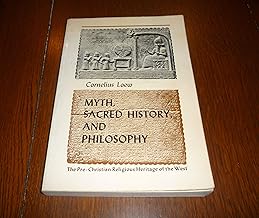
Cornelius Loew, Myth, Sacred History and Philosophy (Harcourt, Brace & World 1967)
https://www.goodreads.com/book/show/26308179-myth-sacred-history-and-philosophy
This comprehensive study looks at the evolution of religious thought from the early Sumerian creation myths to Plato’s Academy.
To early Man, the church and state were the same institution, and city-states evolved out of precincts surrounding temples and shrines. Human leaders (kings) were thought of as descended from or adopted by the gods, and it was their responsibility to align human order with the divine. Creation was considered to be a (sexual) union between Mother Earth and Father Sky. The Egyptian pantheon reflected a political conflict between the desert (Seth) and agriculture (Osiris).
The earliest art of 7500 BC, naked female figurines, showed a reverence for fertility. The ancient Greeks’ reverence was for the concept of fate, to which even the gods were subject. Then developed the concept seen in the Book of the Dead that the deceased was to be judged by the gods for his ethical behaviour in life.
With Pharoah Akhenaten came the first concept of monotheism (although I believe the historical Moses was earlier).
Hebrew sacred history drew from this history, reflecting ‘the conviction that there is an ultimate other than man, society or the cosmos’, and the idea that God was bigger than the cosmos. Their sacred books portrayed kings as real humans. Religious thought stressed appeals for social justice. The Deuteronomic ‘reforms’ reflected the different political situations of Israel (Samaria) and Judah and cultic rivalry with the worshippers of Baal.
The Greeks invented drama in 535 BCE (Thespis and the tragodoi), influencing later civilisations’ thinking that stories of the gods were ‘just stories’. Xenophanes went so far as to say that man created God in his own image. Cultic practices emphasised both ‘the Apolline remoteness with God and the Dionysiac identity with it’ (ER Dodds). Amid the growing confidence of post-Persian Athens, later dramatists stressed the concept of moira (fate).
Socrates’ hero as archetype strove for personal awakening, moral wholeness and an ultimate that was superior to the state, an idea that was considered ‘impiety’ and for which he was executed in 399 BCE.
Auguste Comte mapped the philosophic evolution from anthropomorphic theology to metaphysical philosophy (using concepts rather than gods) to positive science to genuine knowledge.
Much can be said about this subject, and this book goes some way toward saying it.
 Susie Helme
Leave a comment