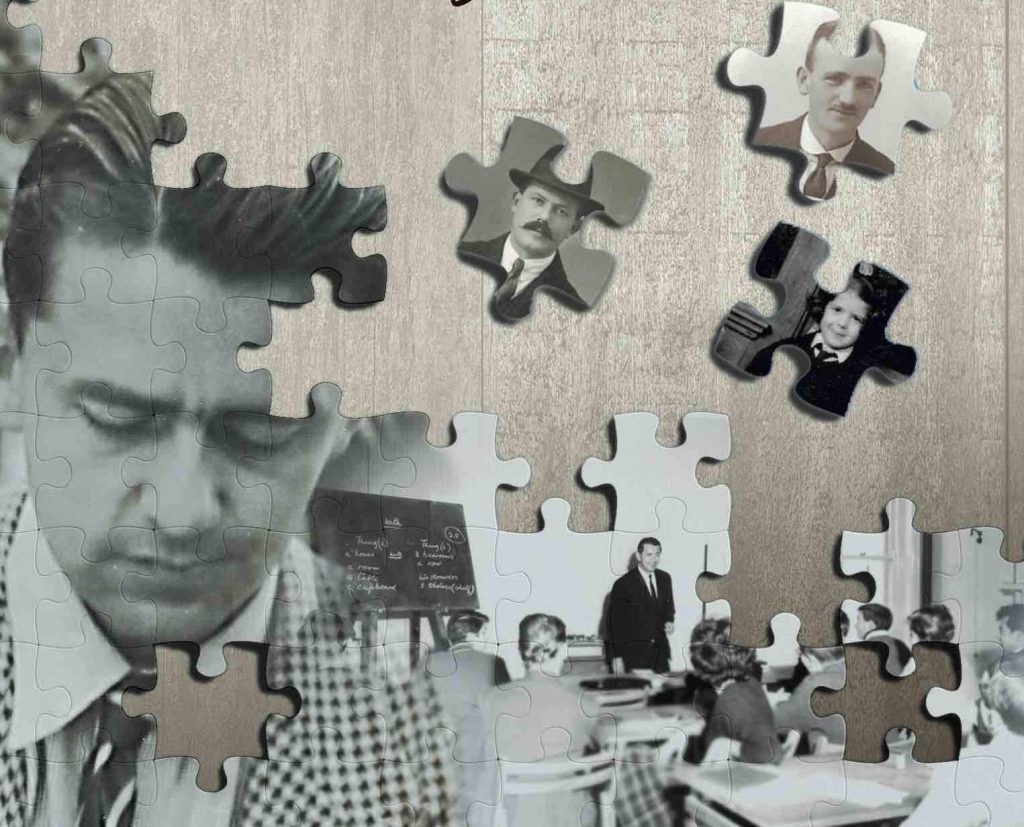
Una Suseli O’Conner, The Absent Prince (The Conrad Press 2020)
Beautifully written family portrait
The author recounts her family history, having pieced the story together from family documents discovered after her parents’ deaths.
Her grandfather Harry married the nurse, Grace, who cared for him when his leg was shot during the war. Harry was a lonely man, shunned by his family for marrying a Protestant, shunned by his native Ireland for serving in the British armed forces.
Her maternal grandfather, Ernst, a policeman, had trouble meeting his wife Rosa’s expectations, and was accused of stealing some money, committing suicide in shame. This was never discussed by her Swiss mother Lea, and she, herself, often threatened suicide.
Peter taught at Groton, a prestigious American boys’ prep school, and a great proportion of the book is devoted to singing its praises. Described by students and colleagues as ‘an inspirational leader’, Peter suffered from some inner unhappiness, jumping from therapist to guru, leaving the family for long periods to chase wacky treatments.
They married when Lea is 38, but, because of her tuberculosis, she was unable to get a visa, so Peter moved to England. Peter and Lea founded and ran a successful English language school in Folkestone.
We begin the book thinking we’re going to read all about Peter’s and Lea’s extended families, and we end up reading mostly about philosophies of education. The author refers to a manifesto written by her father entitled ‘The Absent Prince’ on his prescriptions for ‘the ideal teacher’, one who includes love and psychology in the mix. We realise toward the end of the book that this has been an overall theme. But this, if it is ‘mission creep’, gives additional meaning to the lives of these characters, especially Peter. Everyone in the family tree is treated with understanding and compassion. But the person we get to know most is Peter O’Connell, and what an interesting, complex, inspiring and yet probably difficult man!
The structure is complex, not necessarily directly chronological, which I liked very much. Instead, it’s organised more thematically, making for more interesting and more meaningful reading. For example, after a passage about her grandfather’s religious beliefs, she moves into the story of her great-grandparents, beginning from their religious beliefs. She also brings in other people in history whose stories are related to her themes. During the part where she discusses her grandfather’s suicide, she tells the tale of other people in the story who also killed themselves. After discussing her father’s good relationship with his students, she discusses her own bad relationship with a childhood teacher.
This thematic structure is very satisfying to read, as you get to grips with a broader subject matter instead of jumping from person to person or date to date. It also results in a richer understanding of the characters than if we had simply read ‘in 1938 they did that, in 1939 they did that’.
Links are found between one theme and the next, artfully weaving them into a narrative that flows seamlessly.
This novel is beautifully written and well edited, and it also includes illustrations, family photographs.
(reprinted with permission from) https://kentbylines.co.uk/family-history-the-absent-prince-in-search-of-missing-men/
 Susie Helme
Leave a comment