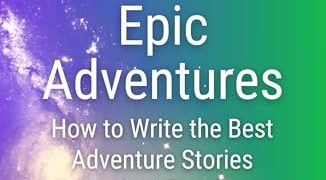
Val Andrews, Epic Adventures: How to Write the Best Adventure Stories of all Time (Opal Tree Press 2024)
https://www.goodreads.com/book/show/216173924-epic-adventures?ref=nav_sb_ss_1_23
Outline of how to write adventure stories
Adventure stories have 3 things in common:
• a protagonist who undertakes a journey
• a setting that is often unfamiliar and perilous
• a sequence of events that involve conflict and resolution
Start with action or intrigue—Hooking readers early is critical in adventure stories, where action and tension are key elements, so begin with a scene of intrigue, danger, or a significant event. Often there is an Inciting Incident, where the protagonist is confronted with the new world and challenged.
The plot structure is usually:
• Scenario (protagonist + status quo world)
• Initial setup (some backstory, setting and character)
• Inciting incident
• Preparation and departure
• First dive
• Exploration and discovery
• Rising tension, stakes, dangers
• Climax
• Resolution
Subgenres
You should write to your subgenre, which each have their own conventions and tropes:
• Exploration and discovery—
• Fantasy adventure—
• Historical adventure—
• Mystery and suspense—
• Myth and legend—
• Political and social commentary—
• Science fiction—
• Survival adventure—
The Hero’s Journey
It was Joseph Campbell in The Hero with a Thousand Faces who defined the precise stages in The Hero’s Journey. His story structure involved 17 stages in 3 acts. Departure, Initiation, Return.
Christopher Vogler condensed them into 12 stages:
Thrilling escape and return home—The protagonist overcomes, returns, usually with newfound wisdom or growth or riches.
Literary devices
All genres will use a mixture of (in alphabetical order):
• action
• antagonist(s)
• character development
• conflict
• Description
• Dialogue
• foreshadowing and flashbacks
• vivid imagery
• internal monologue
• juxtaposition (compare and contrast)
• metaphor and simile
• narrative style
• pacing
• plots and subplots
• point of view
• psychological depth
• Setting
• show don’t tell
• supporting characters
• symbols
• themes
• tone and mood
• voice
• worldbuilding
The 20-plus literary devices are also outlined in other books by Val Andrews, but it never hurts to go over them again. Here, she underlines their specific relevance to adventure writing.
I’ve read all this stuff before, but this book outlines it all in a cogent, coherent blueprint, which is worth memorising. Most useful to me were the notes on making the transitions between one stage and the next and the notes on the character development accompanying each phase.
I would also like to work more on using symbolism and juxtaposition in my plots and character developments and introducing scenes illustrating the hero’s transformation. I want to work more on foreshadowing.
It gave me some ideas on how to make my antagonists more multi-dimensional.
 Susie Helme
Leave a comment